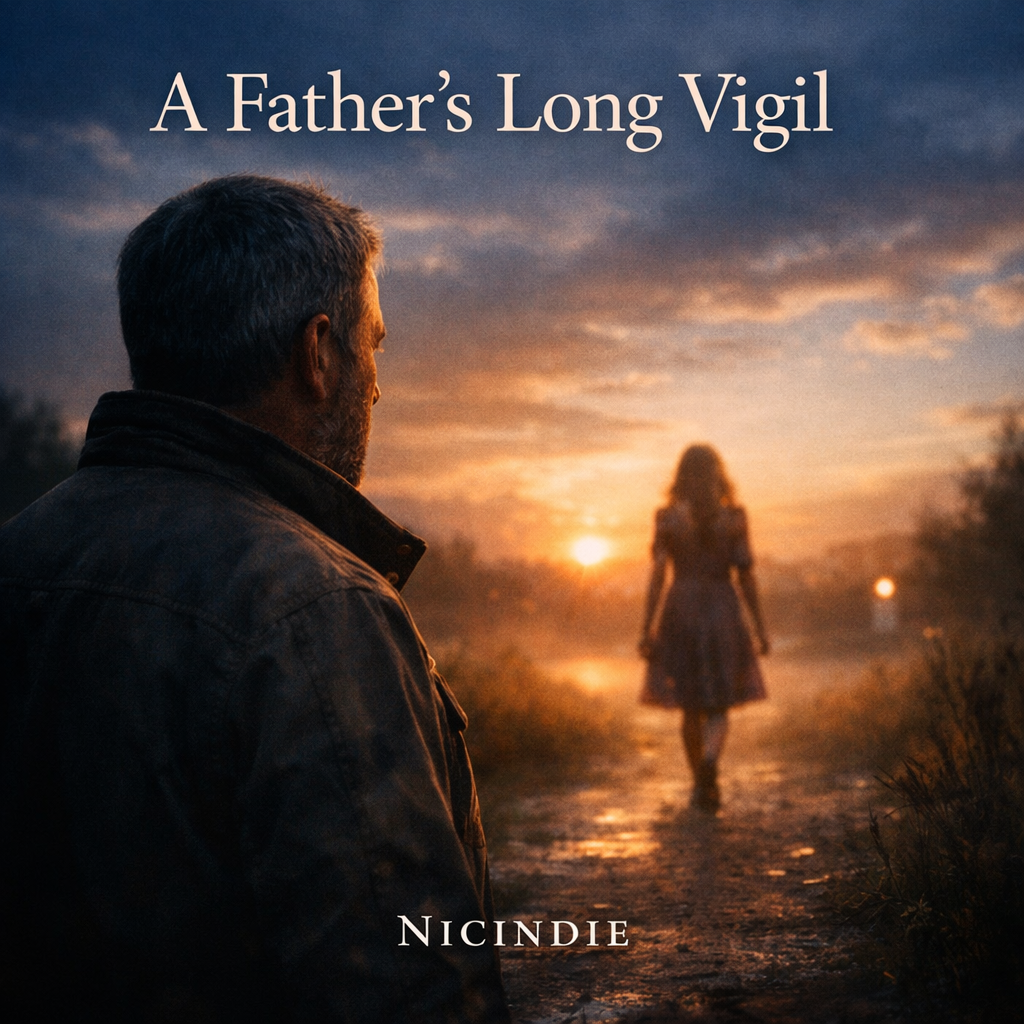
The instrumentation is spare almost to the point of austerity, and this restraint is the record's great cunning. Where a lesser songwriter might have reached for swelling strings or a chorus built to fill arenas, Nicindie keeps his hands close to the chest. Guitar figures arrive like footsteps on a landing at night — careful, familiar, unwilling to wake the house. Around them, a faint atmospheric wash does the work of memory itself: present but never quite in focus, the way a childhood room is present in the mind long after the furniture has changed.
What separates this from the glut of confessional folk currently crowding streaming playlists is its refusal to explain itself. Too many songwriters treat vulnerability as a kind of exhibition, narrating their feelings before the listener has had a chance to locate them independently. Nicindie does the opposite. He withholds. The lyric sits at the edge of specificity — a father, a vigil, the unbearable patience of love that watches without being asked to — and lets the listener supply the rest from their own private archive of waiting rooms, hospital corridors, and quiet doorways where someone once stood guard over someone else.
This is, in the end, a song about time rather than event, and it is remarkable how thoroughly the production mirrors that theme. Tempo here behaves less like a metronome and more like breathing — it dilates and contracts, mimicking the strange elasticity of hours spent watching over a sleeping child or an ailing parent, where a single evening can feel both endless and gone in an instant. Few producers working in this idiom understand that grief and devotion are not dramatic states but durational ones; Nicindie clearly does.
Vocally, he resists the temptation toward performance. The delivery is conversational, almost private, as though caught mid-thought rather than composed for an audience — closer to the hushed register of Nick Drake than the theatrical ache that so often passes for sincerity in contemporary singer-songwriter circles. It is a performance of restraint, and restraint, wielded well, is far harder to achieve than catharsis.
It would be easy, and not inaccurate, to file this alongside the current vogue for cinematic, wedding-adjacent folk — the kind of track destined for slow-motion footage and softly lit toasts. But to leave it there undersells the record considerably. Beneath its evident tenderness lies something sturdier: an understanding that love, particularly the quiet, unglamorous kind practiced by parents at three in the morning, deserves music that does not perform its own importance. *A Father's Long Vigil* simply sits with the feeling, patiently, the way its subject once sat with his child.
It is a small song about an enormous thing, and it trusts its listener to know the difference.