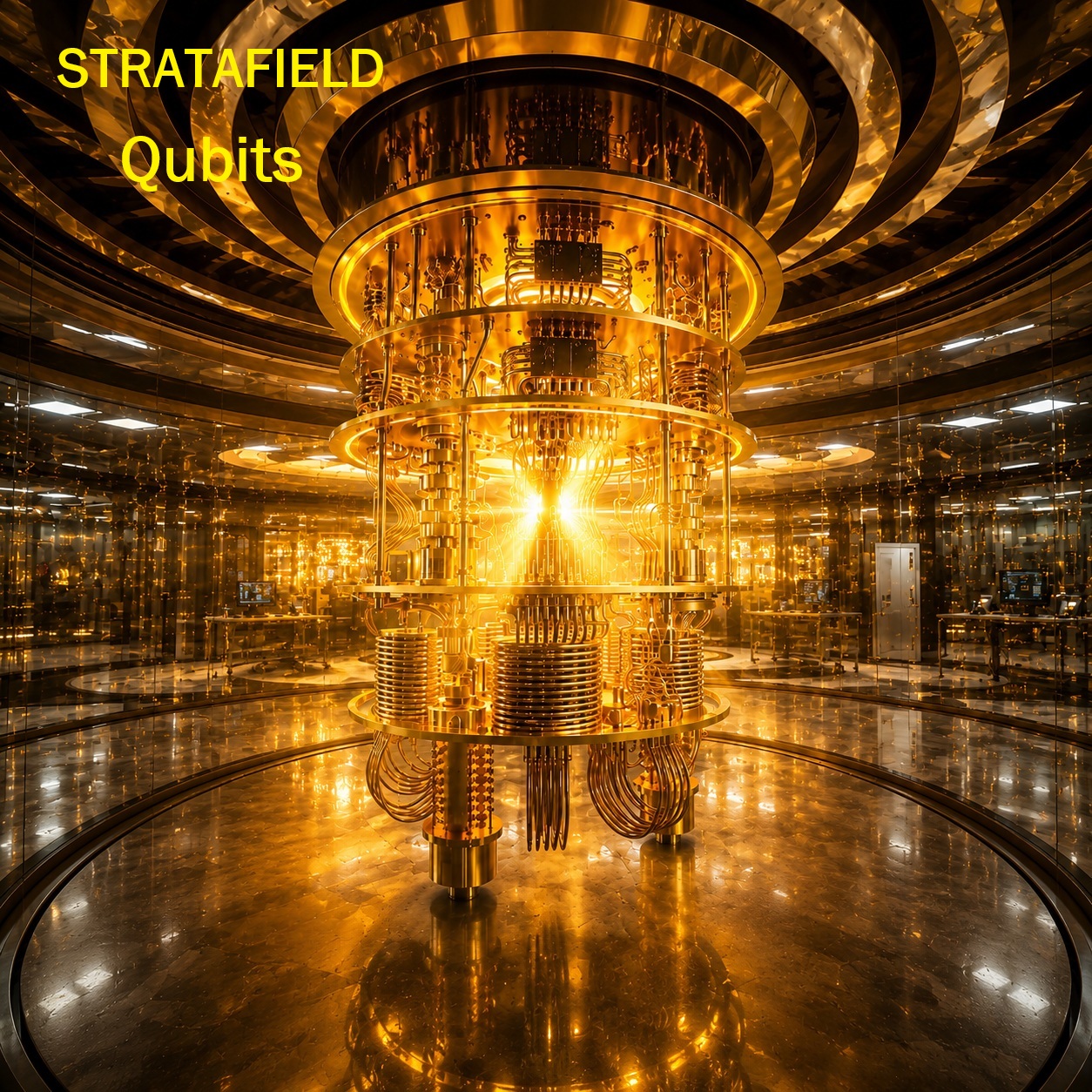
Lewman has said he heard the whole film before he wrote a single chord, and you can feel that discipline in the structure. The opening pulses are tentative, almost granular, mirroring the qubits themselves — three coloured points of light, red, blue, yellow, flickering through what looks like a honeycomb built from pure probability. When the track finally cracks open into full progressive house, it doesn't arrive as a drop in the EDM sense, all bombast and release; it arrives as a hatching. The beat doesn't so much kick in as emerge, the way protozoa emerge from lattice, the way a thought emerges from static. Lewman has clearly studied his Vangelis and his Jean-Michel Jarre, but he resists their grandiosity in favour of something more patient, more curious — music that watches itself become.
The middle stretch, scored to a wormhole sequence that drags this newborn life forward in time, is where the track earns its keep as a piece of composition rather than a piece of accompaniment. The motifs from the opening don't vanish; they resurface underwater, thickened, harmonised, given new low-end weight, exactly as the visuals show life itself thickening and complicating beneath the waves. It's a clever piece of structural mirroring, music as evolutionary recapitulation, and it would be a clever trick even if it weren't also genuinely pleasurable to listen to with your eyes closed.
And then, the mudskipper. It would be easy to mock the audacity of building a four-act electronic odyssey around a fish hauling itself onto a muddy bank, but the moment plays with real conviction, both visually and sonically. The arrangement thins out, leaves room for breath — literally, a creature learning to breathe — before the camera burrows into its eye and finds a spinning galaxy and a lone spaceship inside it. The music doesn't oversell this swerve into the cosmic. It simply opens up, lets the synths stretch toward something approaching awe, and gets out of the way.
What's most winning about "Qubits" is its refusal to separate the visual stunt from the musical idea. Plenty of artists bolt a video onto a track after the fact, decoration applied to a finished product. Lewman has done the opposite, writing sound and image as twins from the same conception, and the hybrid production process — AI-assisted imagery cut and paced by human hands — never feels like a gimmick because it's been so clearly subordinated to that original vision. The seams don't show.
It's a strange, lovely thing, this single: ambitious in scope, unhurried in execution, content to let four billion years of imagined evolution unfold across six minutes of music. Stratafield has made a habit of treating instrumental electronic music as a serious narrative form rather than a backdrop, and "Qubits" might be the clearest, most fully realised statement of that habit yet.