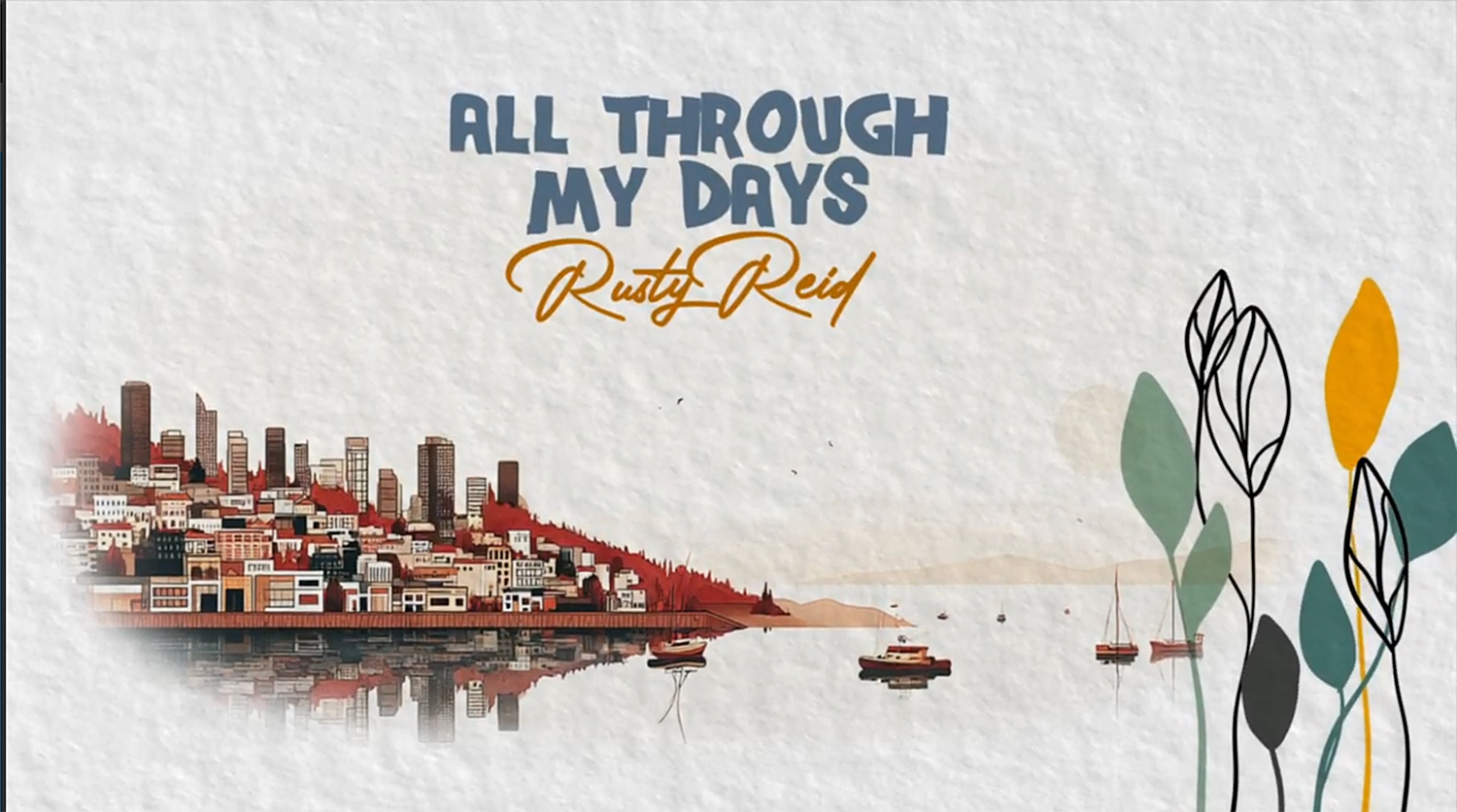
The song belongs, originally, to Vince Bell and Connie Mims Pinkerton, who wrote it during the fertile, undersung years of the Houston music scene somewhere around the mid-1970s — a scene that was, for reasons of geography and critical fashion, almost entirely ignored by the gatekeepers who decided what mattered. Bell has long been a songwriter's songwriter, championed by Nanci Griffith and Lyle Lovett, and "All Through My Days" is precisely the sort of song that explains why: it is melodically graceful, lyrically elusive, alive with the romantic mystery of a person who passes through your life like weather. *You were ruled by the southern sky / Made you trade your world for another style / The way you slipped through the streets of my city / You were a melody.* That last image — a person as melody — is the kind of lyric that a lesser writer reaches for and fumbles, but here it lands perfectly.
Reid's reading strips the song of whatever rhythmic jauntiness the original carried, and the effect is transformative. This is a slower, more interior version, practically a ballad, given to long thoughts and longer guitar notes. Steven Beasley's production — he plays acoustic guitar, electric guitars, organ, bass, and drums here, a one-man orchestral army of restrained good taste — creates a soundscape that breathes. The organ sighs in the spaces between Reid's guitar lines rather than asserting itself, which is precisely the right instinct. When the extended guitar solo arrives, it does so on unhurried, sustained notes that seem to hang in the air like smoke over still water. The Beatles are in here somewhere — in the tonal approach, the unhurried confidence of the arrangement — and so, faintly, is John Denver's folk-country warmth. But the result is neither pastiche nor homage: it is simply Reid's own sound, mature and assured.
That voice is the crux of the matter. Reid possesses what might be called a voice of accumulated experience — not rough exactly, but lived-in, the kind of instrument that has metabolised both the influences it absorbed and the years it has weathered. He delivers the central chorus — *All through my days / All over my nights / I never dreamed it could be so simple* — with a plainspoken conviction that refuses melodrama. He is not performing heartbreak; he is reporting it, which is considerably more devastating. The simplicity he finds in the lyric is the simplicity of emotional truth, and it carries.
The music video, directed with an eye for the unpretentious, opts for the kind of visual honesty that suits the song perfectly. Rather than the soft-focus, gauzy romanticism that lesser productions would reach for, it favours Reid's own presence as its focal point — a man with a guitar and something genuine to communicate. This is not negligence but wisdom. Some songs are diminished by too much visual distraction, and "All Through My Days," in Reid's rendering, is one of them. The imagery serves the music rather than competing with it, which, in the current visual landscape of music promotion, is an act of quiet radicalism.
What Reid is doing across *Lone Stardust*, and what this single most vividly embodies, is an act of cultural archaeology that doubles as autobiography. These songs — Bell and Mims Pinkerton's included — are not merely songs he has chosen to cover. They are the air he breathed coming of age in Houston, the music that formed whatever it is he has since become as an artist. A covers album made from pure fandom tends to feel like a museum exhibition; a covers album made from this kind of personal excavation feels like a confession. "All Through My Days" feels like a confession.
Vince Bell and Connie Mims Pinkerton wrote something lasting half a century ago, and Rusty Reid has had the good sense and the artistry to prove it. Not everyone who picks up an old song and calls it theirs earns the right. Reid earns it here, note by unhurried, heartfelt note.