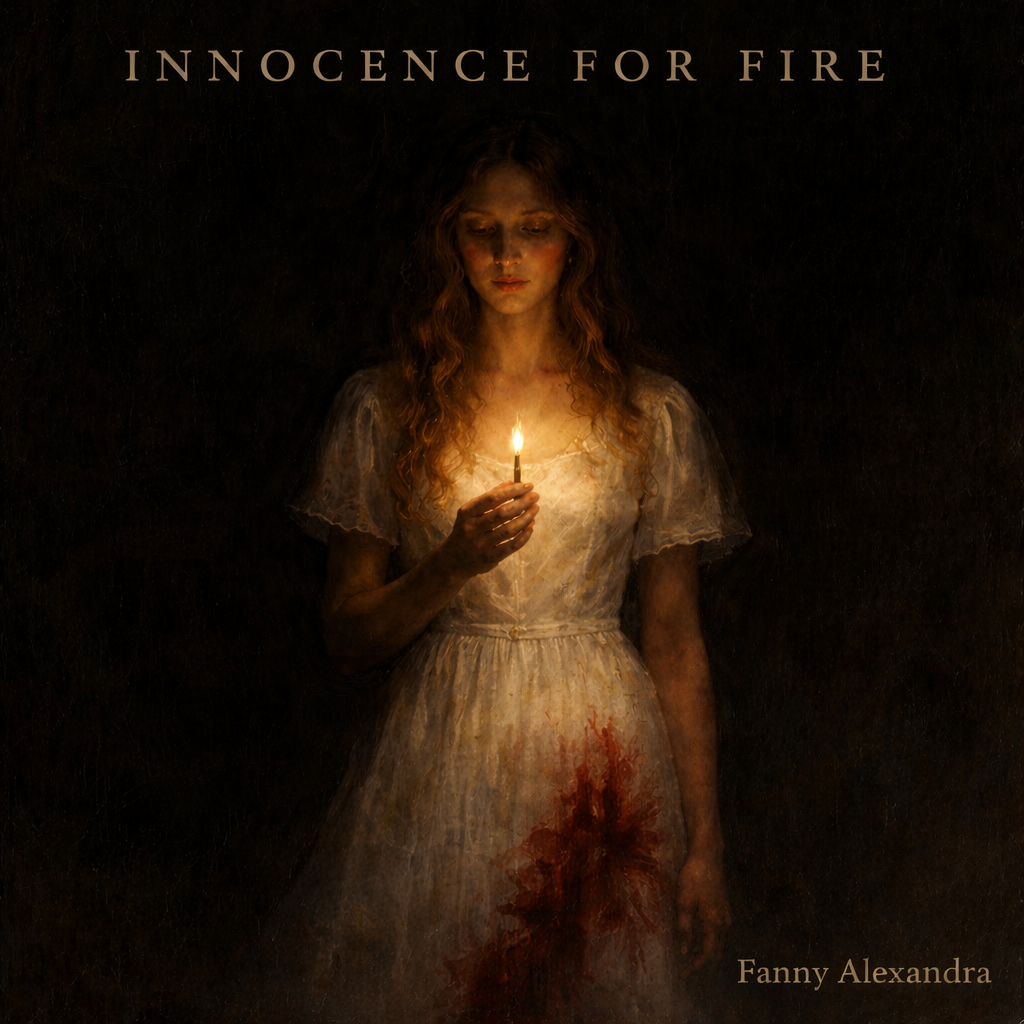
The intro is fragile in the truest sense — not weak, but breakable. The piano sits in the kind of acoustic loneliness that recalls early Portishead, or the more introspective corners of Lana Del Rey's catalogue, before the thought is quickly set aside: this is something rather more its own. Alexandra lets the quiet do its work without apology, coaxing the listener into a false sense of resolution before the electric guitar enters and rewrites the contract entirely.
And what an entrance it makes. The shift from piano to full instrumentation is managed with a surgical confidence that separates the craftswomen from the merely talented. It is not a jolt — it is an inevitability. The song has been building toward this moment since its first note, and when the chorus finally arrives, it feels less like a change of gear and more like the lifting of a veil. The electric guitar does not storm in; it rises, burning slowly, the way fire takes hold of something that was always destined to burn.
"Alexandra's voice occupies that rare and dangerous territory where vulnerability and ferocity coexist without apology — and it is magnificent."
It is in the vocal performance, however, where "Innocence for Fire" truly earns its place in the conversation. Alexandra sings with the kind of raw female authority that British music has always, at its finest moments, celebrated and misunderstood in equal measure. She does not ornament for the sake of ornamentation. Every rasp, every held note, every deliberate retreat into near-whisper is a considered act of communication. Her voice occupies that rare and dangerous territory where vulnerability and ferocity coexist without apology — and it is magnificent.
Thematically, the song is doing serious work beneath its cinematic surface. The title itself is a contradiction — a trade, perhaps an impossible one. Innocence for fire: to gain something consuming, something alive, one must surrender something pure. Alexandra does not explain this transaction; she inhabits it. The inner conflict she evokes is not the adolescent variety of pop confessionalism, but something older and harder to name. This is the quiet strength of someone who has already walked through the thing they feared and emerged, scorched but standing.
Atmospherically, the production leans into the moody and the cinematic without ever becoming self-indulgent. The arrangement breathes. The mix trusts the listener. There is a restraint here — particularly in the verses — that makes the emotional release of the chorus feel genuinely earned rather than engineered. In an era of music that routinely mistakes loudness for power, "Innocence for Fire" understands that the most devastating moments arrive in the transitions, the silences, the long exhale before the next phrase.
Comparisons will be lazily drawn — they always are — to figures in the alternative canon who traffic in similar emotional real estate: a little of Florence Welch's operatic instinct, something of PJ Harvey's unsentimental gaze, perhaps a trace of Anna Calvi in the guitar's slow ceremonial ascent. But Fanny Alexandra sounds, above all, like herself. That, in 2026, remains one of the rarest achievements a debut single can manage.
VERDICT
A cinematic, emotionally lucid debut that announces Fanny Alexandra as a serious and singular voice in dark alternative rock. Slow-burning, quietly devastating, and entirely its own.