'I Never' lives up to that promise with a quiet, unsettling completeness.
The title is built from two words that carry enormous psychological freight. As a phrase, it functions simultaneously as confession, refusal, and accusation. It is the language of things withheld, of the spaces between what people say and what they mean, and Kalligary exploits this ambiguity with the kind of patience that suggests an artist who has spent time genuinely listening to silence rather than merely filling it. The result is a track that feels less like a song than an atmosphere — a weather system moving slowly overhead.
Musically, the piece draws from a deep well. One hears traces of the hushed grandeur that Scott Walker brought to his later work, stripped back to its skeletal core; the desolate folk-adjacency of early Grouper; and something of the grey, coastal melancholy that seems to be the particular inheritance of artists who know what it means to stand at the edge of something vast and unknowable. The production is meticulous without being pristine. It breathes. It allows imperfection its rightful place in the arrangement, which is to say it understands that a track like this lives or dies on texture, and the textures here are rich and carefully calibrated — the sonic equivalent of running your hand along weathered timber and feeling the grain.
The vocal performance deserves particular attention. Kalligary does not resort to displays of technique; rather, the voice operates as just another instrument in the ensemble, treated with the same regard for restraint and placement as everything else. Lines are delivered with the flat, almost affectless delivery that the best British and Irish artists have always managed to weaponise so effectively — think of how Thom Yorke made stillness feel like devastation, or how PJ Harvey could make a whisper land harder than a scream. There is something similarly loaded happening here. The negation at the heart of the lyric — the *I never*, the refusal, the thing that didn't happen and perhaps never will — accumulates across the track's duration until it becomes genuinely affecting.
The arrangement builds according to its own internal logic rather than to any conventional notion of pop structure. Tension is introduced not through the escalation of volume or density but through a kind of slow harmonic pressure, like watching a bruise form beneath skin. When a release of sorts finally comes, it arrives sideways rather than head-on, and the satisfaction is all the more complete for being slightly unexpected. This is compositional intelligence of a high order, and it marks Kalligary out as an artist thinking seriously about the relationship between form and feeling.
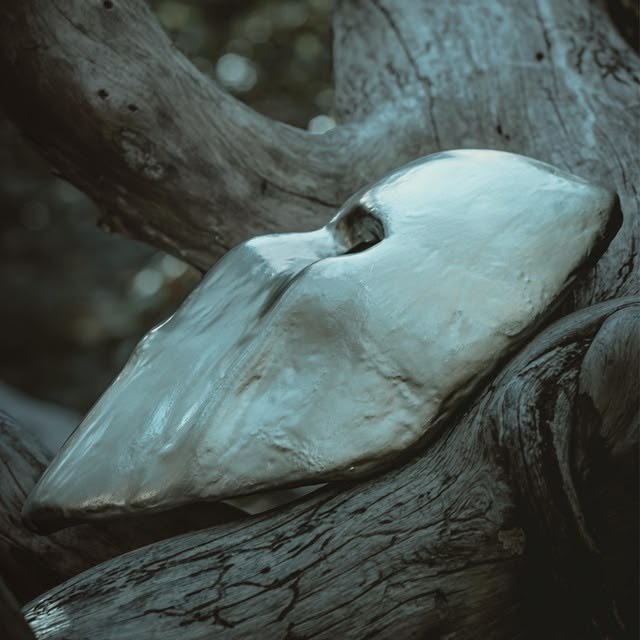
British music criticism has, at its best, always made a virtue of holding the baroque and the austere in productive tension — celebrating ambition without losing sight of authenticity. On that measure, 'I Never' is a debut single of real consequence. It arrives with no hype, no fanfare, no obvious pedigree to trade upon, and is rather better for all of those absences. The mask on the cover is not a disguise; it is, if anything, a provocation. Look at this, Kalligary seems to be saying. Look at what is hidden in plain sight. The music, if you let it, will do the rest.