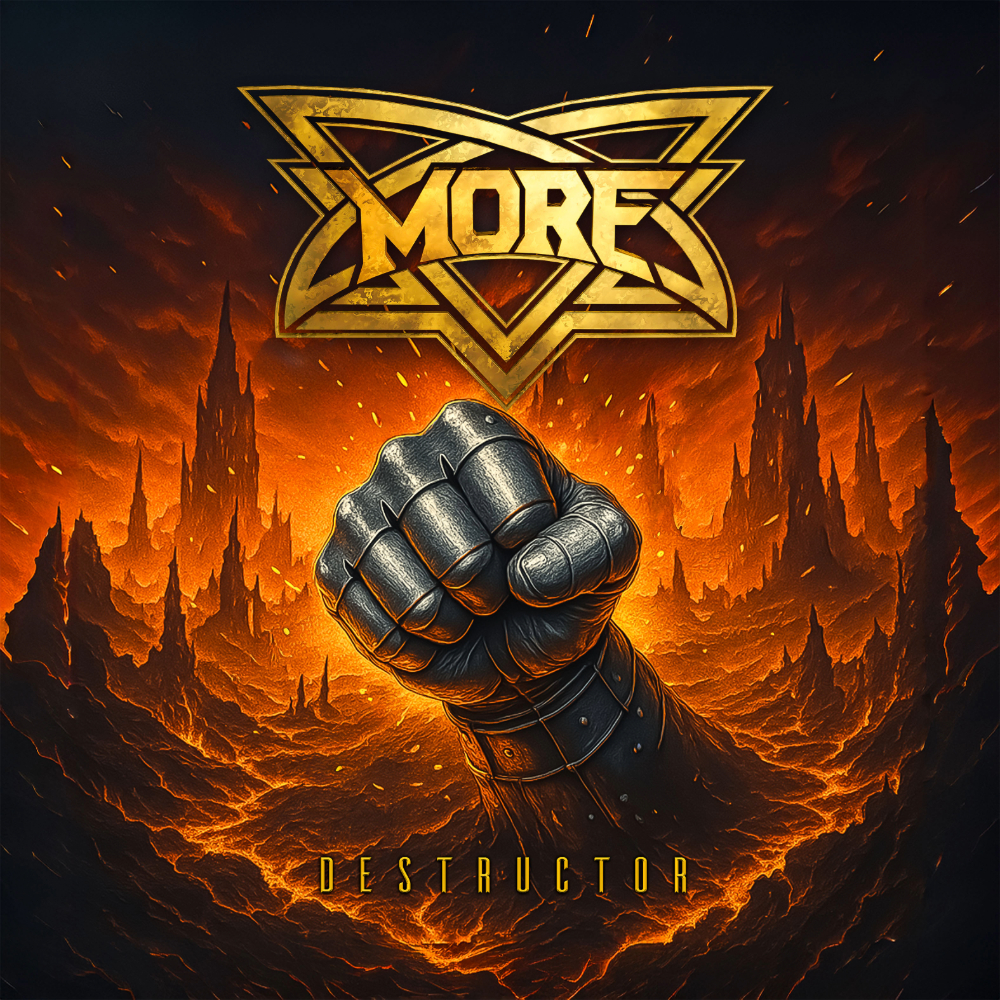
The story of how *Destructor* surfaced reads like something from a metal fairy tale — bassist Baz Nicholls retrieving the finished mixes from equipment abandoned after Tsangarides' Ecology Rooms studio closed, the files sitting dormant on a USB key until the stars aligned and legendary mastering engineer Maor Appelbaum was brought in to finish the job in Los Angeles. None of that context would matter a jot, of course, if the music didn't deliver. But deliver it does, with both fists clenched and the volume knob snapped clean off.
Opener "Hearts on Fire" announces intent with a directness that feels almost confrontational. There is no ambient introduction, no slow-burn preamble — just riffs, hewn from solid iron and dropped directly onto the listener's sternum. Kenny Cox may have founded this band back in 1979 under the name Defender, but the MORE of 2026 is a different, harder-won creature: Nicholls on bass, Peter Welsh on guitar, Steve Rix behind the kit, and Mike Freeland up front handling vocal duties with the kind of seasoned authority that only comes from years in the trenches. Together they sound like a band with something to prove — not to the world, but to themselves.
Tsangarides' famous Vortex system lends the guitar work throughout the album a peculiar spatial quality, simultaneously intimate and vast. On "Spirits of War" — the lead single, and quite possibly the most immediately accessible track here — the guitars seem to spiral inward and outward at once, building a sonic architecture that modern producers with their laptop presets could spend a lifetime failing to replicate. It is, bluntly, the sound of a craftsman who loved this music with every fibre of his being.
"Rocquiem" is the album's most unexpected pleasure — a track that flirts with genuine grandeur without ever tipping into pomposity, suggesting a band entirely comfortable operating across different emotional registers. "Scream" is rawer, angrier, more urgent. "Immortal" has a melodic spine that lodges itself in the memory with minimal resistance. And the closing title track, "More," feels like a manifesto — defiant, uncompromising, built to last.
Not everything here is spotless. "My Obsession" feels slightly undercooked compared to the peaks surrounding it, and one or two moments in the mid-section suggest the album might have benefited from a slightly tighter running order. But these are minor quibbles against a record of this ambition and emotional weight.
What is impossible to escape is the elegiac quality that hangs over the whole enterprise. Tsangarides didn't just produce this album — he played on it, wrote parts of it, toured with MORE across decades of friendship. His presence is woven into the DNA of every track. *Destructor* is not simply a comeback record or a nostalgia exercise; it is something rarer and more affecting — a document of what loyalty between musicians actually sounds like when pressure-tested by time, loss, and circumstance.
The New Wave of British Heavy Metal produced many bands who burned bright and vanished. MORE kept going. *Destructor* is their evidence: forty-plus years in, and they are still swinging.
**Essential.**