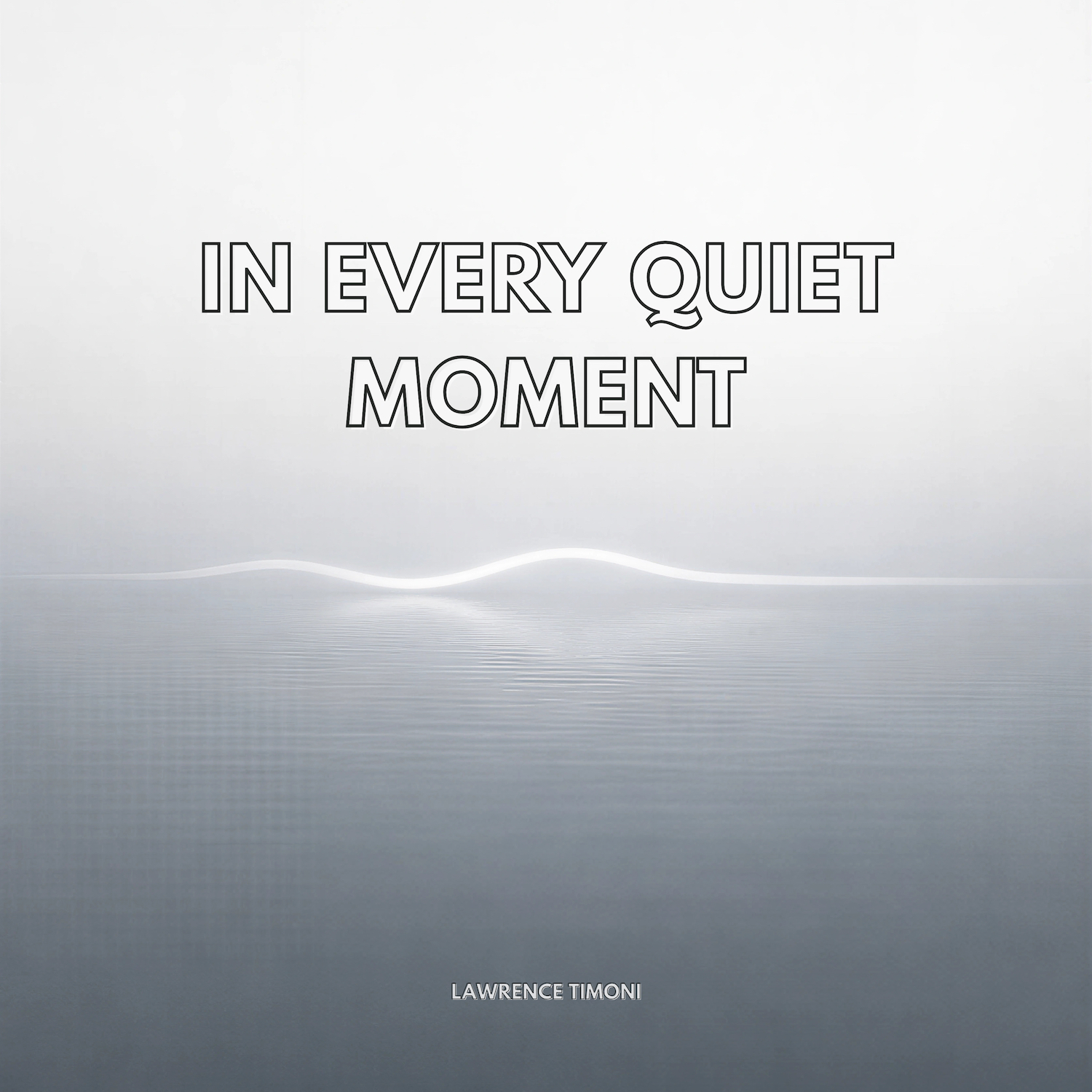
"In Every Quiet Moment" announces itself without fanfare. The electric bass arrives first — low, deliberate, almost stubborn in its refusal to hurry — and the drums follow with a restraint that feels almost confrontational by modern pop standards. No crash, no swell, no attempt to seduce you into the room. Timoni opens the door and simply waits for you to walk through it. Many listeners, weaned on music engineered for the fifteen-second scroll, will not. Their loss.
For those who stay, the reward is a track of genuine atmospheric intelligence. The production — spacious without ever feeling empty — recalls the textural work of producers like Brian Eno or, more recently, the careful negative space that defines the better moments of Perfume Genius or James Blake. But Timoni is not merely a borrower of aesthetics. The groove here has its own particular personality: urban, slightly worn, possessed of a quiet anxiety that feels entirely contemporary. This is music shaped by the modern condition — the digital hum beneath every waking hour, the pressure of perpetual connectivity — without ever resorting to the tired sonic signifiers that lesser artists deploy to signal such concerns.
The vocal performance deserves particular attention. Timoni moves between intimacy and a studied detachment with a fluency that speaks of genuine craft. The R&B inflections are subtle — inflections being precisely the right word, since the track never tips into genre pastiche — and the slight tape-worn quality applied to the voice is deployed with tasteful economy. At moments, a faint robotic texture creeps in, not as a production flourish but as a thematic instrument: the voice becoming as mediated and fractured as the urban identity it describes. It is a clever choice, executed without self-congratulation.
Structurally, "In Every Quiet Moment" earns its ambitions. Where a lesser songwriter would force the track toward a conventional chorus — the contractual emotional climax that streaming economics now demand — Timoni lets the song breathe, unfurl, and nearly dissolve. The decision to hold back the distorted guitar surge until the track appears to be fading from existence entirely is the kind of move that reveals a composer thinking in architectural rather than algorithmic terms. When the surge comes, it genuinely startles. Not because it is loud, but because it is *earned*. The contrast lands with the precision of a well-placed punch.
The song's central preoccupation — identity discovered in the friction between noise and stillness, connection and withdrawal — is not a new subject. Post-punk and art rock have orbited these themes for forty years. What Timoni brings is a contemporary specificity and an emotional honesty that prevents the material from calcifying into mere aesthetic exercise. The silence his narrator inhabits is not romantic or bohemian. It is the silence of a person standing very still while the world vibrates chaotically around them, searching for resonance in the gaps.
"In Every Quiet Moment" will not trouble the charts. It is not designed to. It is designed, instead, to be discovered slowly, played late at night, and heard differently on the third listen than on the first. Berlin, as ever, has produced music that refuses to perform its own relevance. That is, in 2026, a genuinely radical act.