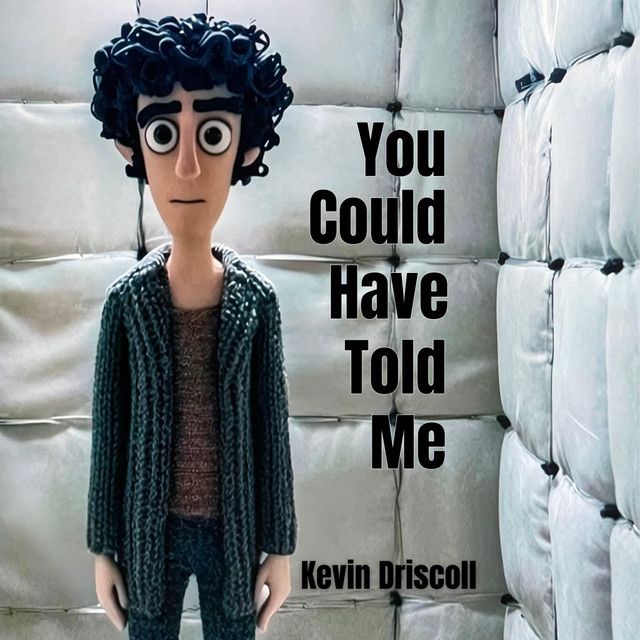
Recorded at Long Jump Records in Jacksonville, Florida, this self-performed tour de force showcases Driscoll as a rare multi-hyphenate talent. Unlike many singer-songwriters who claim total creative control only to quietly lean on session musicians, Driscoll genuinely handles everything from composition to instrumentation and drum programming himself. This is auteur music-making in its purest form.
The track's sonic palette draws from seemingly incompatible influences. One detects the art-rock intellectualism of David Byrne and Talking Heads—that same ability to make the familiar strange and the strange familiar—but filtered through what one astute listener described as "Nine Inch Nails meets folk music." It's an apt characterization; there's a controlled tension throughout that suggests Reznor-esque industrial undercurrents without ever fully surrendering to them.
What elevates "You Could Have Told Me" beyond mere stylistic experimentation is its psychological precision. Driscoll has crafted a devastating portrait of revelation—that moment when the stories we've told ourselves about our relationships collapse under the weight of newly discovered truth. "When you finally come to realize what you thought was true... isn't," as Driscoll himself puts it. This emotional pivot forms the track's narrative backbone, delivered not with histrionics but with the quiet devastation of someone piecing together a new reality.
The production, expertly handled by sound engineer Richard Dudley with mixing and mastering from Jeremiah Johnson, achieves that rarest of feats: technical excellence that serves emotional expression rather than overshadowing it. Each sonic element occupies its own distinct space, creating a layered experience that reveals new details with each listen.
At a time when so much contemporary music mistakes volume for emotional impact and confession for art, Driscoll offers something far more substantial. This isn't merely a breakup song—it's an invitation to reexamine personal narratives, to find growth in disillusionment. For listeners willing to engage on these terms, "You Could Have Told Me" provides a cathartic journey that extends well beyond its runtime.
What's perhaps most intriguing is that this release represents a turning point in Driscoll's creative methodology. After years of complete self-reliance, he's embraced collaboration with professional sound engineers—a decision that has clearly paid dividends. The resulting track possesses both the intimate vision of a solo project and the polished execution of a team effort.
"You Could Have Told Me" stands as both artistic statement and emotional exorcism—a song that doesn't just describe transformation but embodies it. In a musical landscape cluttered with artificial sentiment, Driscoll offers something genuinely transformative: an unflinching look at disillusionment that somehow leaves one feeling more whole, not less.