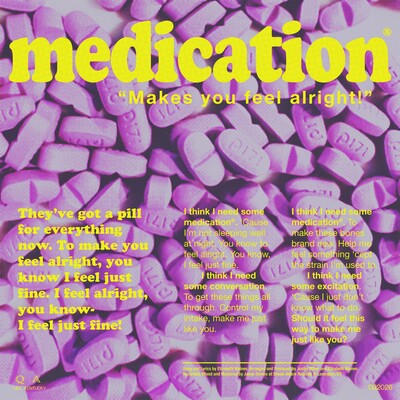
Start with the sleeve, because the sleeve is the thesis. Acid-yellow lettering the colour of a highlighter pen sits over a heap of lilac pills, printed in a halftone haze that recalls a late-night flyer, a pharmacy leaflet and an Andy Warhol silkscreen at once. Underneath, the cheery strapline promises that the contents will make you feel alright. Anyone who has ever lain awake at four in the morning negotiating with their own ceiling will recognise the sales pitch, and will also recognise the small print.
That tension drives the song. Aster's narrator catalogues a world that has found a pill for everything and hands her the full set: sleeplessness, the hunger for a proper conversation, the frantic need for a spark of excitement. Her request for something to steady her nerves, to get her through, to make her feel as she used to, is delivered with such studied lightness that the sadness takes a moment to land. When it does, it lands hard. This is a song in which the chorus sounds like a wellness advert and the verses read like a confession.
Her vocal is the main event. Aster never oversells the melancholy. She sings with the breezy poise of someone reciting a prescription label, and the effect is closer to Jarvis Cocker's deadpan than to any torch-song wail. The lines trip over one another in an anxious rush, then flatten into a shrug, and the contrast between brightness and ache gives the record its dramatic charge. It recalls Self Esteem and Billie Marten in its refusal to dress distress as tragedy, and Robyn in its conviction that the best sad songs are built to be danced to.
The writing deserves credit too. Pop confessionals tend to drown in metaphor, but Aster keeps things plain: she needs this, she needs that, she'd like to feel like herself again. The repetition works as an incantation and, at times, as a symptom. By the final refrain the cheerful hook has curdled into something nearer a plea, and the ambiguity of "alright" (content, or merely functioning?) hangs over the whole record. It is a wonderful trick, and Aster performs it without once raising her voice or tipping her hand.
The single's greatest virtue is its restraint. It never lectures, never takes a side on the pills themselves, and never mistakes a diagnosis for a manifesto. It simply holds up a mirror to a generation fluent in the vocabulary of sleep hygiene, burnout and optimisation, and lets the listener decide whether the reflection is funny or frightening. Usually it is both within the same chorus.
Pop singles this short are rarely this sure of themselves. "Medication" has a hook that lodges instantly, a lyric that rewards a third and fourth listen, and a central performance of real charm and quiet nerve. It is bright on the surface and bruised underneath, which is exactly where the best pop has always lived. Queen Aster has delivered a small, sharp, intensely human record, and one suspects the full-length will be worth waiting for. Take two, and call us in the morning.