The biography is irresistible, and it matters. Hellquist put out records as Red Mode in 2001, then let the day job swallow him, as day jobs and small children do. The pandemic emptied his catering calendar and silenced his kitchen. Rather than let it gather dust, he turned it into a studio, with the cold store doubling as a vocal booth. That detail would be mere novelty if the record sounded cramped. It doesn't. The vocals carry a close, slightly chilled intimacy, as though sung into the collar of a winter coat, and the effect is hypnotic rather than gimmicky.
The track is a feast, fittingly, and Hellquist is a cook who understands that the best dishes rest on restraint. The foundation is soul sampling of the old, dusty, crate-digging kind, vintage textures with the warmth of a record left in a sunlit window. Over it he lays UK garage's skipping, shuffling swing, then breakbeat's tumbling, off-kilter drums, and finally the polished steadiness of modern house. These ingredients should fight. Garage and breakbeat have spent three decades eyeing each other across the dancefloor like rival firms, but here they share a table and pass the salt. The broken rhythms never trip the groove, they tilt it, so your hips keep guessing and the track keeps winning.
Then comes the low end, which is considerable. The bass is heavy, rounded and faintly menacing, the sort that rearranges the furniture in a neighbour's flat. Yet Hellquist never lets weight turn into brute force. The sub-frequencies sit under the vocal like a hand at the small of the back, steering rather than shoving. The deep-house-leaning vocal itself is the quiet triumph. It is unhurried and slightly weathered, with the patience of a man who has had twenty-five years to decide what he wants to say. It repeats, loops and lulls without ever turning to wallpaper.
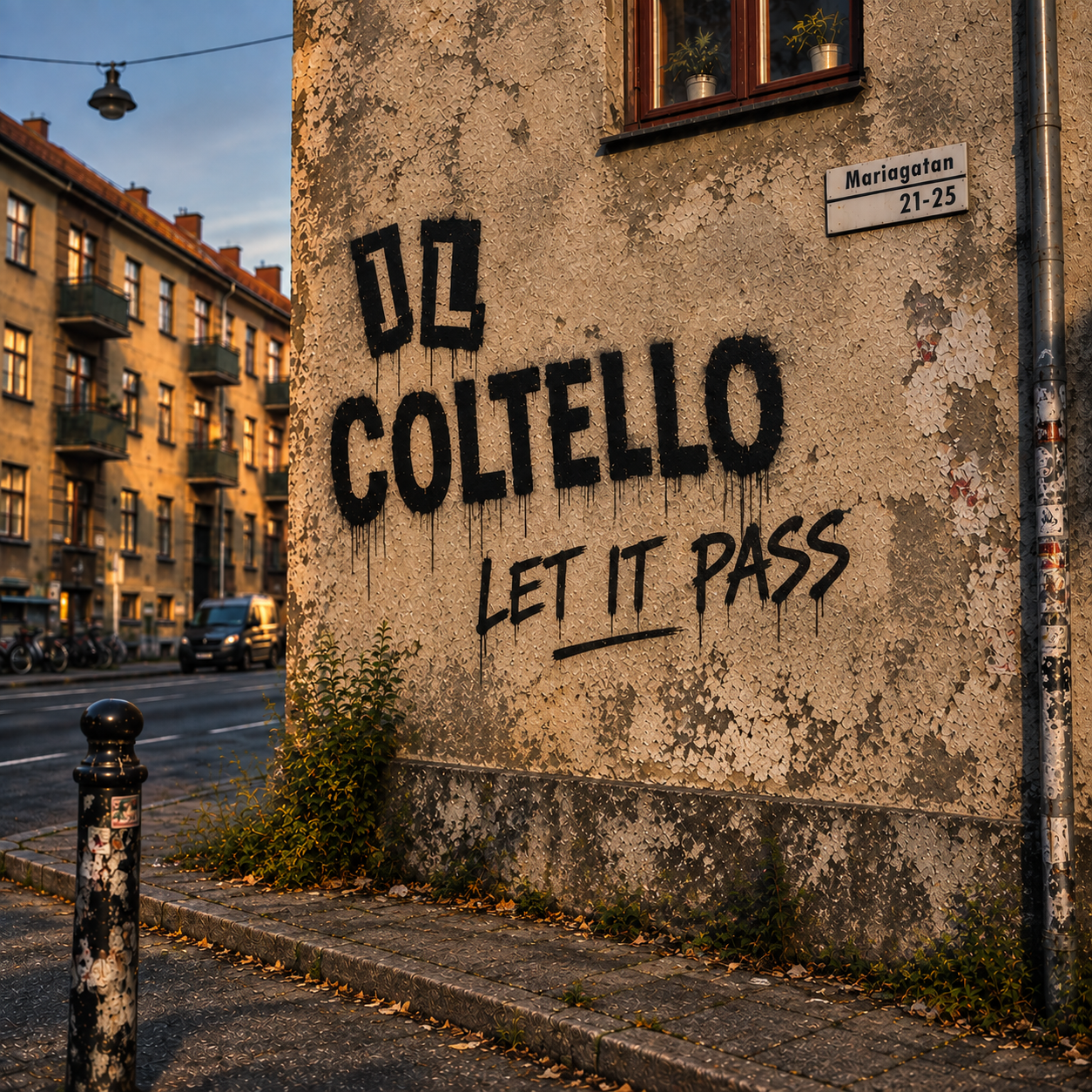
The title is the thesis. "Let It Pass" is a surprisingly wise instruction for a club record, a shrug of the shoulders set to a rolling beat. Hellquist makes music about reflection without collapsing into mawkishness, and about time without wringing his hands over it. The atmosphere is that of the dancefloor at 3 a.m., when the sweat has dried and the mind has wandered somewhere tender. It is soulful in the true sense, and the Swede has earned the right to the word.
Comparisons are tempting, from the soft-focus nostalgia of Burial's heirs to the sample-drunk generosity of the Bristol and South London scenes, but Il Coltello is no pastiche merchant. He is a man with his own history, his own kitchen and a genuine feel for the music's mechanics. The production is clean without being sterile, and each sample is placed with the precision of a chef plating a single perfect scallop.
Twenty-five years is a long time between courses. On the evidence of *Let It Pass*, the wait was worth it, and the knife is very sharp indeed.