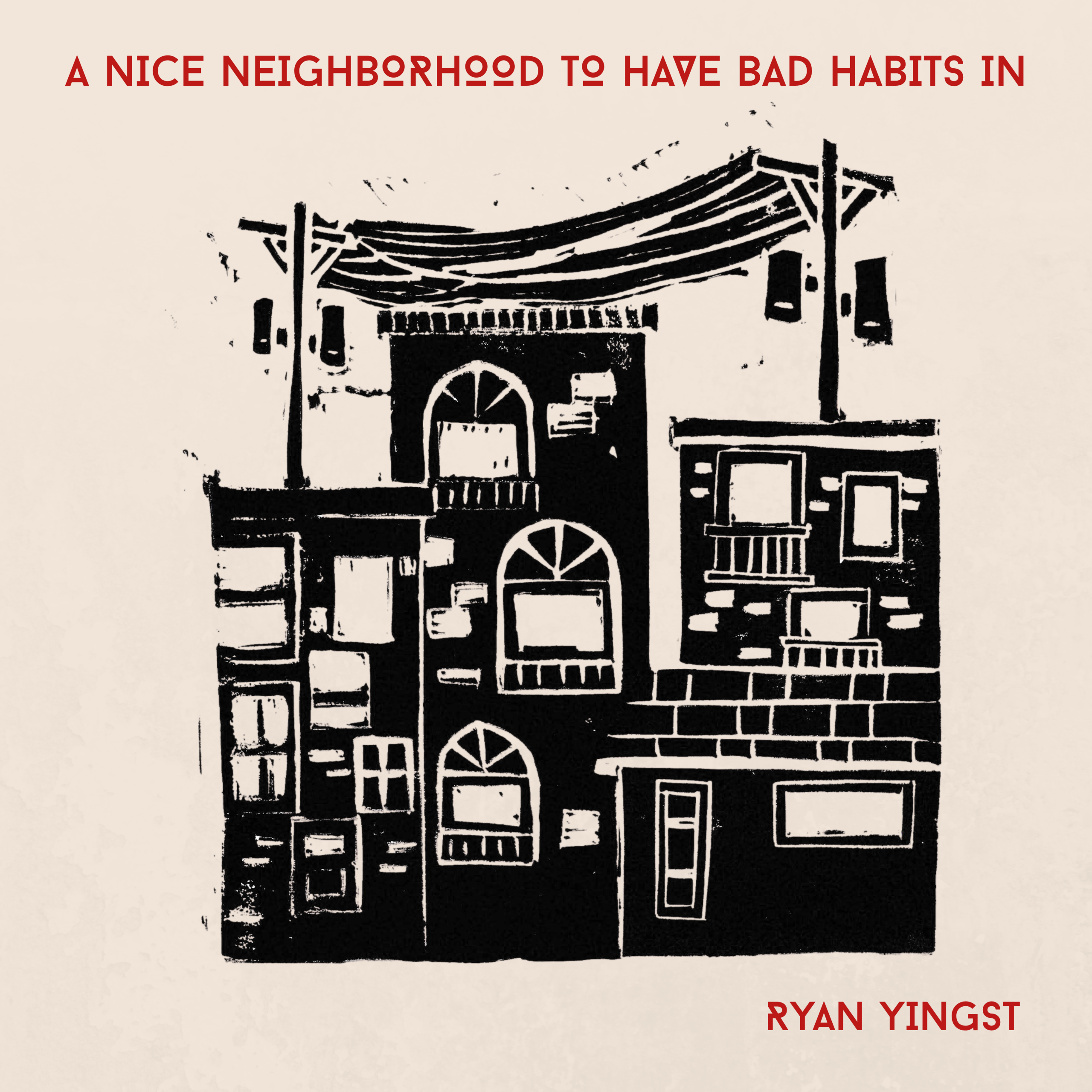
The EP was never planned as a grand statement. Yingst is an independent working musician, and multitrack budgets do not fall from trees, so the songs were gathered over months, each recorded as circumstance allowed. Such records usually sound like what they are, a drawer emptied onto a table. This one sounds like a life, and the seams are a virtue. Johnny Richeson's drums and Stefan Kuriga's bass, borrowed from Yingst's live band, pass through the same rooms as a cellist, a string quartet and a guitar tone that has clearly spent years being argued with.
"Canary In The Coal Mine" opens the set, and it is a leaving-Nashville song without the usual grudge. Music City taught Yingst a great deal as a performer, sound engineer and writer, mostly about what he did not want to become, and the song carries that weary education in its fingerpicking. The slide guitar arrives like a change in the light. Yingst's voice is grainy and unhurried, a baritone that has stopped trying to impress anyone, and the effect is magnetic.
"If I Don't Have You" is the live-set favourite, and it kicks the shutters open. Ringing 1990s guitars, a swagger somewhere between Fountains of Wayne's wit and Oasis's appetite for a chorus, and a tongue lodged firmly in cheek as it dissects the sort of love that does you no good. It is the EP's lightest moment, and the placement is shrewd, since the heavier songs breathe easier for it.
Then the shadows come back. "The Tallest Trees" was tracked live at Treacle Mine in 2023, with Gusten Rudolph on drums and Erin Busch's cello holding the room's grief in its lower register, before Yingst added keys, bass and harmonies. Its subject is a man who cannot survive the loss of his partner, a story gleaned from reports of pandemic widowhood and coloured by the writer's own reckoning with mortality in the early 2020s. It is a hard song to sit through and a harder one to shake.
"Dopamine" is the sly masterstroke. Yingst hands the microphone to the addictive substance itself, an idea sparked by a friend's remark that the thing you crave may secretly be rooting for you to get better. The song becomes a seduction and a confession at once, and it dodges the sermon completely. Addiction, in his telling, is a persuasive voice rather than a moral failing, and few songwriters manage that with such economy.
"Ordinary Means," the single that preceded the record, turns its attention to the beauty we walk past daily. The finale, "We Were Once Wild," is the record's aching heart. It began in 2021 with his parents' divorce, sat half-written for years, then surfaced from a wave of nostalgia and a busy acoustic guitar figure. The string quartet was arranged and produced by Yingst himself, built in Kontakt and Pro Tools with fastidious care over bowing, dynamics and part-writing. It sounds nothing like a compromise. It sounds like an orchestra of memory, and it lifts the listener clean out of the room and back into a kitchen that no longer exists.
Mastering the whole business to reel-to-reel tape at Treacle Mine lends a saturated warmth that suits it perfectly, like a photograph left on a sunlit sill. The influences are worn lightly and clearly: Shakey Graves and Gregory Alan Isakov for the woodsmoke, Hozier and Noah Kahan for the wounded lyricism, The Cure for the shade, and Jeff Buckley for the reach of the melodies.
Yingst says he tries to find something to point to in his own troubles and offer it as a lesson worth hearing. He is being modest about his success rate. Comfort without condemnation is a difficult thing to manufacture, and here it seems effortless. Play it late, with the lights low, and the neighbourhood turns out to be excellent company.