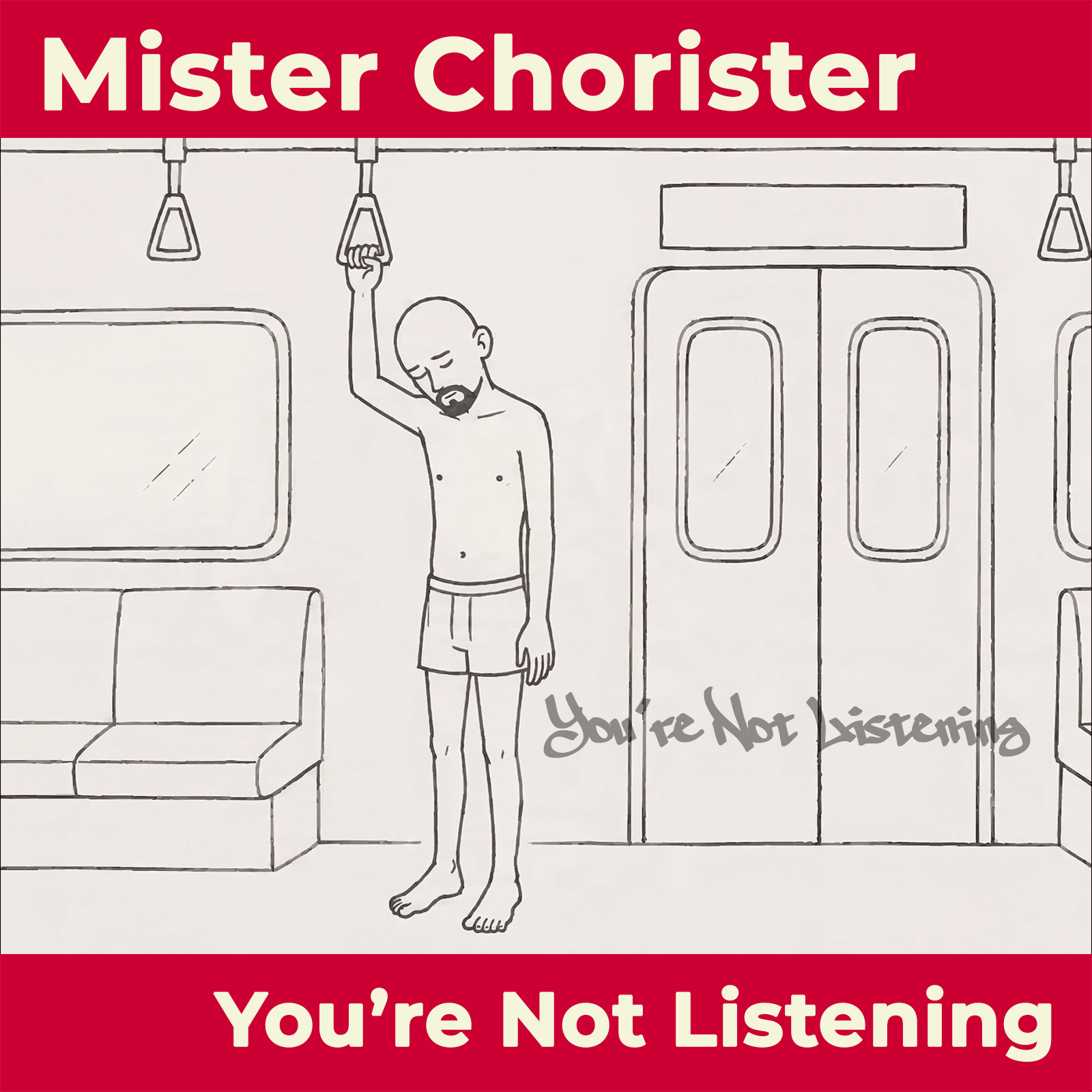
The record opens on a Tube Screamer squall that immediately announces its intentions: this will not be a comfortable listen, nor should it be. Power chords stack up behind it, a keyboard cuts a bright melodic line through the murk, and Chris Castellitto's drumming drives the whole apparatus forward with the kind of urgency that refuses to let the listener settle into passivity. Then, cannily, the tempo drops for the verse — a trick as old as dynamics itself, but deployed here with real cunning, so the release feels earned rather than programmed.
What separates this from a hundred other tension-and-catharsis rock singles is the sleight of hand buried in its origin story. Brammer has said the song began as a grievance — a colleague who wouldn't listen — before a single question turned the whole thing inside out: what if he felt unheard too? That pivot could have remained a footnote in a press release. Instead it becomes the song's engine. By the second verse, with its grunge-inflected guitar figure and cinematic piano rolling toward the line "free… your gaslight is on," the target of the accusation has quietly become the self. Few writers manage that reversal without it feeling like a gimmick; Brammer and producer Billy Crabbe pull it off by trusting the arrangement to do the emotional labour rather than the lyric sheet.
And what an arrangement it is. A warbling pad hums beneath everything like tinnitus made audible, refusing to fully vanish even in the quiet passages. A sliding bass keeps the ground unstable until the choruses arrive, when a locked sixteenth-note pattern snaps everything into determined focus — a neat musical metaphor for a mind pulling itself together. The vocal production tells its own parallel story: delay effects multiply the voice into something like the babble of competing inner monologues, before the final chorus swaps that anxious echo for a megaphone rasp, and then, gloriously, a seven-part harmony that feels less like a hook and more like an exhale.
Reference points name-checked by Crabbe — Free's "Alright Now," ELO's "Don't Bring Me Down" — are audible in the song's classic-rock muscle, but the finished product resists nostalgia. Ninety-something grunge grit rubs against genuinely cinematic piano, and the combination shouldn't cohere as well as it does.
Best of all is the ending, which earns its quiet through sheer nerve: after all that noise, the band strips back to acoustic guitar, one clean vocal, and that same warbling pad, before a shimmering cymbal dissolves into television static and then, deliberately, silence. "It's never too late," sings Brammer, and for once the platitude lands, because the song has spent four minutes proving it.
This is a genuinely gripping piece of songwriting — confrontational, self-aware, and unafraid of its own melodrama. Mister Chorister's third chapter suggests the story is only getting more interesting.