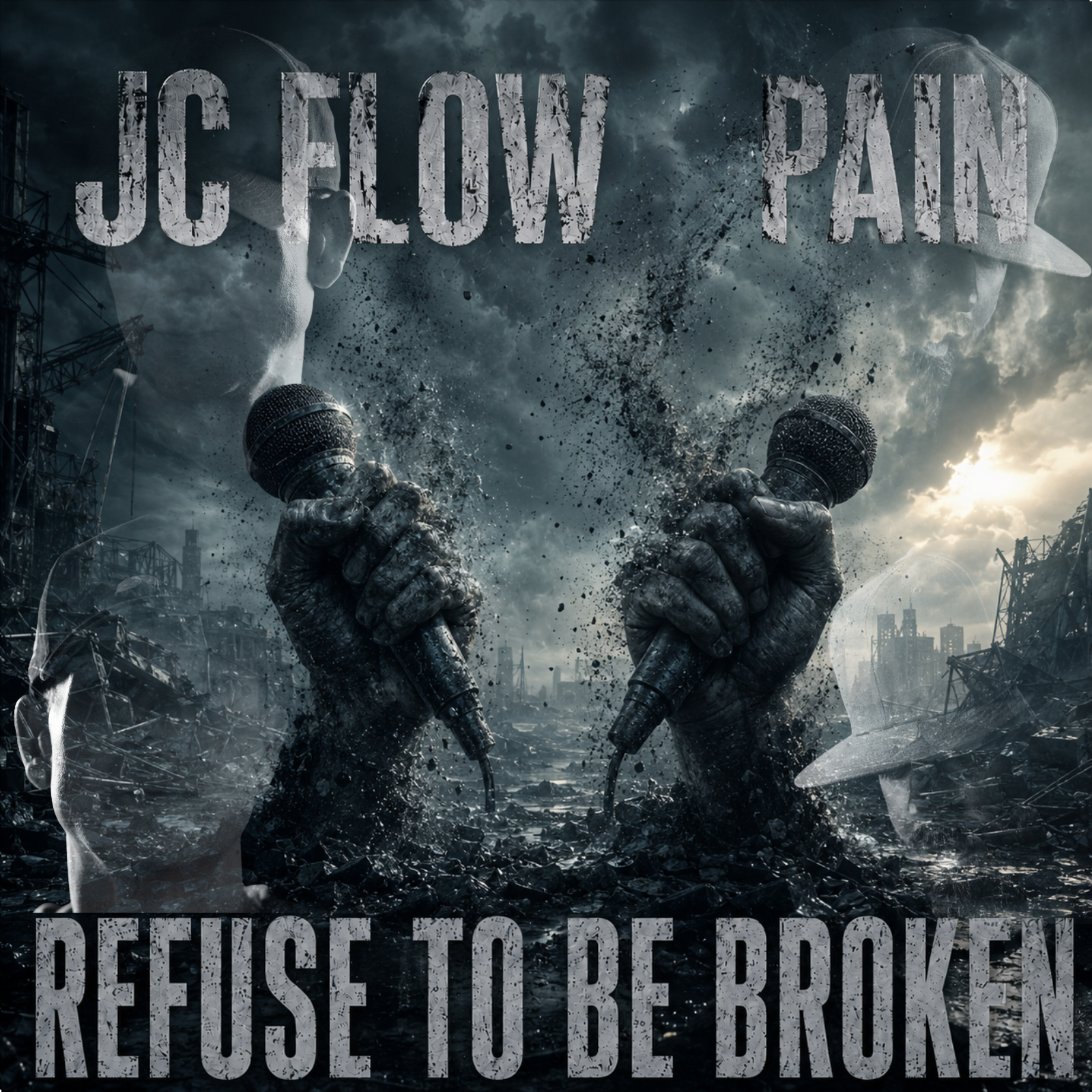
JC Flow and PAIN split the difference between confession and combat. The drums land like a door being kicked in rather than knocked on, the low end sits under everything with the patience of a bruise waiting to surface, and the production keeps a widescreen, almost cinematic haze around the verses, as though the whole thing were scored for a film about survival rather than a three-and-a-half-minute single. It is rap-rock in the sense that matters: not guitars bolted onto beats for texture, but genuine tension between grit and melody, verse and chorus, restraint and release.
JC Flow's writing carries the wounded lyricism of someone still working things out in real time, vulnerability delivered with enough control that it never curdles into self-pity. PAIN, twenty-five years into a career built on turning heartbreak into craft, answers with the weathered authority of a man who has already had this argument with himself and won. The pairing works because neither artist is performing resilience for effect. They sound like they have earned the right to use the word.
The chorus does the heavy lifting, and it does it well. Where the verses simmer, the hook opens the whole record up into something genuinely soaring, a melodic lift that never tips into sentimentality because the low end never lets it float too far from the ground. It is the sound of two men agreeing on a single sentence after years of writing different drafts of it separately.
Thematically, the song sits comfortably in hip-hop's long tradition of turning damage into declaration, but it avoids the genre's laziest shortcut, the assumption that volume alone equals conviction. Pain, here, is not a badge to be worn loudly; it is raw material, something to be shaped rather than shouted about. The hook's central idea, that scars do not have to write the ending, is not a new one, but it is delivered with enough weight and specificity that it earns its place rather than borrowing it from a hundred records that said something similar with less discipline.
What holds the track together is a shared vocabulary between two artists who did not know they had one until recently. Their backgrounds, separated by a few years and a high school hallway, converge on the same instinct: that honesty is only useful if it is followed by forward motion. The production respects that instinct, giving both voices room to breathe without ever letting the energy sag. Nothing here overstays its welcome, and nothing feels padded to hit a runtime.
"Refuse to Be Broken" will not reinvent hip-hop's relationship with adversity, and it does not try to. Instead it does something more difficult and more useful: it makes an old theme sound freshly lived-in, delivered by two voices who clearly needed each other to say it properly. Decades of near-misses finally paid off in three and a half minutes, and the wait sounds, on this evidence, entirely worth it.