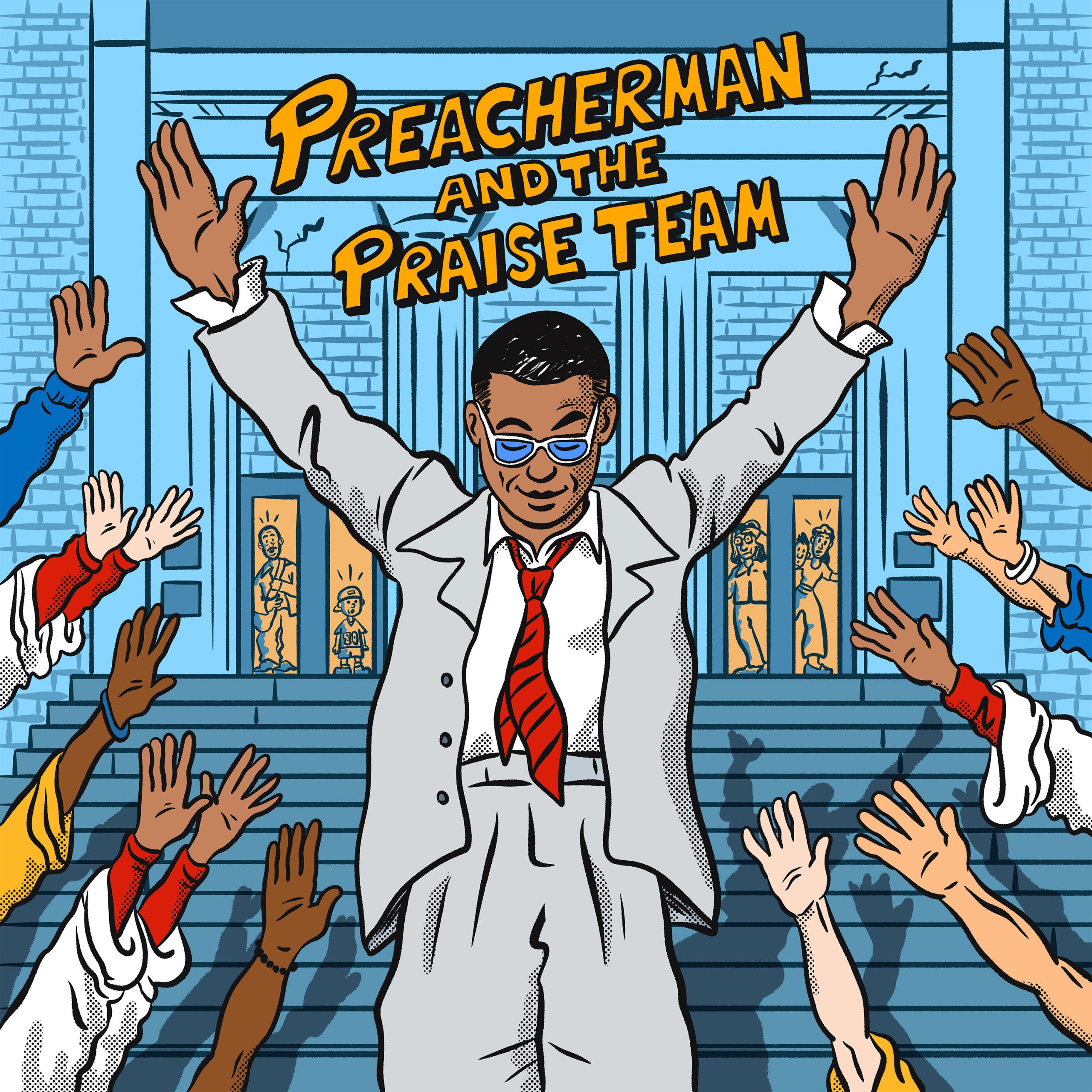
Here's a man who once sat inside the machinery of the modern pop industry — signed to Warner, mentored under Max Martin's MXM operation, presumably fed a diet of hooks engineered for maximum chart penetration — and got spat back out in 2018. What he did next matters more than the drop itself: he vanished. No comeback single, no "here's my truth" Instagram essay. Just silence, and apparently a conversion to Christianity that reads, on the evidence of this mixtape, as genuine rather than marketable.
"Preacherman and The Praise Team" is what emerges from that silence, and it sounds like exactly what it claims to be: something stitched together in a brownstone basement with a sound engineer borrowed from NYU rather than assembled by committee in a Los Angeles writing camp. You can hear the difference. The polish of his MXM days has been sanded off, replaced with something rougher and considerably more alive.
The record's central trick — grafting house music's four-on-the-floor pulse onto gospel's call-and-response architecture — shouldn't work as well as it does. House was built for 4am hedonism; gospel was built for Sunday morning testimony. Jack seems to understand that both genres are, at bottom, about surrender: bodies giving themselves over to rhythm, congregations giving themselves over to something bigger. Collapsing the two isn't a novelty move, it's a genuinely clever bit of musical theology, and it gives the mixtape a physical urgency that most contemporary Christian rap sacrifices in favor of earnestness.
That's not to say earnestness is absent. Jack wears his faith plainly, without the winking irony that a major-label vet might be forgiven for reaching for. He's on record wanting the whole of New York to praise God outdoors, loudly, "like a praise band" reverberating off brownstone and asphalt — and that image, ridiculous and stirring in equal measure, is basically the record's mission statement. This is music imagined as public event, not private confession. It wants a crowd, a street corner, a wall of sound bouncing between buildings.
What keeps it from tipping into pastiche is the specificity of the city underneath it. New York isn't wallpaper here — it's structural. The brownstone basement, the borrowed engineer, the sense of a scene assembled from whoever was around rather than whoever the label could afford: all of it bleeds into the tape's texture. Grassroots is an overused word for records like this, but the mixtape earns it by sheer circumstance of its own making.
What Jack has made is a document of a man rebuilding his relationship to music from the studs up, with faith as the scaffolding and New York as the site. Few artists get a second act this honest, and fewer still make it sound this good on the way back.