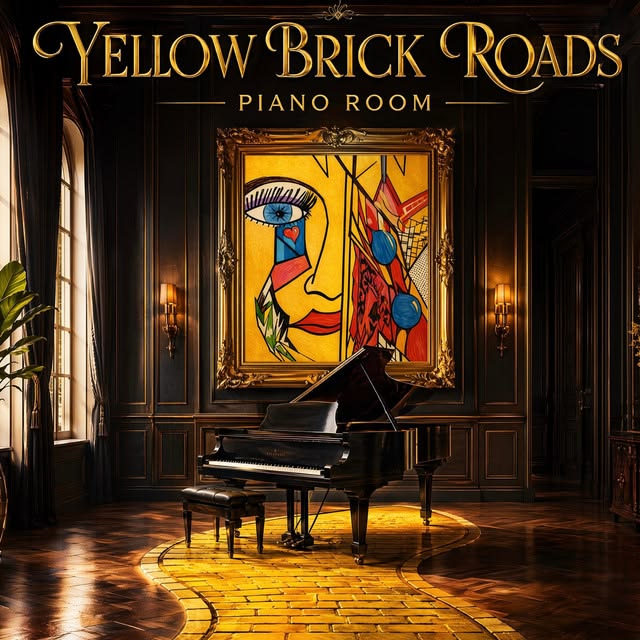
The arrangement is spare almost to the point of austerity — a single piano, a voice recorded at home rather than in any studio built for flattering vocals, and a production philosophy that treats polish as a kind of dishonesty. It's a bold gamble, this insistence on rawness. Plenty of bedroom artists mistake lo-fi for authenticity and end up with neither. James avoids that trap because her instrument — her voice, cracked and plainspoken — carries the conviction that studio sheen would only muffle. You believe her. That belief is the whole engine of the record.
Lyrically, the song draws on the same tributaries as her stated influences: Bowie's shape-shifting candour, Annie Lennox's emotional directness, the hushed confessional mode of Daughter. But the comparison only goes so far, because the song's real subject — a grown woman writing a letter to the teenager who "never quite fitted" — belongs to nobody but her. The cover art, drawn by James as that same teenager decades ago, does something few single sleeves manage: it turns the packaging into part of the composition. Look at the smoke-wreathed, violet-lit portrait on the front and you're not looking at a marketing image; you're looking at a handshake across thirty years.
Where the song earns its keep is in its refusal to resolve too neatly. James has spoken of the piece as "an apology" to her younger self, and that word choice matters — it's humbler and stranger than the usual language of empowerment anthems. The melody doesn't swell into triumph so much as settle, gently, into acceptance. It's a song about being seen rather than being saved, and that distinction gives "Yellow Brick Roads" its particular ache.
Critics reared on maximalism might find the minimalism here a hard sell at first listen. But patience rewards. The song's power accumulates the way a diary entry does — not through spectacle, but through the slow accretion of honesty. By the final verse, the piano has thinned to almost nothing, and James's voice is doing all the work, which feels correct: this is a song about being heard without accompaniment, without armour.
That it has already found listeners across continents, and provoked requests for a sequel, speaks to something the industry too often forgets — that intimacy travels further than production budgets do. "Yellow Brick Roads (piano room)" isn't chasing trend or spectacle. It's a nurse-turned-songwriter handing her younger self a mirror, and trusting that whoever's listening might catch their own reflection in it too. Few debut singles manage that kind of quiet, unguarded generosity.