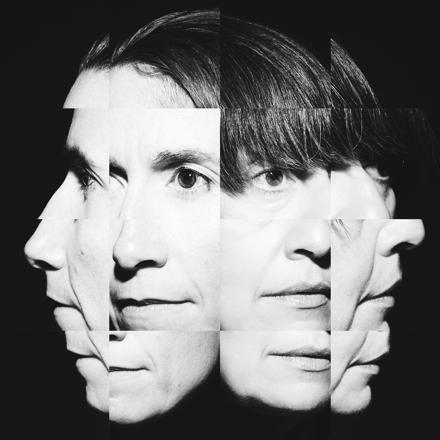
Castello and Benedini have built their career on contrasts that shouldn't cohere but do — Italian against English, analogue warmth against digital chill, the gloss of '80s synth-pop rubbing against the scuffed guitars of '90s Britpop. On *11* these tensions stop being decoration and become the whole architecture. Tracks slip between languages mid-thought, as though the duo are translating themselves in real time rather than performing bilingualism for effect. "Questa Lingua" makes the bit explicit, turning the act of choosing a language into a stand-in for choosing how much of yourself to hand over to another person.
Musically, this is minimalism with its sleeves rolled up. Arpeggiators tick over steady, almost martial rhythms; synth lines repeat and mutate by tiny degrees, the way a long relationship reshapes a person without anyone noticing the moment it happened. "To Fall" opens the record on a deceptively bright pulse, all New Order glide and pop instinct, before the lyric undercuts the sheen with something more unsettled. "Hip Hop in the Fog" does something trickier still, smudging a clipped, percussive verse into a chorus that dissolves into reverb, as if certainty itself were evaporating in real time.
The guest spot from Rachele Bastreghi on "Scegli Me" could have been a cheap bid for crossover credibility — Baustelle's name carries weight in Italy, and plenty of acts would have leaned on it shamelessly. Instead the song earns its company. Bastreghi's voice doesn't decorate the track; it argues with it, adding a second perspective to a record otherwise built from one relationship's internal weather.
What separates *11* from the glut of breakup-and-reunion records clogging streaming playlists is its refusal to pick a side in the argument between fusion and individuality. Most pop albums about coupledom function as advertisements, all soft focus and resolved tension. This one plays out more like a transcript: falling in love, merging, fracturing, wandering off to rediscover the self, and then — crucially — choosing to walk back rather than being swept back by fate or chemistry. The duo describe it themselves with disarming clarity, framing love not as a fusion that erases boundaries but as a daily, repeated decision to remain distinct while staying close.
That clarity extends to the production choices. Nothing here overstays its welcome; nothing reaches for a stadium chorus it hasn't earned. The melancholy that's always trailed I'm Not a Blonde like a coat they can't take off is present throughout, but it's deployed with restraint rather than indulgence — closer to Hurts at their most controlled than to the maximalist heartbreak of their bigger-budget peers. Having shared stages with Duran Duran, Wolf Alice and Franz Ferdinand evidently taught them something about economy; not a single one of these eleven tracks asks for more time than it needs.
*11* doesn't offer love as resolution. It offers love as ongoing negotiation, scored with a tact and a sonic intelligence that most albums twice as ambitious never manage.