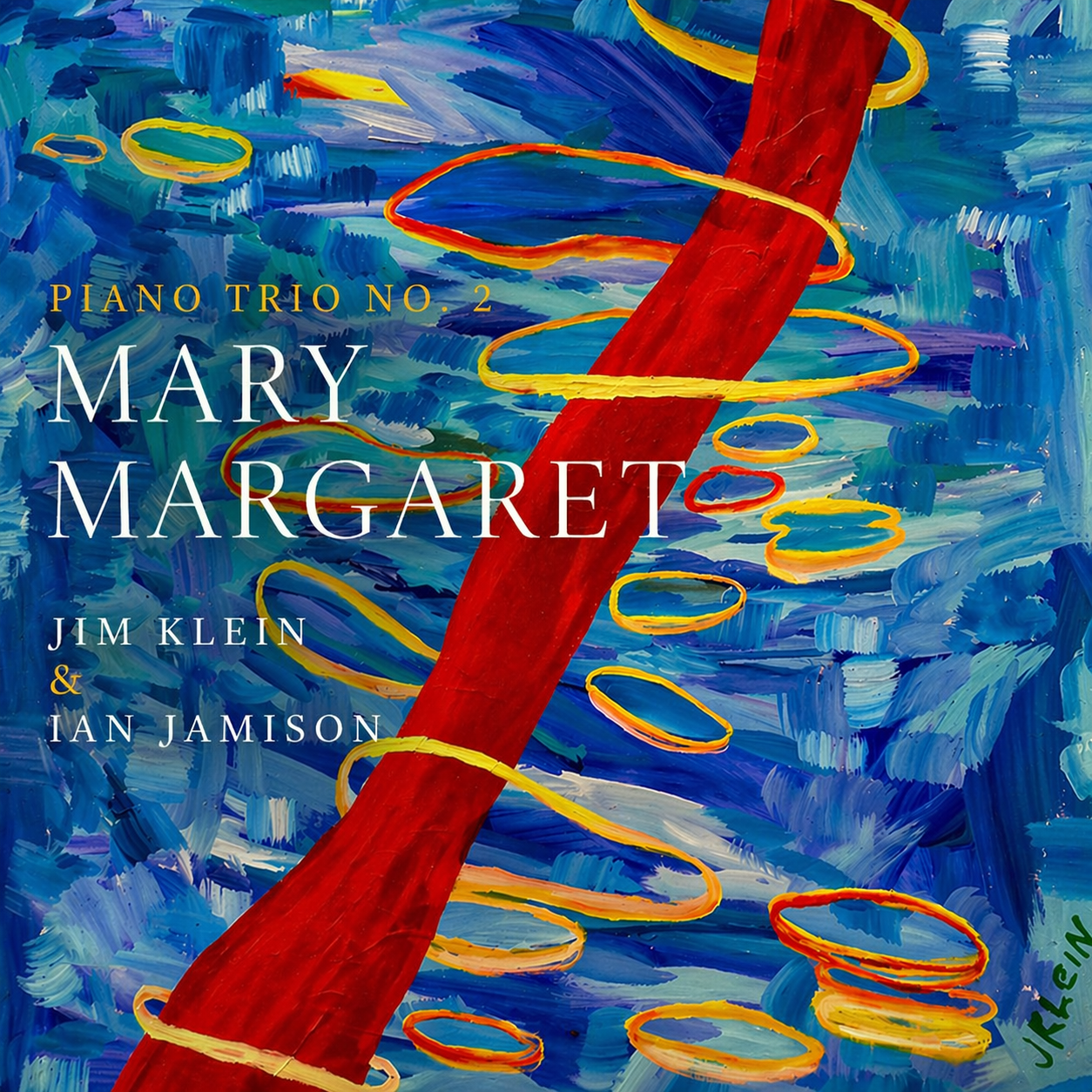
Piano Trio No. 2, subtitled *Mary Margaret* and written as an elegy for Klein's deceased infant granddaughter, does not attempt to resolve its subject's impossible brevity into consolation. It refuses the comfort of narrative arc. Ninety minutes has no arc; it has only arrival, presence, and absence. The music understands this. And in understanding it, Jamison and Klein have made something that goes considerably beyond the personal occasion of its composition.
The working method of this collaboration is worth understanding before approaching the piece. Klein supplies the melodic ideas — intuitive, direct, the kind of lines that suggest human presence rather than technical construction. Jamison then takes those seeds and builds outward, incorporating them into larger architectural structures informed, as he has described, by his own existentialist preoccupations. The result is music with two centres of gravity: Klein's melodic particularity, rooted in the specific grief of a grandfather, and Jamison's philosophical restlessness, the larger questions of existence, meaning, and the indifference of time that any death provokes and that the death of an infant provokes most acutely of all. The tension between these two orientations — the personal and the metaphysical — is not a flaw in the work's conception. It is its engine.
Jamison has always been drawn to titles that carry existential freight — *The Abyss*, *The Flood*, *Summation* — names that gesture toward experiences that exceed any single work's grasp. *Mary Margaret* is, by contrast, a name: specific, intimate, irreducibly human. That the philosophical architecture of the piece grows from so personal a root gives the music an unusual quality of earned abstraction. The existentialist musing does not feel imported from elsewhere; it feels like the natural destination of a mind confronting the oldest and most unanswerable of questions through the most intimate of losses.
The Colorado Piano Trio, with Steinway Artist Adam Zukiewicz at the keyboard, rises fully to the challenge. Zukiewicz has been this duo's most committed and long-standing interpreter — the pianist who gave the premiere of *Piano Sonata (The Abyss)*, who carried Klein-Jamison repertoire to ASU Tempe and Baylor University, and who anchored the all-Klein-Jamison programme in the Beethoven in the Rockies series. His relationship with this music is not merely professional but deeply personal, and that depth is audible throughout. He brings a quality of listening to his playing — a readiness to recede, to accompany, to let the strings carry a phrase to its conclusion — that the music absolutely demands. This is chamber playing in the truest sense: collective, attentive, shaped by mutual trust.
The harmonic language is characteristically searching, neither conventionally tonal nor aggressively modernist, but occupying that expressive middle ground where contemporary composers do their most distinctive work. The string writing has an inwardness that suits the subject: these are not gestures of public mourning but private ones, the sounds of a room after news has been received. Klein's melodic material surfaces and subsides with the quality of memory — present, then gone, then present again in altered form. Jamison's structural intelligence holds it all together without constraining it.
Listeners wishing to deepen their engagement with the piece will find a remarkable resource in the series of short videos currently available across the J Klein Gallery YouTube channel and Ian Jamison's Instagram and TikTok accounts (@IanJamisonMusic and @ian.jamison.music respectively), in which Jamison, Klein, and Zukiewicz each discuss the Piano Trio No. 2 from their own perspective. These are not promotional supplements but genuine critical documents — rare instances of composers and performer articulating, in their own voices, what a piece means and how it came to be. They are strongly recommended.
*Mary Margaret* will not leave you reassured. It is not that kind of music, and the loss that prompted it is not that kind of loss. What it offers instead is the rarer and more valuable thing: the sense that a life of ninety minutes has been taken seriously, commemorated with intelligence and craft and genuine feeling, and handed to the world in a form that can outlast all of us. That is what music, at its most necessary, is for.