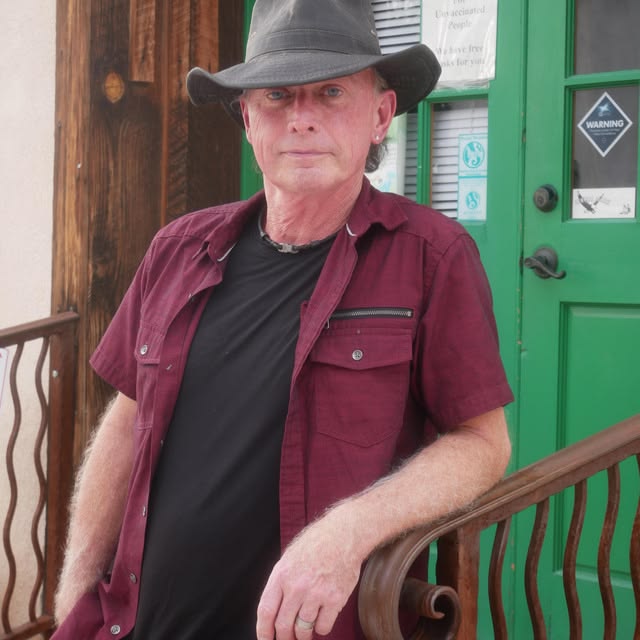
Fate's musical bloodline is not difficult to trace. The ghost of Tom Petty hovers in the mid-tempo pulse, that particular American cadence where emotional urgency is disguised as nonchalance. Bruce Springsteen's heartland insistence is audible in the lyrical directness — the refusal to dress a plain truth in ornamental language. And there is something of John Mellencamp's stubborn Midwestern dignity here too: a man who has looked at the world without flinching and decided, against all reasonable evidence, to believe in it. These are not small inheritances. Fate does not squander them.
What distinguishes *Hold On* from the merely competent is Fate's capacity for arrangement as emotional argument. He has long demonstrated an ear for orchestral texture — violin and cello have appeared in his live configurations, humanising what lesser artists leave as mere rock mechanics — and that sensibility permeates this recording. The song breathes. Spaces are left intentionally empty, a formal gesture that communicates more than any additional instrument could. The production trusts the listener in a manner that has become almost eccentric in contemporary rock, where every silence tends to be plastered over with sonic wallpaper.
The guitar work is, as one has come to expect, central to the track's emotional logic. Fate is a self-taught player, and this matters in ways that are audible: his phrasing lacks the occasional tyranny of formal technique, that tendency of conservatoire-trained musicians to play what is technically correct rather than what is emotionally true. Instead, his lines land where feeling dictates. There is a melodic economy at work throughout *Hold On* — notes chosen not for display but for necessity — and it gives the song the texture of something genuinely lived-in rather than constructed.
His voice, meanwhile, carries that quality which no amount of vocal training can manufacture: the sense that the person singing has earned the right to sing these particular words. Lyrically direct without being blunt, the lyric manages the difficult trick of addressing universal emotional territory — the act of persisting, of maintaining grip when release would be so much easier — without tipping into the kind of abstraction that allows a listener to remain at comfortable distance. You are not permitted to listen to *Hold On* with arms folded. The song won't allow it.
The single also demonstrates something underappreciated about Fate's craft: his songs hold their shape across radically different contexts. He has performed the same material with a full rock ensemble and with an orchestral configuration that includes strings, and both versions have reportedly worked as independent artistic statements. This is not versatility for its own sake — it speaks to the structural integrity of the songwriting itself. A song flexible enough to bear such transformation is a song whose skeleton is genuinely strong. *Hold On* would, one suspects, survive even a solo acoustic rendition with nothing lost but the production's particular beauty.
The title itself rewards a moment's reflection. *Hold On* is a phrase of desperate grammar in the popular songbook — Wilson Phillips made it into a kind of pop theology, Springsteen threaded it through Nebraska's bleak pastoral — but Fate deploys it differently. Less a plea than a statement of purpose. Less anxiety than resolve. The imperative here carries neither panic nor sentimentality but something closer to clear-eyed commitment: the decision, made in full knowledge of the alternatives, to remain.
Fate's music has previously appeared in NFL broadcasts and national television programming, including *Today* and *Extra*. These are unusual placements for an artist operating largely outside the mainstream industrial complex, and they speak to an emotional accessibility that should not be confused with blandness. The work reaches people because it means what it says. That is rarer than it sounds.
Hold On is, in the end, a record about endurance — which is to say, it is a record about being human. Brian Fate makes that subject feel urgent and specific and, against the odds, hopeful. Not the hollow optimism of someone who has never encountered difficulty, but the hard-won kind: the sort that knows exactly what it is up against and chooses to stand anyway.