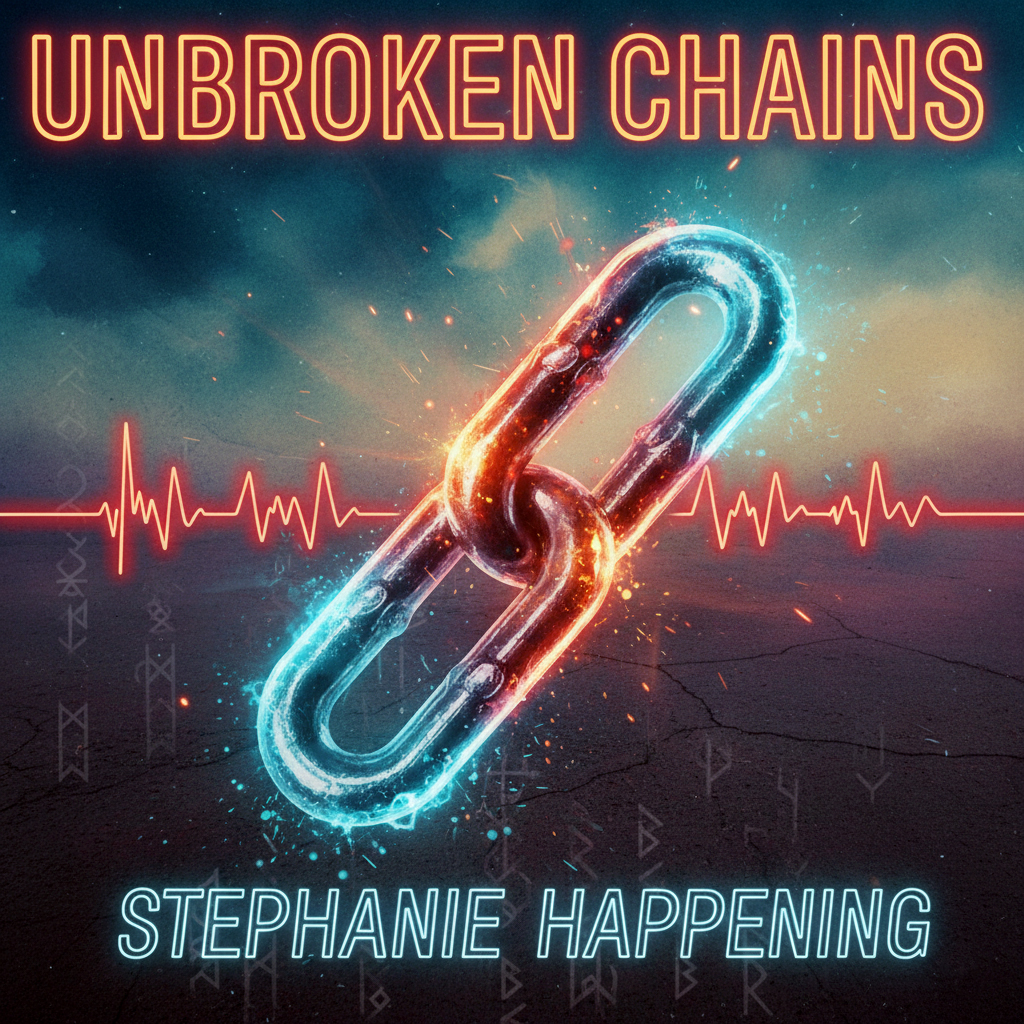
Let's be clear about the context, because context here is not merely background noise — it *is* the music. *Unbroken Chains* carries a sense of confrontation from its opening moments, and the title alone suggests endurance under pressure, but the track refuses passive suffering. This is not a wounded artist bleeding quietly in a corner, hoping someone notices. This is a reckoning delivered at full volume, on entirely new infrastructure, by someone who has decided that the existing machinery of the music industry is not broken — it is working perfectly, just not for them.
Stephanie Happening's work is rooted in identity, fragmentation, and reclamation. As a system living with Dissociative Identity Disorder, the project does not reduce personal complexity into simplified narratives or inspirational clichés. Instead, the music embraces contradiction, emotional multiplicity, and the ongoing process of rebuilding selfhood in public view. In an era when vulnerability has been weaponised into content strategy and trauma packaged as a Spotify playlist, that distinction matters enormously. This is not a carefully calibrated emotional brand. It is something considerably messier and, consequently, considerably more honest.
The song is not interested in polished perfection. It values truth, even when truth feels uncomfortable. You feel that in the production — cinematic, reaching, occasionally overwhelming — which pushes against the kind of antiseptic sheen that passes for ambition on the algorithmic streaming platforms this release is pointedly refusing to prioritise. The sonic architecture is built for the widest possible screen: swelling, insistent, the kind of sound that demands to be heard through speakers rather than laptop tinsel.
And then there is the matter of what *Unbroken Chains* represents beyond its three minutes and three seconds of audio. The release arrives attached to a larger technological and philosophical statement. *Unbroken Chains* became the first musical asset minted through the Sovereign Protocol System IP Passport, an infrastructure designed to prioritise artist control and bypass traditional royalty bottlenecks. Some critics will dismiss this as tech evangelism dressed in a leather jacket. They would be wrong. The structural argument being made here — that artists have functioned for decades as involuntary creditors to institutions that launder exploitation as opportunity — is not a fringe position. It is a demonstrable, documented reality that the industry has simply relied upon artists accepting as natural law.
What Happening is doing — and *Unbroken Chains* is the proof of concept — is insisting that the law can be rewritten. The Direct-to-Split payment rails, the five pence per play against an industry average roughly fifteen times smaller, the elimination of the 90-day royalty lag that functions as a quiet, structural theft: these are not vanity projects. They are a genuine attempt to reorder the terms. Ownership becomes part of the art itself, inseparable from the emotional themes embedded in the music. That fusion — of form and content, of infrastructure and feeling — is where *Unbroken Chains* achieves something genuinely rare.
Beneath discussions of infrastructure and decentralisation sits a deeper question about dignity: who controls creative labour, personal identity, and the stories people are allowed to tell about themselves? *Unbroken Chains* answers by refusing surrender, both emotionally and structurally. This is not a question the mainstream industry is comfortable having asked loudly, which is of course precisely why it needs to be asked loudly, on record, attached to something you can actually listen to.
Stephanie Happening's broader artistic vision continues to stand apart because it refuses compartmentalisation. Trauma, healing, identity, technology, and music coexist naturally inside the same creative universe. The British critical tradition, at its best, has always saved its highest regard for artists who cannot be filed away neatly — who insist on occupying space in more than one category simultaneously. Unbroken Chains is such a work. It will frustrate those who need their music and their politics separated by a polite distance. For everyone else, it sounds like a door being kicked open.
Whether the Sovereign Protocol System fulfils its considerable promises at scale remains to be seen. First proofs of concept always carry more manifesto than market. But the song? The song is already real. It already exists. It is already, chain by chain, making the case that the most radical act available to an artist in 2026 is simply to own what they've made, to be paid instantly for what they've made, and to refuse — beautifully, cinematically, without apology — to pretend that anything less than that was ever acceptable.
Unbroken Chains is not merely a debut transmission. It is a frequency shift. And those don't come along very often.