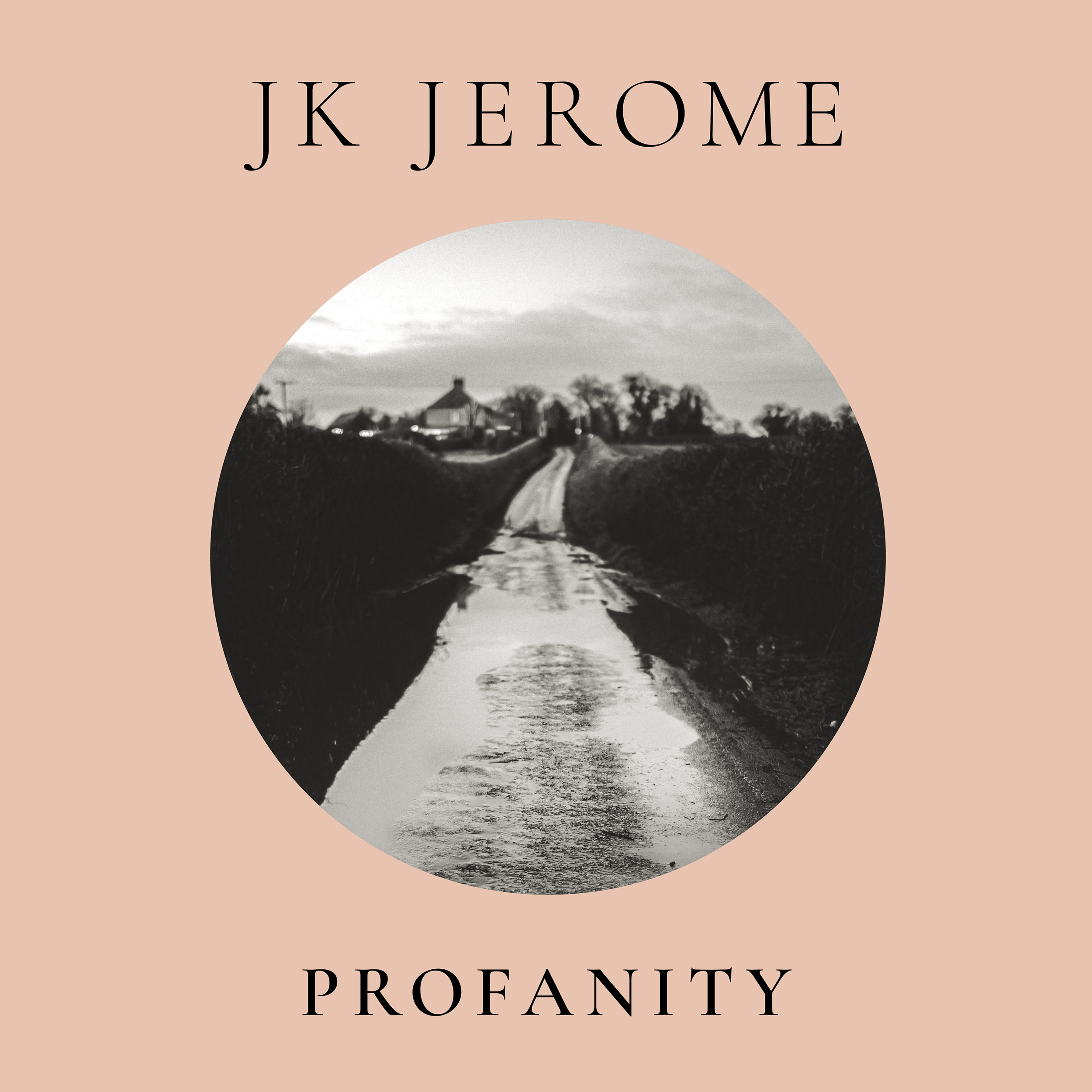
The central line arrives quietly, the way the best lyrical punches tend to: *"Profanity is a single parent family."* It doesn't rage. It doesn't italicise itself. It simply holds the mirror up to the word and asks you to look at who decided it was dirty. This is writing of genuine precision — not the precision of the journalism school or the think-piece, but the precision of someone who has lived inside the subject long enough to know exactly which angle cuts cleanest. Jerome is a Salopian, raised in the particular texture of 1990s working-class Britain, and he writes from that specificity with the confidence of someone who has stopped apologising for the narrowness of the frame. The narrowness, of course, is the whole point. The universal is always dressed in somebody's particular clothes.
Musically, the track refuses to flatter its listener with easy entry points. Finger-picked electric guitar opens proceedings with a warmth that is immediately complicated — not acoustic warmth, exactly, but something more ambiguous, as if the instrument itself has been asked to carry contradictory feelings simultaneously. Beneath it, foley-inspired percussion keeps time with the slightly uncanny rhythm of memory rather than metronome: footsteps, perhaps, or the domestic percussion of a house with one adult in it. Then the sub bass arrives, and the Chase Bliss Mood pedal begins its warped, delay-processed haunting, and suddenly the track is doing two things at once — holding you close and pulling the floor slightly sideways.
This is the production choice that elevates *Profanity* beyond the well-crafted confessional. Jerome is not simply telling you what happened. He is recreating the phenomenology of it — the way childhood memory has both intimate texture and uncanny distortion, the way the past is simultaneously too close and entirely unreachable. The electronics don't undercut the acoustic warmth; they complicate it, shadow it, remind you that the warmth is being recalled rather than experienced. It rewards headphones and repeated listens not because it reveals hidden easter eggs but because the emotional architecture becomes clearer each time, like a photograph developing slowly.
His CV tells a story of someone who has served considerable time at music's coalface — BBC Radio 2, Mahogany Sessions, Boardmasters, BST Hyde Park, a previous project with a million Spotify streams — which is perhaps why there is nothing here that feels like a debut's anxious over-reach. The track has the confidence of someone who has learned, through years of performance and collaboration, exactly what to leave out. Most songs gesture towards meaning. This one simply has it.
The comparison points are there if you want them — you can hear the lineage of Nick Drake's harmonic intimacy, the spectral production of Bon Iver's early work, a dash of the lyrical directness that made early Villagers so remarkable — but they sit quietly in the background, influences absorbed rather than worn. Jerome has his own voice, and it is one that accumulates rather than announces: the kind of songwriting that on first listen feels substantial, and on fifth listen reveals how much you initially missed.
*Profanity* is, ultimately, an act of reclamation dressed as a love song — to a younger self, to a mother, to a class of people whose lives were narrated by people who never visited. Jerome narrates from the inside. The difference is everything.
**Released May 8, 2026. Available now.**