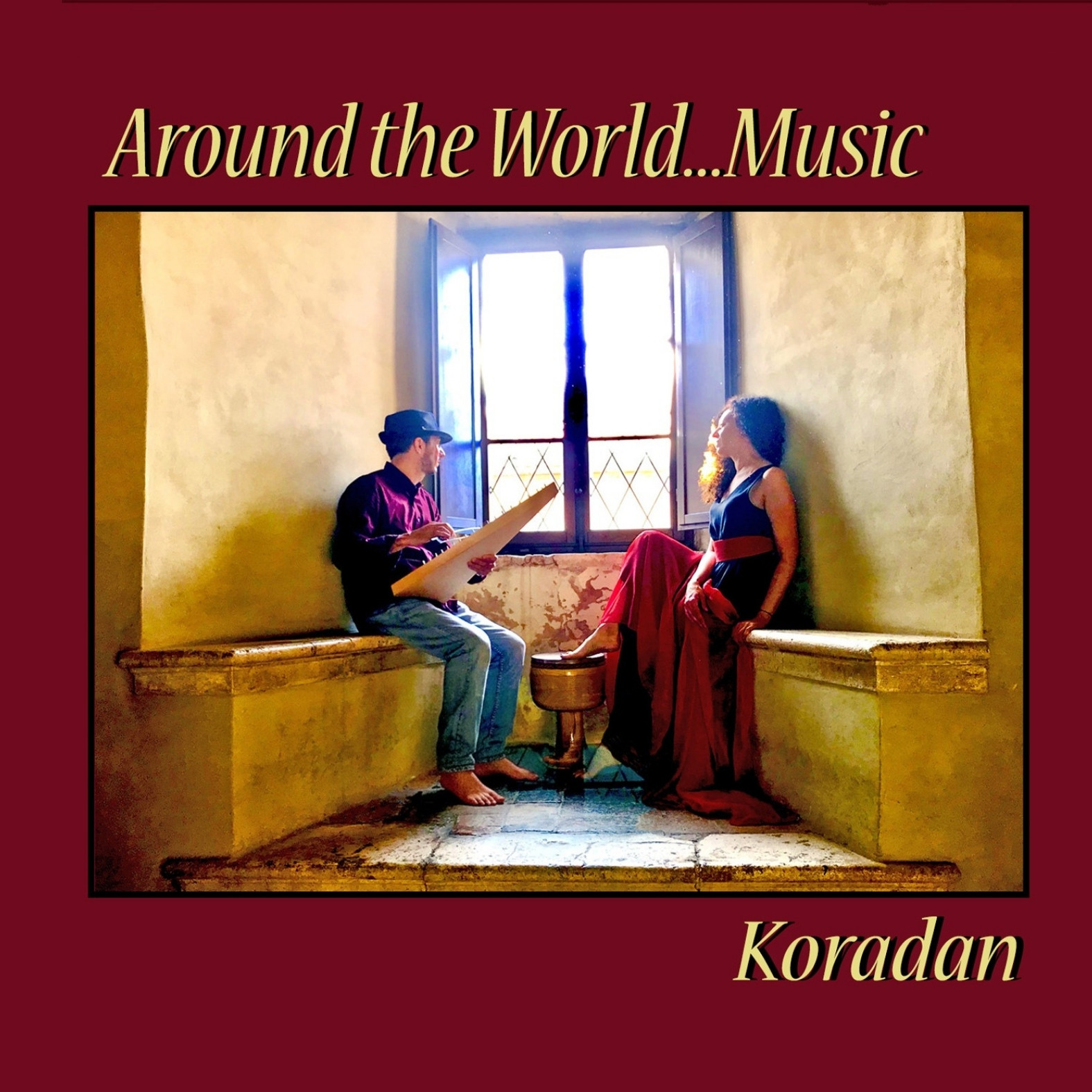
*Around the World...Music* announces itself as the first instalment of a tetralogy built around the classical elements. This opening chapter claims air — breath, dispersal, the invisible connective tissue between all living things — as its animating principle. It is an ambitious conceptual frame, the sort that collapses under lesser artists, crushed by its own grandeur. Koradan wear it lightly, or rather: they let the music wear it, and the music, mercifully, is more than capable.
The album opens with **"Tanec Vetra"** — Slovenian for *dance of the wind* — and immediately establishes the duo's governing aesthetic: tension between rootedness and drift, between the specificity of a tradition and the universality of a feeling. Rhythmic pulses flicker beneath melodic lines that seem to be arriving from several time zones at once, and yet the track coheres. This is the central miracle of Koradan's sound: they have internalized enough musical grammars that they no longer feel obliged to announce the seams between them.
Across fourteen tracks, the geography shifts with disorientating generosity. **"Tarab Café"** — which features a guest saxophone from M. Viviana Marconi, deployed with Coltrane-adjacent restlessness — summons the smoky, emotionally saturated quality of the Arabic concept *tarab*, that state of being transported by music. **"Sawt as-Sahra"** (Voice of the Desert) is perhaps the album's most austere passage, a meditation built from drone and resonance in which silence functions as an instrument. **"Naamu Bowe"** pivots decisively toward West African rhythmic architecture, stripped and insistent. **"Gothic Clagan"** moves through something colder and stranger, an approximation of liturgical European darkness that feels genuinely unsettling rather than decorative.
At the album's physical and philosophical centre sits **"Hara"**, named for the Japanese word meaning *centre*. It is the album's fulcrum — a piece that feels both conclusive and generative, gesturing toward the water-themed second volume while holding the present work in equilibrium. Koradan built this record outward from a single conviction: that music precedes borders, and that the proper response to a fragmented world is not nostalgia for imaginary unity but actual, effortful listening across difference. "Hara" enacts this in miniature. It is beautiful and functional at once.
One cannot discuss Koradan's instrumentation without pausing on the **Koritas**, their patented original creation — a single instrument containing materials and sonic philosophies from five continents, and reportedly the recipient of recognition from the Georgia Tech School of Music. It functions here as something between a manifesto and a party trick, except that the party trick is genuinely revelatory. The Koritas appears across the album as a kind of signature watermark, the sound that makes you think: *I have never heard quite that before.*
That sensation recurs with suspicious frequency throughout *Around the World...Music*. The closing **"Trinithangó"** deconstructs and rebuilds the tango into something genuinely borderless — neither Argentine nor Italian nor anywhere else, but belonging instead to that imaginary country that music occasionally summons into being. It is the album's most audacious gesture, and it lands.
What Baccari and Di Cicco have made is a record that demands a particular kind of listening: patient, receptive, willing to follow sounds into unfamiliar territory without demanding signposts. The album rewards that patience extravagantly. It is world music for people who distrust the category; ethnomusicology for people who find academic discourse deadening; ambient music with a pulse; ritual music that doesn't require belief.
If the three remaining instalments of this tetralogy sustain this level of ambition and execution, we will be talking about Koradan for a very long time. Begin here. Begin with air.