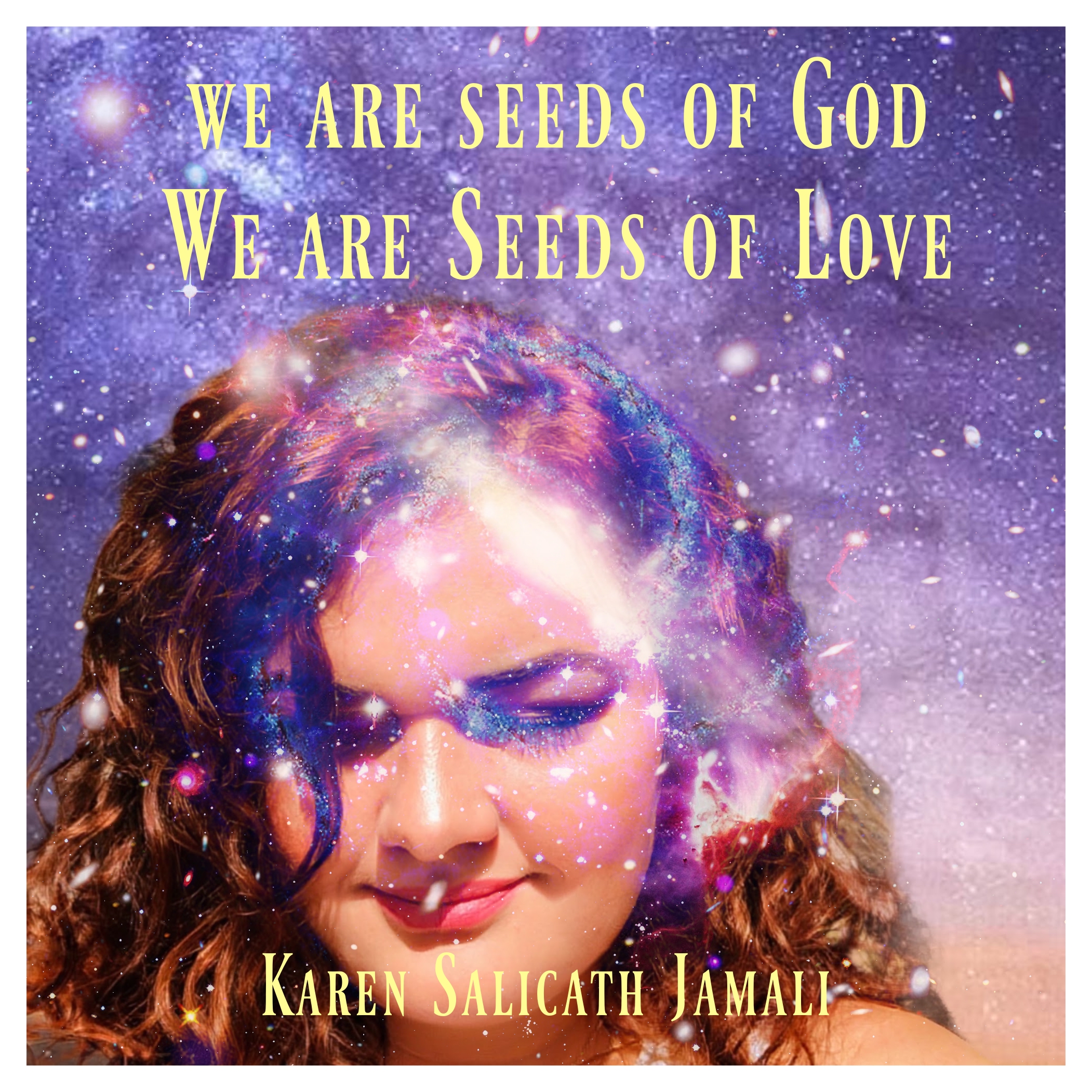
The result is something quiet, strange, and genuinely affecting.
Structurally, the single is almost wilfully spare. Guitar, voice, and what the press notes describe as "minimal production" — a creative framework that refuses the comfort of layered instrumentation or the insurance of sonic spectacle. It is a piece of music that offers nowhere to hide. Mastering engineer Austin Leeds, whose CV encompasses work alongside Avicii and releases across Spinnin, Ultra, Sony and Warner, has here exercised laudable restraint: the mix breathes, and whatever polish has been applied serves clarity rather than obscuring it.
That clarity is the point. Lyrically, "Seeds of God" meditates on a vision Jamali describes with striking precision: humanity not as a collection of separate, striving individuals, but as seeds resting within a single conscious field — a living, luminous continuum that she encountered during her near-death experience. This is not the language of casual mysticism or fashionable spirituality. It is the vocabulary of someone attempting, with considerable earnestness, to translate an experience that sits beyond ordinary language into something communicable through melody and chord.
Whether or not one shares the metaphysics, the artistic intention commands respect. The composition grew not from dream-received piano pieces — her established creative method — but from guitar and voice, the instruments of her childhood. She studied classical guitar from the age of eight, maintaining that practice for over fifteen years before pivoting to visual art and then, after 2012, to piano. "Seeds of God" is, in that sense, a return and a reunion, the adult artist finally introducing herself through the instrument that first formed her ear.
The vocal performance will not satisfy those seeking conventional technical display. It is direct, unadorned, and prioritises the delivery of the lyric above embellishment. Comparisons to the austere intimacy of early Nico, or to the quietly devotional recordings of Alice Coltrane's final decades, are not entirely fanciful — this is music that understands the difference between polish and sincerity, and consciously chooses the latter. The guitar playing carries a classical economy: notes placed deliberately, space treated as a compositional element rather than an absence.
Given the biographical weight underpinning all of Jamali's output — exhibitions at the Louvre, the near-death pivot, the dream-composition practice, the Carnegie Hall platform — it would be easy to approach "Seeds of God" as documentary evidence of an interesting life rather than a piece of music to be heard on its own terms. That would be a disservice. Taken purely as sound, it holds. The minimalism is earned, not imposed. The arrangement serves the lyrical thesis. The restraint is principled.
What Jamali has made here is a small, sincere, and quietly courageous record — the sound of an accomplished artist choosing vulnerability over virtuosity, and meaning it entirely.
**Karen Salicath Jamali — "Seeds of God" — available on all major streaming platforms**