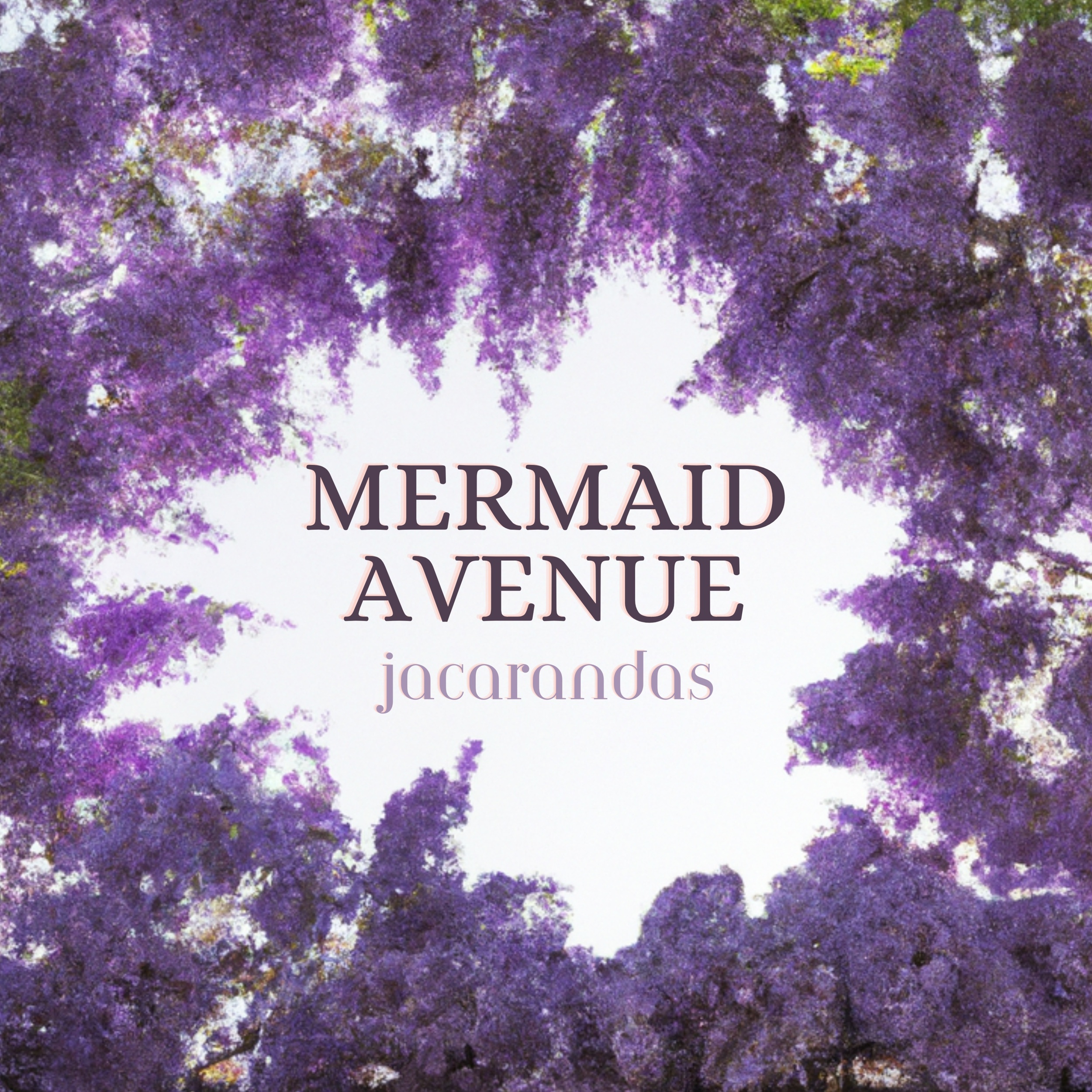
Clarke's voice has been compared to Michael Stipe, and one hears the logic — the same grain of vulnerability worn publicly, the same capacity to make private feeling feel communal — but the comparison sells the man short. Stipe was always slightly alien to the narratives he sang; Clarke sounds as though he has lived inside every line before committing it to tape. That impression of hard-won authority runs through the entire record, recorded with evident care by James See at Airlock Studios and mixed and mastered by Jason Millhouse at Recordworks. The production is warm without being soft, spacious without being indulgent. You can hear the room.
The title track opens proceedings with a lyric of almost cruel economy — the jacaranda trees in bloom standing as seasonal proof that time passes while longing does not — and the band underpins it with exactly the arrangement the song demands: guitars that ache rather than shout, a rhythm section that breathes rather than drives. Mike Kearey's lap and pedal steel work throughout the album deserves particular mention. He has the gift, rare among steel players, of knowing when not to play; his interventions feel like sighs rather than fills, which is the highest compliment one can pay the instrument.
"She'll Come Down When She's Ready" is the record's most immediately pleasurable track, built on a riff that carries the ghost of mid-period Counting Crows without mistaking homage for imitation. Its subject — the tender absurdity of adolescent shyness — is handled with a lightness that more earnest Americana practitioners would almost certainly have misjudged. Clarke plays it for warmth rather than pathos, and the song is the better for it.
"Better Not to Know" represents the album's most intriguing stylistic gamble. Casey Lee Chadwick opens it on keys that establish a distinctly nocturnal mood — the sound of a city with the sound turned down — before the band eases into a groove that nudges, gently but unmistakably, toward funk. The effect conjures a city at night, its wet streets reflecting neon back at the sky. It is a different kind of song from anything else here, and the fact that it sits without friction in the running order is testament to how securely the album's identity is fixed.
The closing "Boy in the Mirror" arrives with the accumulated weight of everything that precedes it. Guest violinist Melinda Coles brings a fiddle line of genuine desolation to a lyric about measuring one's adult failures against the promises of boyhood — specifically, the bitter recognition of having made the same mistakes as one's father. It is the kind of song that John Peel would have played at midnight and said nothing afterward, trusting the silence to do the work. Part of what makes the track feel like a different creature from the nine that precede it is a subtle but decisive shift in the rhythm section: Nathan Poetschka moves from kit to double bass, darkening the floor of the song considerably, while Mark Egan trades bass for mandolin, adding a brittle, high fragility that intertwines with Coles' fiddle like a second conversation running beneath the first. The texture is chamber music by another name.
The album was built track by track across 2023 and 2024, each song pre-released as a single — an approach that might, with lesser material, have produced a collection feeling assembled rather than conceived. Instead, *Jacarandas* coheres with the authority of a record made in a single sustained act of creative will. The sequencing is the invisible achievement: ten songs moving from the grief of the title track through the various stations of mid-life reckoning — ambition, memory, the renegotiation of love — to the quiet devastation of the finale. The journey feels both deliberate and inevitable.
The band name carries a debt. With *Jacarandas*, Mermaid Avenue begins, seriously, to pay it.