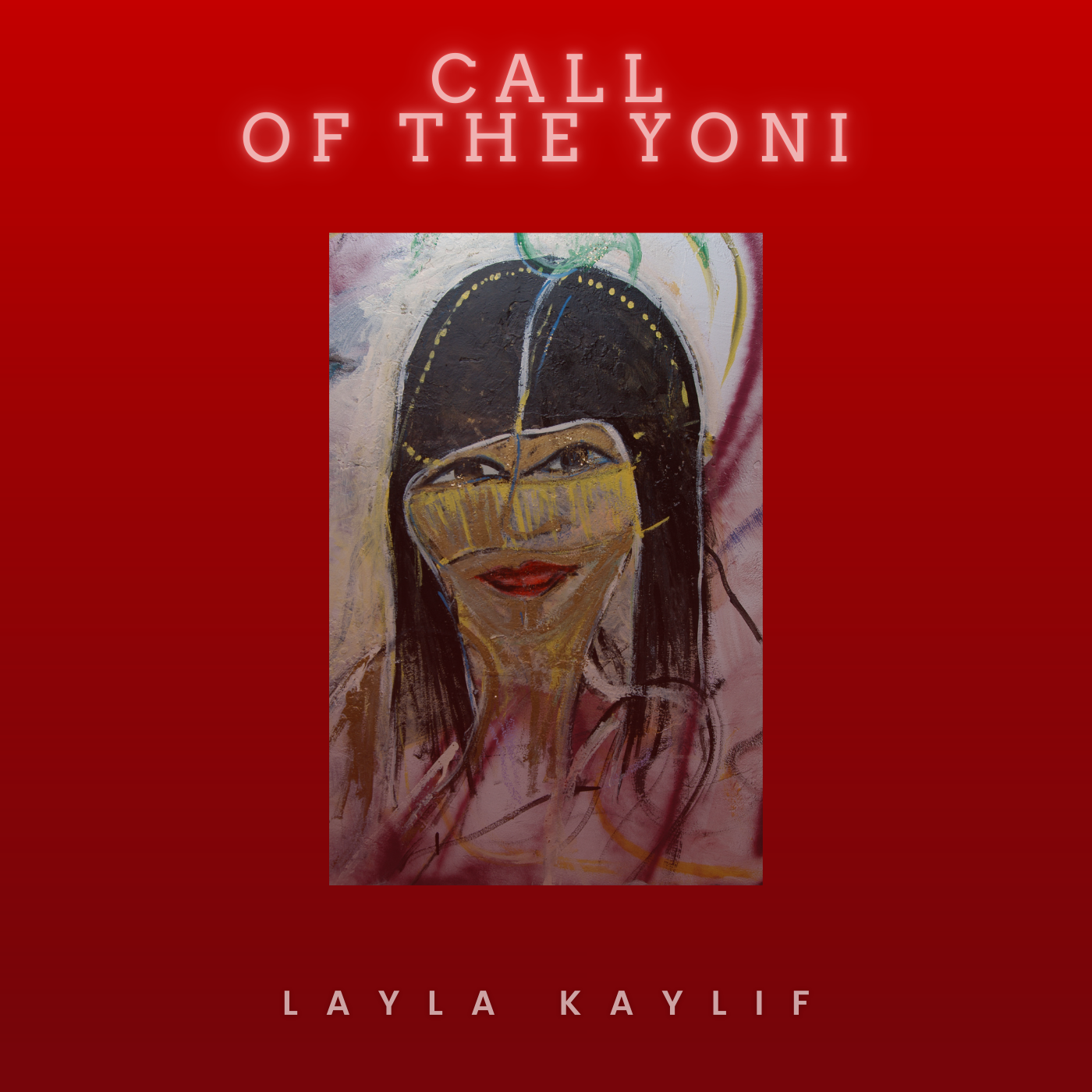
Seven tracks. A song cycle rather than a collection, which is a distinction the press release makes and which the music, to its considerable credit, actually earns. The album moves through what Kaylif describes as the "7-in-1 woman": sensual invocation, erotic-spiritual love, exile, devotion, rage, power and return. These are not themes so much as atmospheric pressures, and listening to *Call of the Yoni* straight through feels less like consuming music and more like moving through rooms in a house you didn't know you'd been locked out of.
The title track opens proceedings as a summoning, which is precisely the correct word. Kaylif understands the difference between announcing yourself and calling something forth, and the distinction shapes everything that follows. The oud moves beneath the vocal with the patience of water finding its level, while the ney carries that quality particular to the instrument — simultaneously ancient and urgent, as though grief and celebration have been bred together over centuries and cannot now be separated.
The centrepiece, "My Lover Is a Saint," is the sort of track that demands you stop whatever you are doing. It begins with spoken text drawn from Ibn Arabi — the Andalusian Sufi whose theology was essentially that divine love and human love were not two things but one thing seen from different distances — before opening into a lyrical meditation drawn from the Song of Songs. This is dangerous ground. The intersection of eroticism and mysticism has claimed lesser artists entirely; they fall into pastiche, or into a kind of spiritual affectation that convinces nobody. Kaylif navigates it with the sureness of someone who has actually thought this through rather than simply found it aesthetically convenient. The moment when devotion to a person begins to resemble devotion to God is a real moment, known to anyone who has been genuinely seized by love, and Kaylif renders it without embarrassment or overstatement. The chamber strings that gather around the song's architecture do not overwhelm; they witness.
Recorded across London, Dubai, Sweden and New York, the album bears its geography lightly but unmistakably. The minimalist electronics that thread through certain passages feel Scandinavian in their restraint; the rabab pulls the listener eastward with a kind of gravitational certainty; the strings carry the self-consciousness and emotional amplitude of the Western art song tradition. Yet none of this sounds assembled. Kaylif is not curating influences in the manner of the conscientious world music producer. She is working from the inside of a genuinely plural sensibility, and the result is music that belongs to no single tradition and is, for that reason, entirely its own.
The project announces itself as an intellectual intervention against what Kaylif calls "the Matrix of Misogyny." Critics have been known to wince at such declarations, suspecting that the concept will outrun the music. Here, it does not. The rage that surfaces mid-album is not performative; it has been earned by everything that precedes it, and when the album turns toward power and return in its final movements, the resolution feels neither tidy nor fraudulent. Kaylif has mapped a genuine emotional and philosophical journey, not illustrated a thesis.
The London-based English-Arab singer-writer is building, album by album, a body of work that occupies a space between global alternative, chamber folk, devotional music and what one might cautiously call philosophical pop. *Call of the Yoni* is her most fully realised statement yet — not a playlist, as the press material cheerfully insists, but a ritual. Attend accordingly.