That room no longer exists. The woman who opened her home to the label, Angie the Backbone, lost the house to foreclosure after her father died. The coffee table that hosted this session also hosted the recorded debut of Grim's nine-year-old daughter, Lyrick Logick, and the weekly artist showcase that held a community of nine hundred-plus creators together through sheer refusal to dissolve. The acoustics were terrible. The archive is irreplaceable.
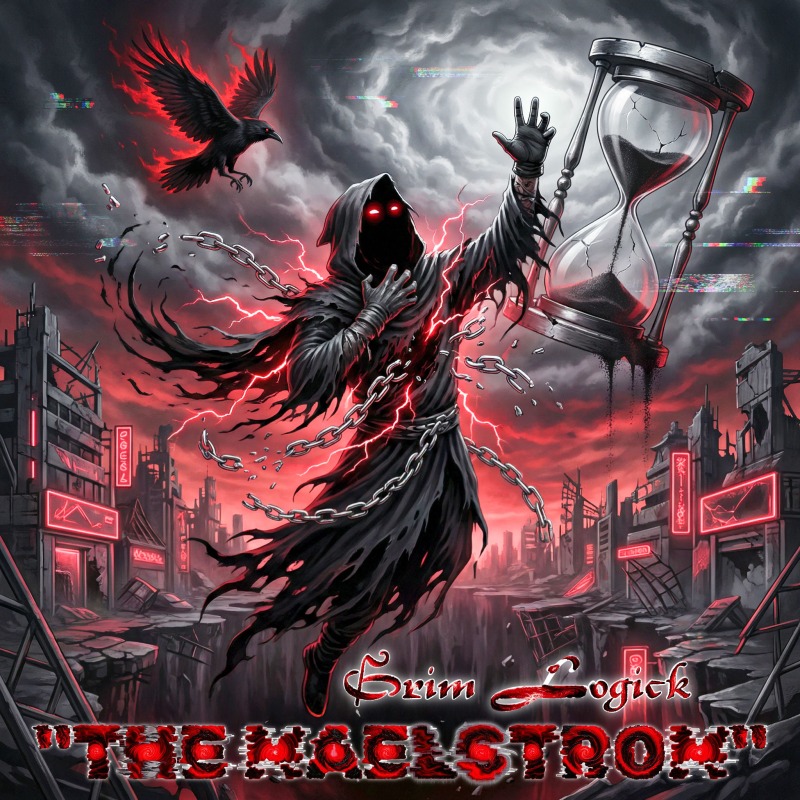
*The Maelstrom* carries all of that inside it — not as backstory, not as press release colour, but as fundamental structural DNA.
Produced by Benny Struggle — a Louisiana multi-instrumentalist who composes between shifts working the oil fields and is, by his own admission, rarely home long enough for a proper studio — the instrumental is a study in deliberate contradiction. Warm piano. Cinematic thunder on the intro. An atmosphere that feels like being inside a particularly beautiful storm. And then Grim opens his mouth, and the content sitting atop that warmth is brutal enough to make the contrast feel like an act of aggression. The production does not comfort the listener. It flatters them into proximity, then refuses to let them look away.
Structurally, the track inverts every commercial instinct with an almost belligerent calm. The chorus runs four bars — not eight, not sixteen, four — and is performed live three separate times, each with different dynamics, none duplicated through copy-paste. The first verse is deliberately compressed. The second verse is where the architecture expands into something close to a controlled detonation, and it is here — around the line "Since the day you saved my ass from drowning" — that the listener who has been paying attention understands that nothing in this song is metaphor. At fourteen, Grim Logick attempted to take his own life. He stopped because he heard his younger brother Matthew calling for him. The song, released on March 30 to coincide precisely with Matthew's eighteenth birthday, was always going to arrive at that line. The journey to it simply needed to be built correctly first.
Co-producer Hollow Logick — who battles Marfan Syndrome with the same deliberate persistence the entire 3NIGMA BRED roster brings to its conditions — completed the arrangement after Benny Struggle returned to the field with the beat unfinished. The production dropout at the lyric "find it damaged, but maintained" fractures the track exactly where it should fracture. Panned echoes push into the second hook. The energy arc, unusually, runs in reverse — beginning submerged and arriving at its loudest only after the confession, not before it. The emotional architecture understands something mainstream production largely ignores: catharsis is earned, not front-loaded.
Grim Logick is, by catalog, a rapper. On *The Maelstrom*, he sings the chorus. Not melodramatically, not with the auto-tuned distance that has become the genre's primary emotional signifier, but with the voice of a man who has run out of stylistic options and found, underneath all of them, something that sounds like himself. The second verse closes with audible tears. Grim chose, in the mixing room, not to re-record a single bar. What came out in the moment stayed in the master. If you are the kind of listener who requires polish as a prerequisite for credibility, this is not the door for you, and frankly the door is not sorry.
The outro breaks the fourth wall entirely. Dameon Wilson — not Grim Logick the artist, but the man — steps outside the song and speaks directly to his brother: *"I couldn't be more proud of you, man. Don't ever be like me. I love you. Grim out."* No rapper puts those five words — *don't ever be like me* — on a distributed release. It is an act of spectacular artistic vulnerability, and it is made more rather than less powerful by the knowledge that the song around it was mixed in BandLab, mastered through Izotope Ozone 12, and distributed through DistroKid with no budget, no management, and no safety net of any kind.
British music criticism, at its most useful, has always understood that scale is not the same as significance. The Sex Pistols recorded Never Mind the Bollocks without particularly caring whether the industry approved. The Fall never mistook comfort for productivity. Grim Logick operates from a tradition — perhaps unconsciously, given his stated refusal to allow any other artist's influence into his process — that treats independence not as a circumstantial limitation but as a prerequisite for honesty. His self-described "Phantom Architecture" philosophy, which maintains that no outside sonic debt exists anywhere in his catalog, is not the manifesto of an artist unaware of the canon. It is the decision of someone who understood that the only story worth telling completely is the one that belongs entirely to you.
The Maelstrom is not a comfortable record. It does not ask to be. A man built it from wreckage — a foreclosed house, a fractured mental health history, a brotherhood held together by the voice of a three-year-old calling out from the other room at exactly the right moment — and released it on his brother's birthday as both confession and dedication. The coffee table microphone stand picked up all of it.
Released: 30 March 2026 | 3NIGMA BRED MUSIC / DistroKid
Produced by Benny Struggle | Co-Produced by Hollow Logick