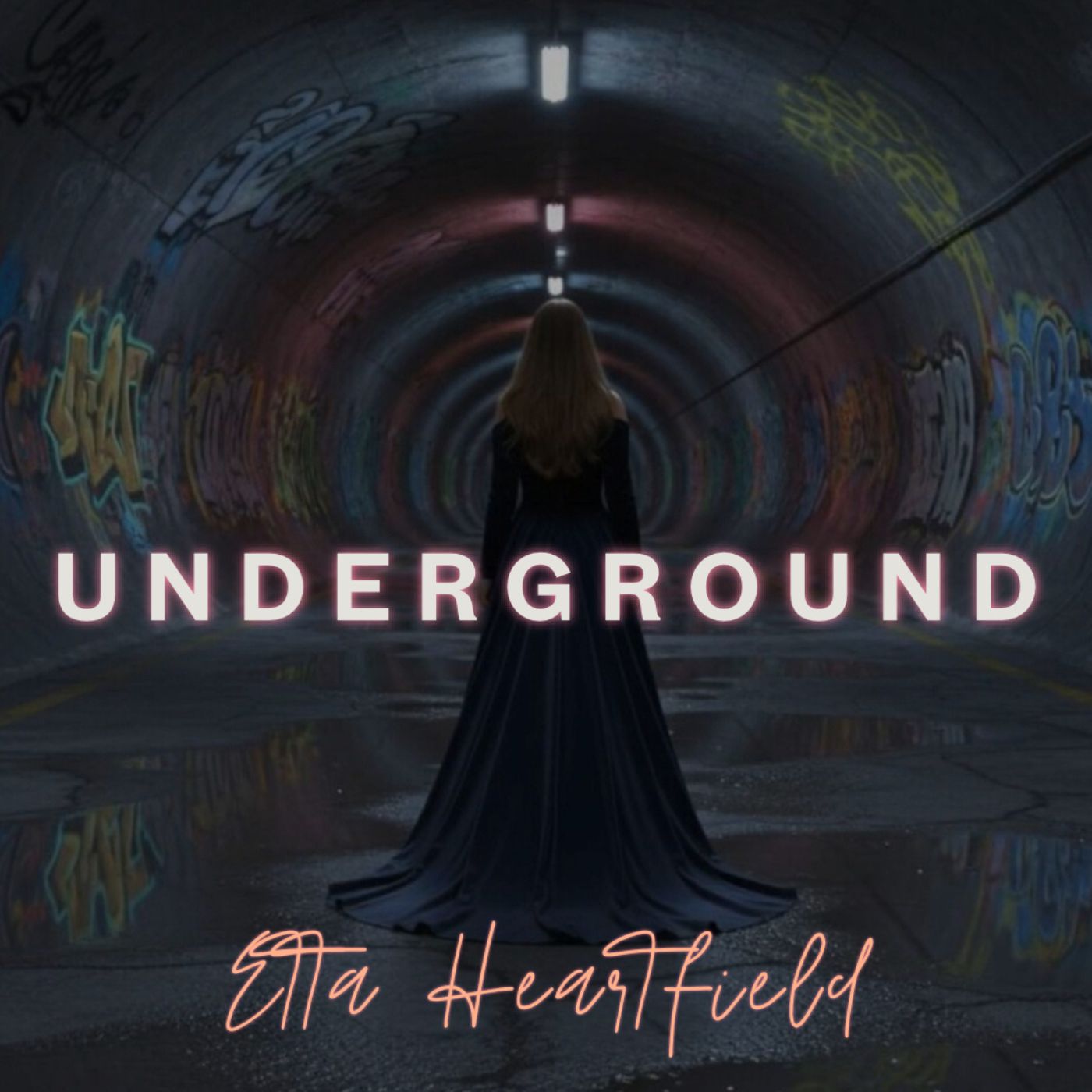
Every so often a single arrives that makes all the noise around it feel suddenly beside the point. Not because it is louder, or more finely produced, or more aggressively marketed — but because it is so nakedly, almost alarmingly, real. Etta Heartfield's "Underground" is precisely this kind of record. It lands quietly and then refuses to leave, pressing itself into the mind with the patient insistence of something that knows it has earned its place there.
Heartfield comes to this moment with a formation that most contemporary songwriters would do well to envy. Raised in a household where art was not merely appreciated but practised — where the working life of a creative was understood from the inside — she absorbed music the way other children absorb language: organically, structurally, as a native tongue. Classical training in piano, cello, and voice gave her not just technique but architecture. You can hear it in "Underground": the way the arrangement breathes, the way space is used as deliberately as sound, the way her voice moves within the melodic frame with the confidence of someone who has mapped every room.
She does not aestheticise her suffering. She translates it — which is a far more demanding and far more honest thing to do.
The song concerns, at its core, the long aftermath of domestic violence — years of it — and the grinding isolation that follows survival. These are not easy subjects to hold, and they are even harder to render in music without tipping into either melodrama or understatement. Heartfield navigates this with a maturity that belies her position as a debut artist. She does not aestheticise her suffering. She translates it — which is a far more demanding and far more honest thing to do. The weight the song carries feels specific and earned, not borrowed from some generalised lexicon of pain. When she sings of suffocation and shame, you believe, quite utterly, that she has been there.
The title itself does significant work. "Underground" implies not just burial but concealment — the life lived beneath the visible surface, hidden from those who might help, from those who might judge, from oneself. The shame of trauma, Heartfield seems to understand, is often its most vicious component: the way it turns the interior against itself, convincing the sufferer that invisibility is the only safe condition. The song does not argue against this — it does not offer easy counsel or a redemptive arc resolved before the final chorus. Instead it holds the experience still, examines it, and by doing so returns to the listener something that shame had taken: the sense that their experience is legible, is real, and does not disqualify them from the world.
Technically, the track is immaculate. Heartfield's voice is, frankly, a rare instrument — capable of intimacy and controlled power within the same phrase, able to carry vulnerability without performing weakness. The arrangements, evocative without being fussy, serve the song rather than decorating it; a distinction that many producers and many artists fail to maintain. The sonic palette feels considered, each element placed with intention, nothing cluttering the emotional centre. The result is a piece of music that sounds personal even through speakers, even at a remove — and that is a very particular and very difficult achievement.
It would be tempting to reach for comparisons — to invoke the spare confessionalism of certain folk traditions, the chamber-pop delicacy of this or that beloved record — but to do so would be to miss the point of what Heartfield is building. Her work does not announce itself as derivative of any lineage; it arrives, instead, with the self-possession of an artist who has done the internal work and knows, now, what she has to say. "Underground" is not indebted to influences. It is fluent in them, which is an entirely different relationship.
Heartfield has said that her primary ambition with the track is connection — that she hopes it finds the listeners who need it most. This is a modest and quietly radical aspiration in a moment when so much new music is calibrated for streams, for algorithms, for the brief seizure of an attention span trained to move on. To make something that is not optimised for consumption but offered as companionship is an act of genuine artistic conviction. On the evidence of "Underground," that conviction is not posture. It is the whole point.
This is music that does not feel like a beginning. It feels like an arrival. Keep your eye on Etta Heartfield. She has already found her territory, and it is hers alone.