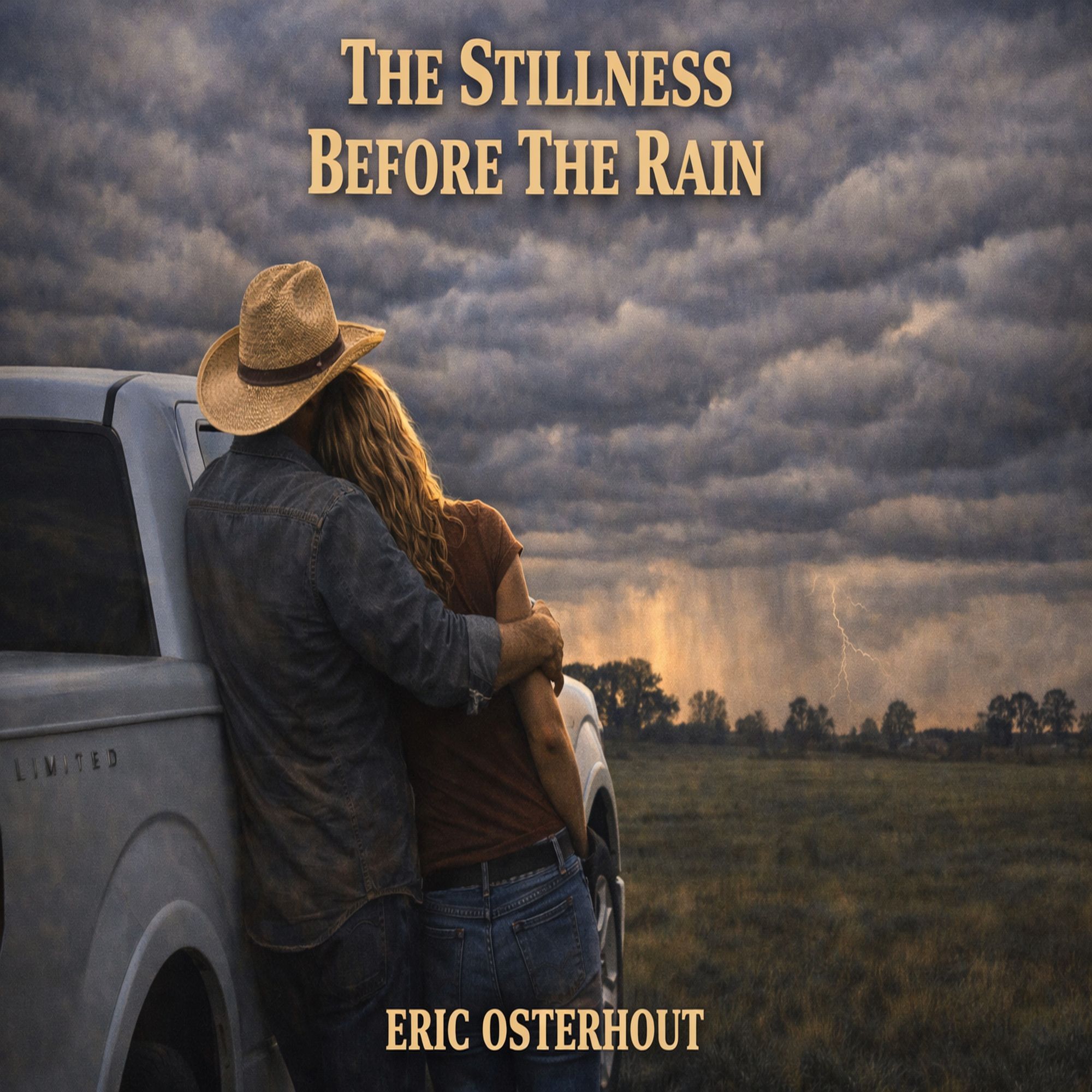
Osterhout arrives not from Nashville's hitmaking machine, nor from the beard-and-banjo Brooklyn contingent that colonised roots music for a decade, but from somewhere altogether more austere: the wide open land of Texas itself, where the sky is wide enough to make a man philosophical simply by looking up. That geographical rootedness matters enormously here. This is not a song assembled from genre signifiers and stylistic tics. It is, plainly, music that knows where it comes from.
The arrangement is deliberately, almost defiantly spare. Warm acoustic guitar forms the spine of the track — not the pristine, studio-buffed acoustic of commercial country, but something that breathes and resonates as though the instrument was recorded in a room that has actual weather in it. Osterhout resists every temptation to stack the track with strings, lap steel ornamentation, or the kind of cosmetic production that often obscures rather than illuminates. The result is a recording that feels genuinely handmade, each note placed with the quiet confidence of someone who has learned to trust the space between sounds.
Lyrically, the song occupies a place that the best Americana has always staked out: the liminal, the in-between. Not the storm itself, but the moment before it. Not the grief or the joy, but the suspended instant when you sense that one or the other is incoming and there is nothing to be done but stand still and receive it. This is emotionally sophisticated territory — far easier to sentimentalise than to render with any precision — and Osterhout handles it with admirable restraint. His storytelling never lurches into melodrama, never reaches for the cheap resolution. He trusts the listener to sit in the discomfort of uncertainty, which is a more radical act than it might first appear.
British audiences who came to Americana through Ryan Adams's early records, or who found their way to Guy Clark and Townes Van Zandt through patient evangelism from the back pages of *Mojo*, will find Osterhout speaking a language they already know. He is emphatically not derivative of those forebears, but he is clearly fluent in the tradition they represent — the one that prizes truthfulness over cleverness, and emotional precision over emotional display.
The fact that Osterhout's previous independent releases have attracted chart attention across European country radio is perhaps less surprising than it might seem. European audiences for Americana have long shown a greater appetite for the quiet, the considered, and the unadorned than their American radio counterparts. A song this stripped back and this sincere would struggle to find traction on mainstream Nashville playlists, where the volume is always rising and the silence is always being filled. On the continent, where the tradition of the song-as-portrait has deeper cultural roots, it finds more natural company.
What Osterhout is doing, at its core, is something musicians have been attempting since long before country music acquired that name: bearing witness to ordinary life with sufficient attention that the ordinary becomes, momentarily, extraordinary. *Stillness Before the Rain* is quiet music made by someone who has learned to listen carefully. The storms, one suspects, will come for all of us. The songs we carry into them are worth choosing with care.