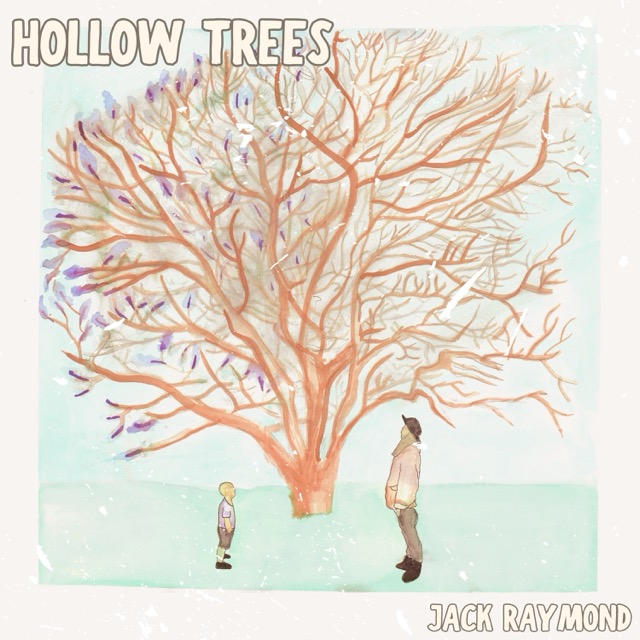
The track opens with a fingerpicked guitar line that feels immediately familiar without being derivative – a delicate balance that Raymond maintains throughout. His voice, weathered at the edges but clear at its core, carries the narrative with the assurance of someone who has lived with these words long enough to know exactly how they should be delivered. There's no performative anguish here, no reaching for effect. Instead, Raymond offers the listener a story told with the calm understanding that comes from years of reflection.
The central metaphor – hollow trees as stand-ins for family, for imperfection, for the structures that support us even as they crumble – could easily have collapsed under its own weight. Lesser songwriters might have belabored the point, underscoring every symbolic connection until the song buckled. Raymond does the opposite. He trusts his listeners, allowing the images to speak for themselves while the music builds around them. When the chorus arrives, it does so with an openness that feels earned rather than imposed, a melodic release that acknowledges complexity rather than resolving it.
This restraint extends to the arrangement, which augments Raymond's acoustic foundation without overwhelming it. The production favors warmth over precision, creating a sonic environment that feels lived-in – the musical equivalent of a well-worn family home. Subtle harmonic layers drift in and out, supporting the vocal line without demanding attention. It's a sound that recalls the best of Australian roots music, that lineage running from Paul Kelly through to contemporary voices like Courtney Barnett, but Raymond has filtered these influences through his own sensibility.
What makes "Hollow Trees" compelling isn't just the quality of the songwriting, though that quality is considerable. It's Raymond's refusal to treat his subject matter with either sentimentality or cynicism. He acknowledges the fractures – in his family, in those symbolic trees, in the neat narratives we tell ourselves about growth and stability – without dwelling in them. The song's emotional terrain is that difficult middle ground between nostalgia and bitterness, where acceptance lives.
The lyrical construction rewards repeated listening. Raymond layers his observations, allowing meanings to accumulate rather than announce themselves. The image of trees growing "hollow inside" resonates on multiple levels, suggesting not just structural weakness but also the hidden spaces within families, the private struggles that exist behind outward appearances. That these trees were planted at his birth, that they grew alongside him, that they fell when his parents' marriage dissolved – these aren't mere coincidences exploited for poetic effect. They're the raw materials of lived experience, shaped into art through careful attention and craft.
Raymond's biography – raised in the High Country, now based on Queensland's Sunshine Coast – suggests an artist attuned to place and movement, to the ways landscape shapes identity. "Hollow Trees" bears this out, grounding its emotional narrative in specific geographical and botanical detail. The result is a song that feels simultaneously intimate and expansive, personal without being solipsistic.
As an introduction to *Mr. Know It All*, "Hollow Trees" suggests an album worth anticipating. Raymond has that rarest of qualities in contemporary folk music: the ability to be earnest without being mawkish, to examine difficult subjects without resorting to easy resolutions. This is songwriting for adults, by which I mean songwriting that acknowledges complexity, contradiction, and the messy reality of how we actually live. That it arrives in such a melodically appealing package, with a chorus that indeed works beautifully in a live setting, is simply good fortune for those of us listening.
"Hollow Trees" stands as evidence that Australian folk music remains a vital, evolving tradition, and that Jack Raymond is a voice within that tradition worth hearing.