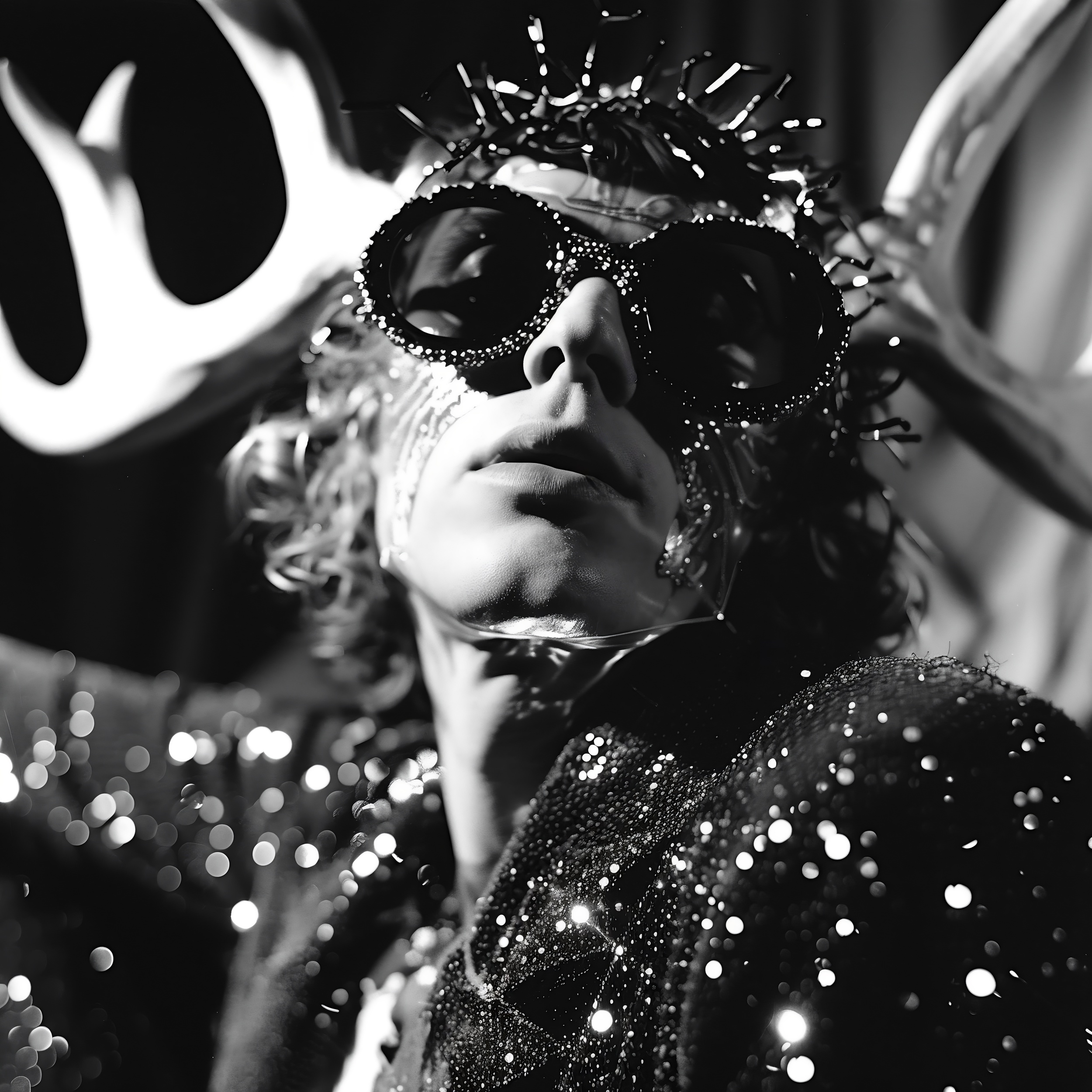
Beckmann, assuming his familiar role as the project's auteur, has assembled a peculiarly effective ensemble for this journey. Newcomers Tanner McGraw and Lawson Mars – charmingly dubbed "the kids down the street" – provide vocals that function less as conventional singing and more as spectral presences, voices that materialize and dematerialize like phosphorescent ghosts. McGraw's lead vocal work possesses a quality of dislocation, as though transmitted across vast psychic distances, while Mars's backing harmonies shimmer and dissolve with the logic of hallucination.
The album's sonic architecture draws from impeccable sources without ever succumbing to mere pastiche. The spectral fragility of Wyatt's solo recordings permeates these songs, that characteristic hushed intimacy where emotion achieves clarity precisely through its suspension in drifting atmospheres. The playful-yet-haunted sensibility of Barrett-era Floyd manifests not through imitation but absorption, filtered through Beckmann's own noir-poetic sensibility. When the influence of Cocteau Twins, Beach House, and Mazzy Star enters the frame, it feels inevitable rather than calculated – these are the natural constellations this music orbits.
What distinguishes *Hide Inside the Moon* from much contemporary dream-pop is its refusal of easy crescendos and conventional dynamics. These songs breathe rather than build, hovering in liminal spaces where synths ripple like heat distortion, guitars fragment into prismatic afterimages, and time itself becomes unstable. Tracks like "Hide Inside the Moon," "My Future Past," and "Eyes in the Sky" operate according to dream logic, where chronology folds back upon itself and memory becomes indistinguishable from prophecy. The album doesn't merely describe this temporal vertigo – it enacts it, creating what the press materials aptly term "a soft, immersive hallucination."
The cinematic dimension proves crucial. Beckmann understands Lynch and Badalamenti's torch-song surrealism – that peculiar alchemy where beauty and unease occupy the same space, where velvet conceals violence and intimacy courts danger. Songs like "Mad Girl's Love Song," "Blue Velvet," and "Devil Doll" conjure rain-slicked noir tableaux: late-night diners where coffee goes cold, stages draped in red where reality quietly unravels. Yet even at its most uncanny, the music retains its humanity. This psychedelia grounds itself in genuine emotion rather than empty spectacle.
The inclusion of a piece inspired by Cy Twombly proves revealing. The American painter's windswept scrawls and mythic fragments – his capacity to hold silence and eruption, restraint and abandon in precarious balance – mirror Beckmann's own aesthetic. Both artists traffic in beautiful mess, in the smeared borders where clarity and obscurity merge.
Beckmann continues to explore his signature preoccupations: longing, doubled realities, the past as invention and the future as recovered memory. *Hide Inside the Moon* represents The Mortal Prophets at their most devotionally intense, crafting a record that asks listeners not simply to hear but to inhabit – to drift beyond gravity, slip outside ordinary time, and hide for a while in that radiant half-light where dreams and waking life become indistinguishable.
This is dream-pop as genuine psychic cartography, mapping the velvet borderlands of consciousness with uncommon grace.