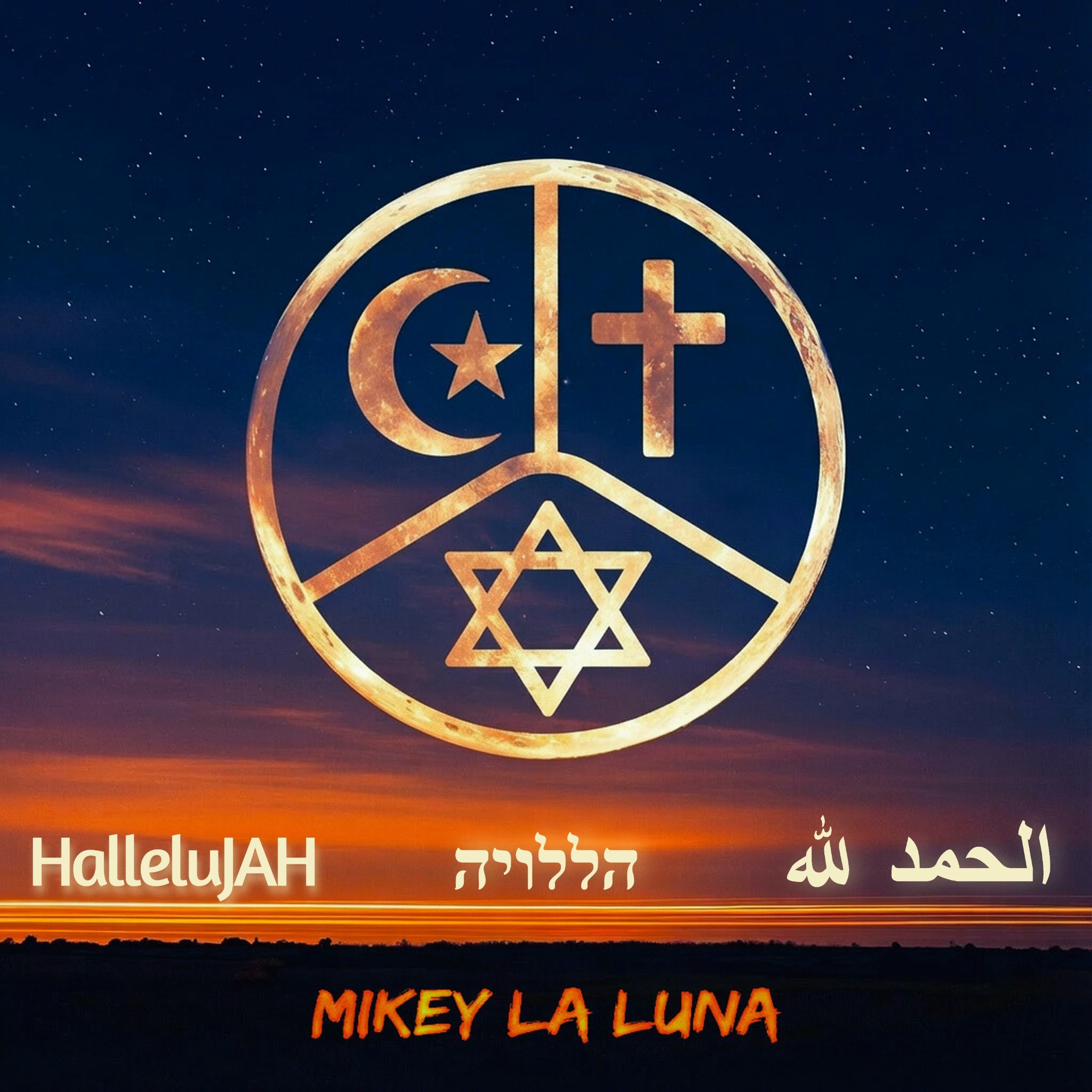
Following his debut EP *Embrace the Light*, which turned its gaze inward, this single pivots outward, seeking connection across the very divides that dominate our contemporary discourse. It's a bold move, particularly for an electronic producer willing to stake his creative vision on the possibility that repetition, intention, and a single word might carry enough weight to bridge chasms of faith and culture.
The production itself is layered with a craftsman's care. Deep electric guitar threads through the arrangement like incense smoke, while church-like melodic passages establish an atmosphere that feels genuinely devotional rather than merely appropriative. La Luna's own voice provides the darker, more intimate vocal passages, chanting in Hebrew and Arabic with a rawness that suggests genuine investment rather than performative multiculturalism. The contrast with guest vocalist Daniela Dvash's angelic tones creates a dialogue – earthbound and ethereal, shadow and light – that mirrors the track's broader thematic concerns.
The producer cites Pink Floyd and Faithless as primary influences, and the synthesis is surprisingly coherent. From the former, he's absorbed that sense of psychedelic expansiveness, the willingness to let a track breathe and evolve across its runtime. From the latter comes the emotional weight, that peculiarly late-Nineties understanding that dance music could carry genuine pathos without sacrificing its essential function: to make bodies move.
What distinguishes La Luna's approach is his deployment of sacred texts not as quotation but as raw material, as sonic building blocks stripped of doctrinal specificity. The vocal lines draw from both Bible and Quran, but they function here as rhythm and memory rather than instruction. It's a risky strategy that could easily veer into the exploitative or the merely aesthetic, but the producer's evident sincerity – his insistence that "Jah, Yahweh, and Allah are the same One, just called by different names" – provides an ethical anchor.
The darkness of the track's sonic palette shouldn't be overlooked. This isn't festival-ready hands-in-the-air euphoria; it's something more brooding, more interior. The beats carry weight, the bassline throbs with a kind of insistent melancholy, and the overall effect is less transcendent release than meditative focus. La Luna has crafted a track that demands attention even as it invites surrender to its hypnotic pull.
Whether "Hallelujah" achieveds its stated ambition – to connect rather than divide, to reclaim a word weaponized by sectarian thinking – will depend partly on who's listening and under what circumstances. The accompanying music video (which one assumes extends these themes visually) becomes crucial to how this message lands. But as a piece of electronic music willing to grapple with the spiritual without lapsing into New Age vagueness, it represents a genuine contribution to a tradition that includes everyone from Jlin to Jon Hopkins to The Orb.
La Luna positions himself explicitly against separation, against the proliferation of boundaries and the hardening of categories. His mantra-electronic approach – melodic techno built on repetition and intention – offers a methodology as much as a sound. The track works because it practices what it preaches: it fuses without flattening, synthesizes without sanitizing, and asks its listeners to find common ground on the dancefloor.
Whether that's naive or necessary feels beside the point. "Hallelujah" makes its case through sound, and on those terms, it's persuasive.