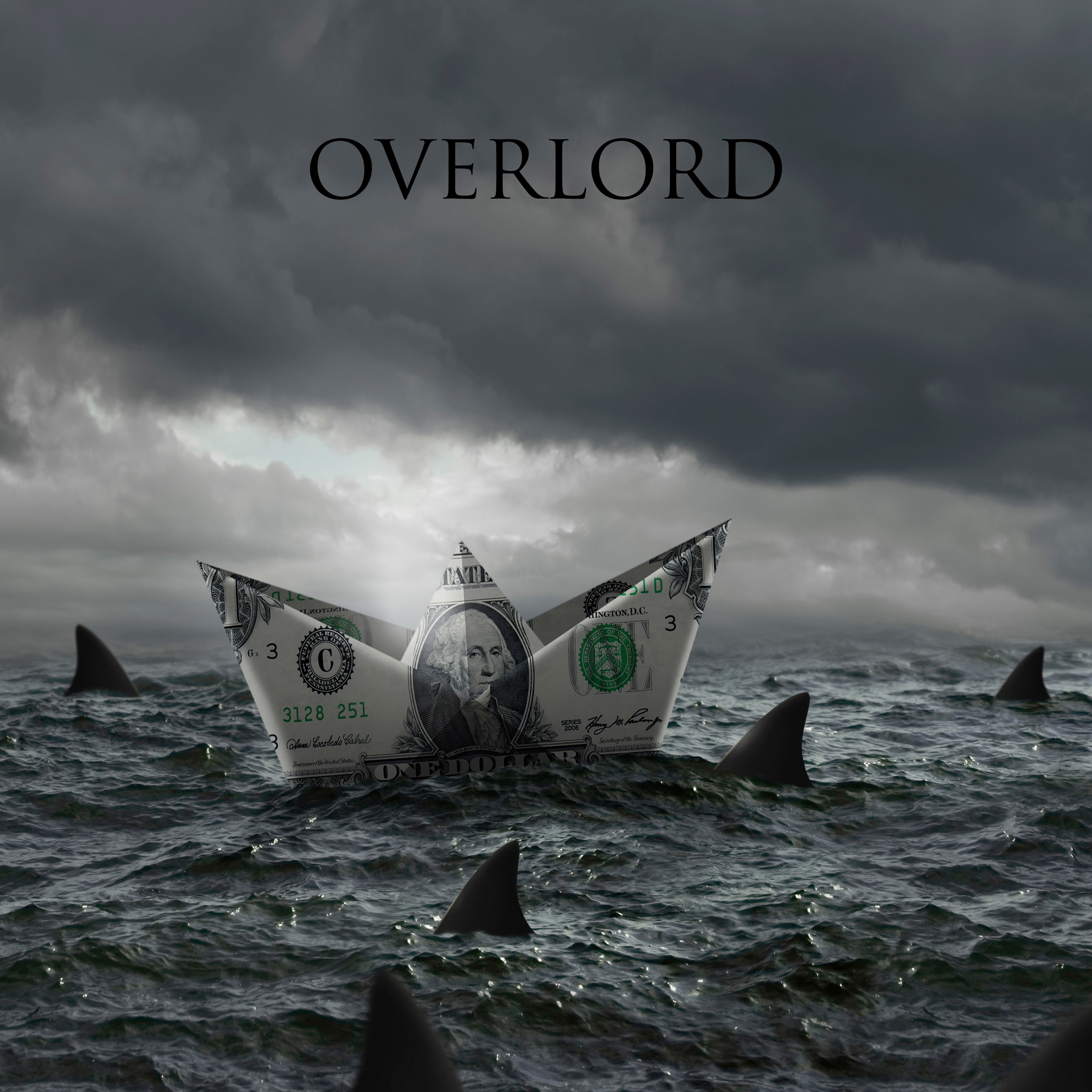
'Overlord' tackles the timeless trinity of money, power, and greed with a lyrical sophistication that feels painfully relevant to our current moment. Yet rather than descending into didacticism, the song allows its themes to unfold through atmosphere and implication. The corrupting influence of power isn't merely stated; it's embodied in the very architecture of the track, which builds from skeletal verses into something far more oppressive and consuming.
Danny's instrumental work provides the perfect canvas for this exploration. The production—notably crafted without AI, a detail worth celebrating as authenticity becomes increasingly precious—achieves a remarkable balance between space and density. Guitar lines shimmer and decay with the textural richness one associates with Robert Smith's best work, while the rhythm section maintains a propulsive urgency that recalls the mechanical pulse of Joy Division. These aren't lazy comparisons; the DNA is genuinely present, filtered through a contemporary sensibility that refuses mere pastiche.
Inês's vocal performance stands as the track's revelation. Her voice carries the ethereal quality of Florence Welch's more restrained moments whilst possessing the wounded intimacy of Lana Del Rey at her most vulnerable. There's something of Chelsea Wolfe's darker textures here too, particularly in the lower register, and the dreamy melancholia that characterizes Weyes Blood's finest work. Yet the comparison that rings truest might be to Warpaint—that ability to sound simultaneously distant and uncomfortably close, floating above the instrumentation whilst remaining anchored to its emotional core.
The Lana Del Rey meets The Cure description proves apt, though perhaps undersells the duo's achievement. Where Del Rey often luxuriates in nostalgia and Smith in romantic despair, Forgotten Garden channel both impulses toward something more pointed. The sadness here isn't decorative; it's diagnostic, examining the systems and structures that breed the corruption the song addresses.
The transatlantic—or rather, trans-European—nature of the collaboration adds an intriguing dimension. Inês in Portugal, Danny in northern Scotland, creating music that bridges geographical and cultural distances through shared artistic vision. One wonders whether the physical separation contributes to the music's haunting quality, whether the longing and isolation inherent in long-distance collaboration seeps into the sonic fabric. Certainly, 'Overlord' possesses the kind of beautiful desolation that comes from artists working in their own solitary spaces, united by technology and mutual understanding.
The duo's growing following—24,000 on Facebook, 4,600 on Spotify, 3,200 on Instagram—suggests an audience hungry for exactly this kind of emotionally intelligent, musically literate work. These aren't viral numbers, but they represent something perhaps more valuable: a dedicated listenership willing to sit with sadness, to engage with music that demands rather than merely entertains.
The accompanying video reinforces the song's thematic concerns through stark, expressionistic imagery. Black-and-white cinematography evokes classic post-punk aesthetics whilst maintaining modern visual language. We watch constraint and control play out through movement and shadow, the visual metaphors working in elegant tandem with the lyrical content.
'Overlord' demonstrates that the post-punk tradition remains vital when handled by artists who understand that influence and inspiration aren't about replication but transformation. Here is music made by humans, for humans, about the very human capacity for corruption and the equally human need to examine it unflinchingly.