The South West England-based artist frames the track as a response to "attacks on innocent members of society" and the "stories of courage in the face of adversity and danger" that followed. It's a noble impulse, this desire to bear witness and commemorate resilience. Yet the history of popular music tackling terrorism is littered with missteps—songs that either trivialize horror through inadequate treatment or collapse under the weight of their own earnestness. The challenge isn't merely to address such events, but to find a musical and lyrical language equal to the complexity of collective trauma.
What's intriguing about The Boy Blue's stated approach is the conceptual framework: "The bliss is what we used to have, the fear is what we now have." This binary construction—before and after, innocence and knowledge—echoes the fundamental psychological rupture that acts of terror create. There's something almost biblical in this framing, a fall from grace narrative that positions contemporary existence as fundamentally post-traumatic. Whether this proves reductive or illuminating will depend entirely on the execution, on whether the song can hold space for the messiness and contradiction that such trauma actually creates.
The artist's musical lineage offers both promise and potential pitfalls. Drawing from Southern rock and country blues, with professed influences from Chris Cornell and Chris Stapleton, suggests a sonic palette built on raw emotional honesty and dynamic intensity. Cornell's legacy—particularly his ability to channel existential dread through soaring vocals and Soundgarden's crushing dynamics—would serve a track about societal fear remarkably well. Stapleton's soul-baring delivery and rootsy authenticity could ground abstract concepts in visceral, human terms. The question is whether The Boy Blue possesses the vocal and compositional chops to synthesize these influences into something genuinely affecting rather than derivative.
The press materials describe a "simplistic yet impactful structure" that "builds," suggesting a gradual accumulation of tension rather than immediate catharsis. This architectural choice feels appropriate for the subject matter—terrorism's impact isn't a single blow but a creeping contamination of everyday life, a slow poison that changes how we move through the world. If the song truly mirrors this psychological trajectory, building from sparse vulnerability to overwhelming intensity, it could achieve something genuinely powerful.
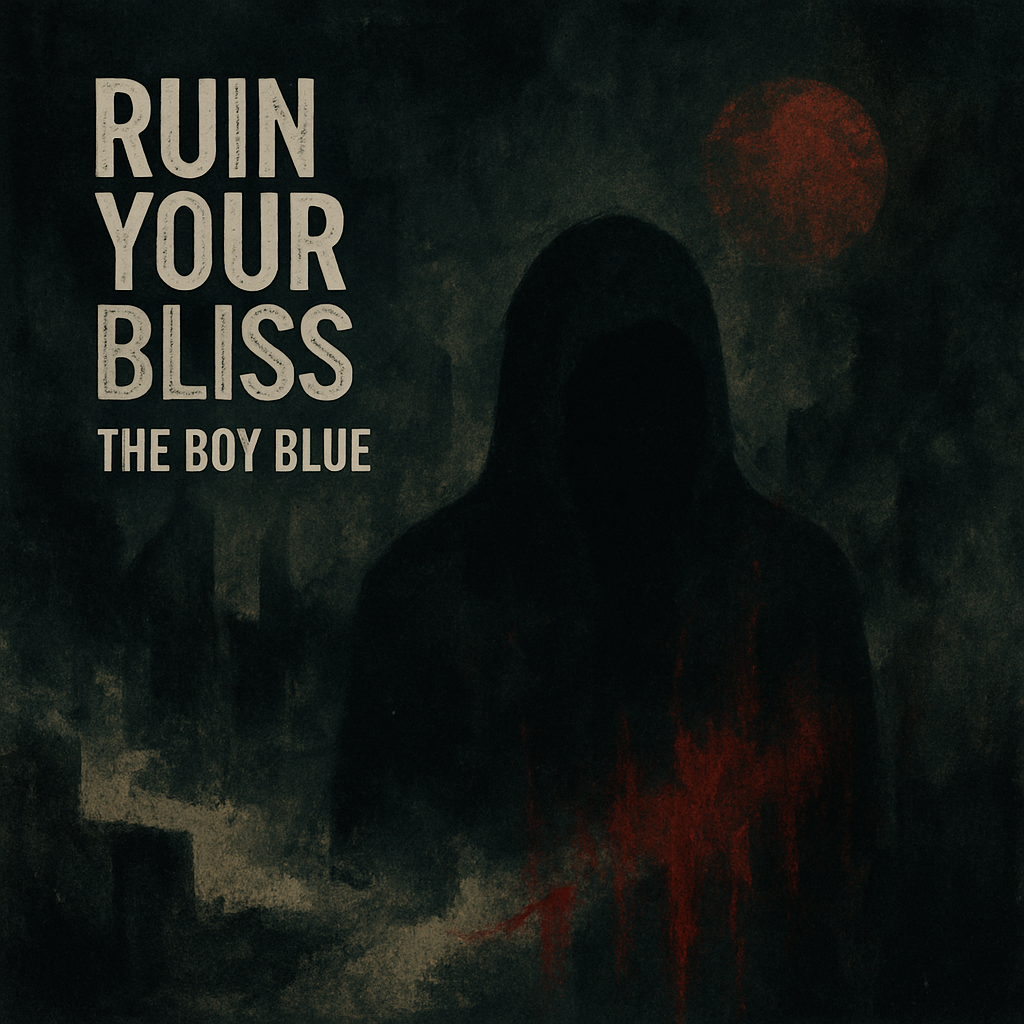
The artwork—shadowy figures against distressed textures, ominous crimson bleeding through darkness—suggests an aesthetic of beautiful decay, of something irrevocably altered. It's evocative without being exploitative, which is a difficult balance to strike when addressing violence and trauma.
"Ruin Your Bliss" arrives at a moment when artists face an impossible challenge: how to address collective trauma without commodifying it, how to bear witness without exploitation, how to inspire resilience without minimizing pain. The Boy Blue's attempt deserves serious attention, if only because the alternative—silence in the face of society's wounds—serves no one. Whether this track will stand alongside the great British tradition of socially conscious songwriting or become another well-intentioned curiosity? One hopes for the former, while preparing for the complexity either outcome will demand we acknowledge.