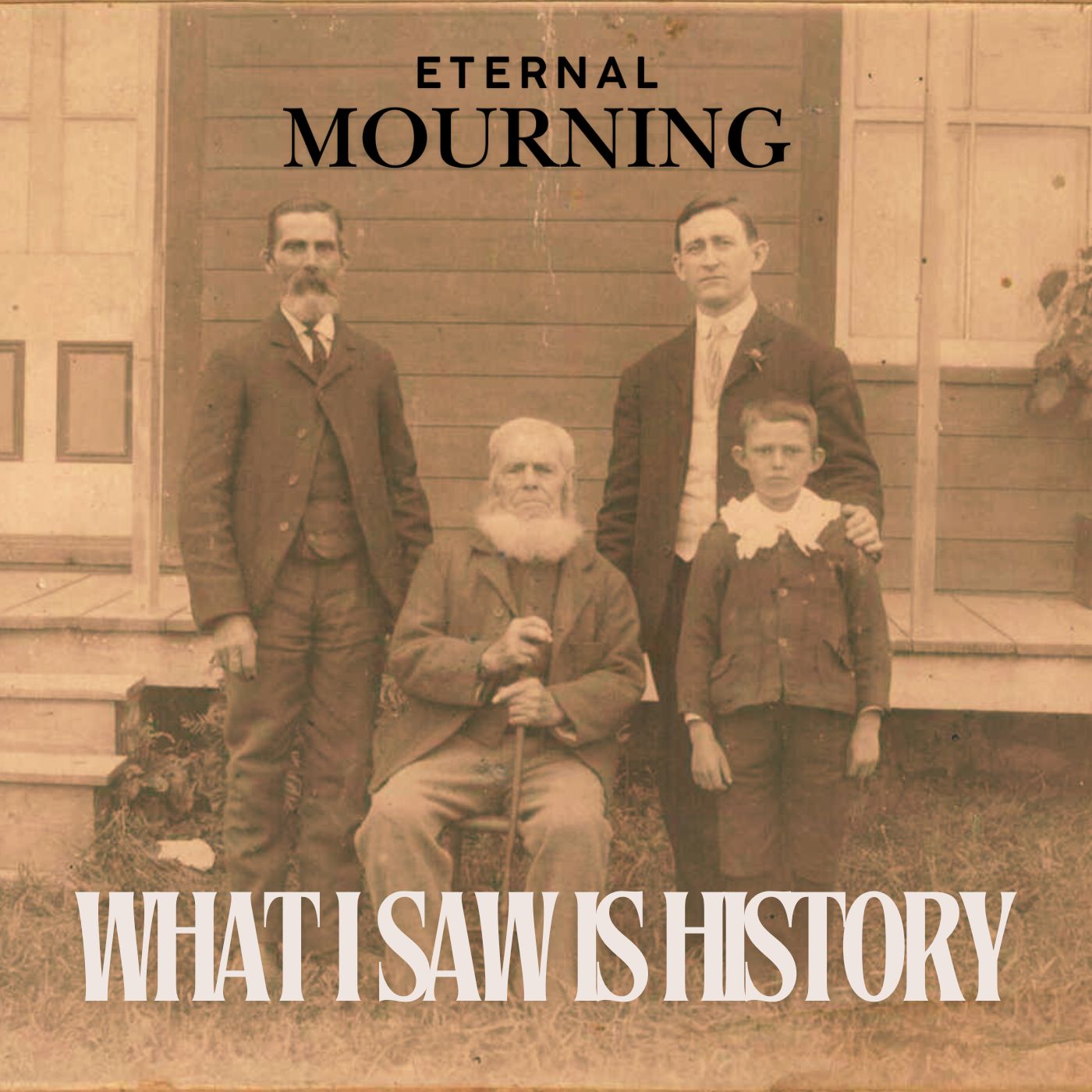
The track opens with a fingerpicked guitar figure that recalls the pastoral melancholy of Nick Drake, though Mourani quickly subverts any expectation of genteel folk revivalism. Pasquale Sacco's guitar work here is exemplary—decades of discipline evident in every note, yet never showy, never excessive. His playing moves with the intuition of someone who understands that space matters as much as sound, that silence can be as eloquent as any chord progression. When the full band enters, David Ganon's drums don't so much announce themselves as materialize, like a gathering storm on a distant horizon.
But it's Mourani's voice that anchors this piece, and indeed, the entire Eternal Mourning project. His vocal delivery carries the weight of someone who has lived inside these words for far too long, turning them over like stones in a pocket, smoothing their edges through repetition and doubt. The lyrics—presumably exploring paternal legacy, inheritance both literal and metaphorical—refuse easy sentiment. Mourani has always been allergic to the tidy ending, the neat emotional bow, and "Father Shoes" continues this tradition. The shoes themselves become a powerful central image: too large to fill, impossible to discard, worn smooth by someone else's journey.
Day Day's fretless bass adds a restless, searching quality to the arrangement. His instrument speaks in the spaces between certainty and doubt, sliding between notes with the fluidity of memory itself. Having honed his craft across continents—London, Los Angeles, Vancouver, Toronto—he brings a cosmopolitan sensibility to what might otherwise risk becoming parochial. The industrial and cyberpunk influences he cites seem, at first glance, incongruous with folk music's earthbound concerns, yet his bass lines prove otherwise. They pulse with urban anxiety, with the dislocated feeling of trying to honor the past while living firmly in a fractured present.
The production bears the hallmarks of a band unafraid to layer, to build, to trust that their audience will follow them into denser sonic territory. Echoes of Talk Talk's later work flicker through the arrangement—that same willingness to let songs breathe and expand, to privilege atmosphere over conventional structure. Yet Mourani never loses sight of the song at the center. For all its textural richness, "Father Shoes" remains fundamentally a piece about one person grappling with what it means to walk in another's footsteps, or whether that's even possible.
The bridge section offers the closest thing to catharsis, as Sacco's guitar finally unleashes the pent-up energy that's been simmering beneath the surface. Here, the grunge influence becomes explicit—distorted, messy, urgent. It's a moment of release that feels earned rather than deployed for mere dramatic effect. Ganon's drumming responds in kind, driving forward with an intensity that recalls the best of '90s alternative rock, when bands still believed that quiet-loud dynamics could tell emotional truths that words alone could not.
"Father Shoes" positions Eternal Mourning as a band with ambitions beyond the comfortable confines of contemporary indie folk. Mourani and his collaborators understand that the genre's conventions—the whispered vocals, the acoustic guitars, the tasteful restraint—can become their own kind of prison. They're willing to crack open those conventions, to let in the noise and chaos of lived experience, to acknowledge that grief and love and confusion rarely arrive in tidy packages.
As a calling card for *What I Saw Is History*, the single succeeds brilliantly. It promises an album that will demand attention, that will reward close listening, that will refuse to provide comfort where none exists. Mourani has stepped fully into his role as songwriter and bandleader, and the results suggest an artist just beginning to grasp the full extent of his powers. "Father Shoes" is the sound of someone learning to walk on their own, even if those first steps remain haunted by the footprints of those who came before.