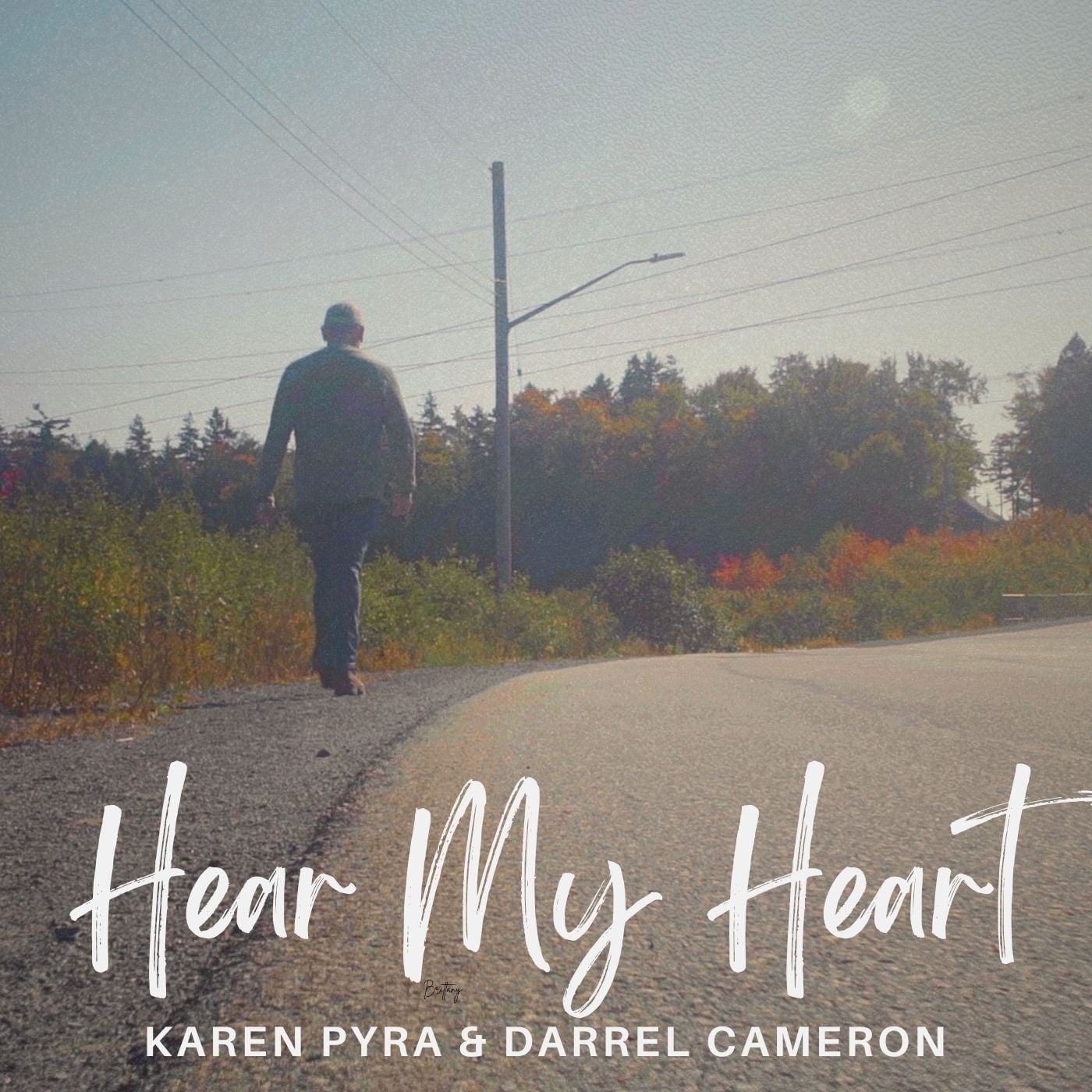
The song's premise—partners separated by work and geography, sustained by phone calls and the promise of reunion—could easily collapse into maudlin territory. Yet Pyra and Cameron navigate these well-worn emotional corridors with uncommon specificity. Foggy driveways and cab windows aren't mere scenic details; they're the architecture of longing itself, the physical spaces where love must prove its durability against distance and routine. This is the sort of observational precision that distinguished the better moments of Emmylou Harris and Gram Parsons' cosmic American experiments, where the mundane became transcendent through attention rather than embellishment.
What separates "Hear My Heart" from the deluge of contemporary country duets is its refusal to mistake volume for feeling. The production, overseen by James in Nashville, understands that space itself can be expressive. Where lesser arrangements might smother the vocal interplay with unnecessary orchestration, here the instrumentation serves the narrative—each element carefully positioned to support rather than compete with the central dialogue between two voices mapping the contours of sustained affection.
The duet format proves essential rather than decorative. Pyra and Cameron's vocal chemistry suggests not the idealized symmetry of studio-constructed partnerships but something more weathered and authentic. Their prior collaboration on "Show Me the Way" for the Aging Disgracefully project clearly established a musical vocabulary they've since refined. Cameron's background as owner of Blue Acres Studio and his production work lends him an instinctive understanding of how to balance intimacy with clarity—a skill that serves the song's emotional architecture admirably.
The lyrical construction deserves particular attention. "Porchside longing" and "nightly phone calls" might read as sentimental in isolation, but within the song's broader framework, they accumulate into something more substantial: a portrait of love as deliberate practice rather than passive feeling. This is the unsexy reality of long-term commitment, the unglamorous work of maintaining connection across time zones and work schedules. That Pyra and Cameron choose to celebrate this quotidian persistence rather than romanticize it speaks to a maturity often absent in contemporary Nashville output.
Pyra's observation about "steady, enduring love" as antidote to a "heavy and divided" world might risk sounding platitudinous, but the song itself earns that statement through its execution. Cameron's complementary sentiment about music helping us "feel seen" when "life pulls us in different directions" articulates the fundamental purpose of country music at its most effective: not escape, but recognition.
The "accidental collaborators" narrative—two writers from different provinces connected through social media prompts—reads as quintessentially modern, yet the music they've produced feels deliberately timeless. This isn't retro cosplay or calculated nostalgia; it's simply good songcraft unencumbered by demographic targeting or algorithmic optimization.
"Hear My Heart" won't revolutionize country music, nor does it aspire to. Instead, it offers something more valuable: a reminder that the genre's essential currency—stories of ordinary people navigating love's complications with grace and determination—remains as vital now as when Loretta Lynn and Ernest Tubb first popularized the country duet format. Pyra and Cameron have crafted a song that trusts its audience to appreciate emotional honesty over manufactured drama, and that trust is rewarded in every bar.