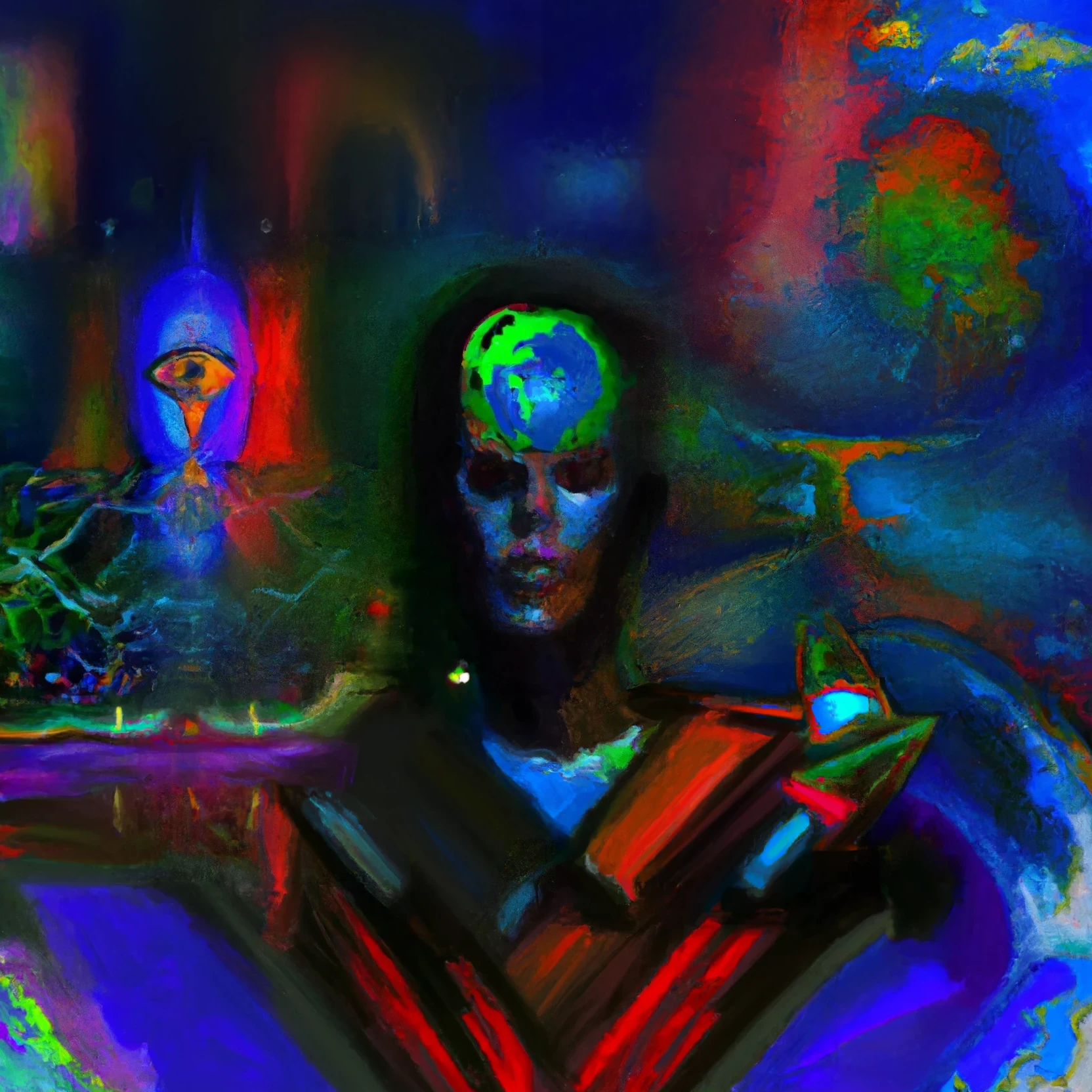
The Chicago-based artist has always positioned himself as a provocateur within rock and pop conventions, and *Together They Were Nothing* finds him at his most confrontational. Album opener "Confession" establishes the record's thematic architecture: relationships dissolving under the weight of their own contradictions, faith systems collapsing, the drowning metaphor recurring like a fever dream. "Why do we fight, when wrong is just as same as right?" Ceyeo asks, his classically-trained voice navigating the wreckage with Katie Burke's harmonies providing spectral counterpoint. The production, handled by Ceyeo with additional work from Max Honsinger, creates space around the vocals—never cluttered, always purposeful.
"Love Is Angry," the album's philosophical centrepiece, invokes Neruda while constructing a radical thesis: that love itself possesses fury, that affection can be weaponized. "Forged like a weapon / love is angry," Ceyeo insists, and the repetition transforms the phrase from observation to incantation. The arrangement builds with controlled intensity, Ryan Streeter's guitar work and Luca Giachi's bass creating a foundation that supports rather than dominates. What could read as undergraduate poetry on paper becomes genuinely unsettling in execution—love as a "bolt of lightning," a "war on your senses," something simultaneously desired and dreaded.
"Bedlam" expands the scope from personal dissolution to societal critique. The opening image—bells ringing in the narrator's head—immediately signals psychological distress, but Ceyeo refuses simple catharsis. References to Kipling and Van Gogh function as cultural touchstones for examining how creativity survives (or doesn't) within violent systems. "We persist but at what psychic cost," he observes, before the track spirals through questions about greed, belonging, and self-examination. The production here feels deliberately claustrophobic, Fede Gucciardo's drums maintaining tension throughout. When Ceyeo asks "Can you tell me how you think this ends?" it scans less as rhetorical flourish than genuine existential plea.
The album's back half shifts registers without losing thematic coherence. "Contact" adopts a more experimental structure, its fragmented observations creating impressionistic rather than narrative progression. "Colossus" confronts grief with devastating directness: "I remember when I learned what all dead know / I remember learning how this earth can let you go so fast." The vulnerability here cuts deeper for its specificity—no vague gestures toward loss, but rather the precise articulation of someone processing bereavement in real time.
Closing track "This is How You Win" functions as bitter coda, cataloguing systems of oppression through sharp, imagistic language. "Space suit with a funeral veil / A private jet gets you closer to god"—these juxtapositions indict wealth, privilege, and the mechanisms that perpetuate inequality. The repeated refrain transforms from observation to accusation, Ceyeo's delivery growing more pointed with each iteration.
What distinguishes this album from mere misery tourism is Ceyeo's evident craft. The instrumental performances—particularly Maga Clavijo's violin on "I Can Tell" and Adam Ward's additional guitar textures—serve the songs rather than showcasing virtuosity. The mixing balances clarity with atmosphere, allowing the lyrics to remain intelligible while maintaining sonic interest.
*Together They Were Nothing* won't provide comfort, nor does it aspire to. Instead, it documents what happens when the consolations of optimism prove insufficient. Whether this represents artistic maturation or simply another phase remains to be seen—Ceyeo has promised *Walls of Love* for early 2026. For now, this stands as a bracingly honest document of contemporary unease, executed with intelligence and no small amount of courage.