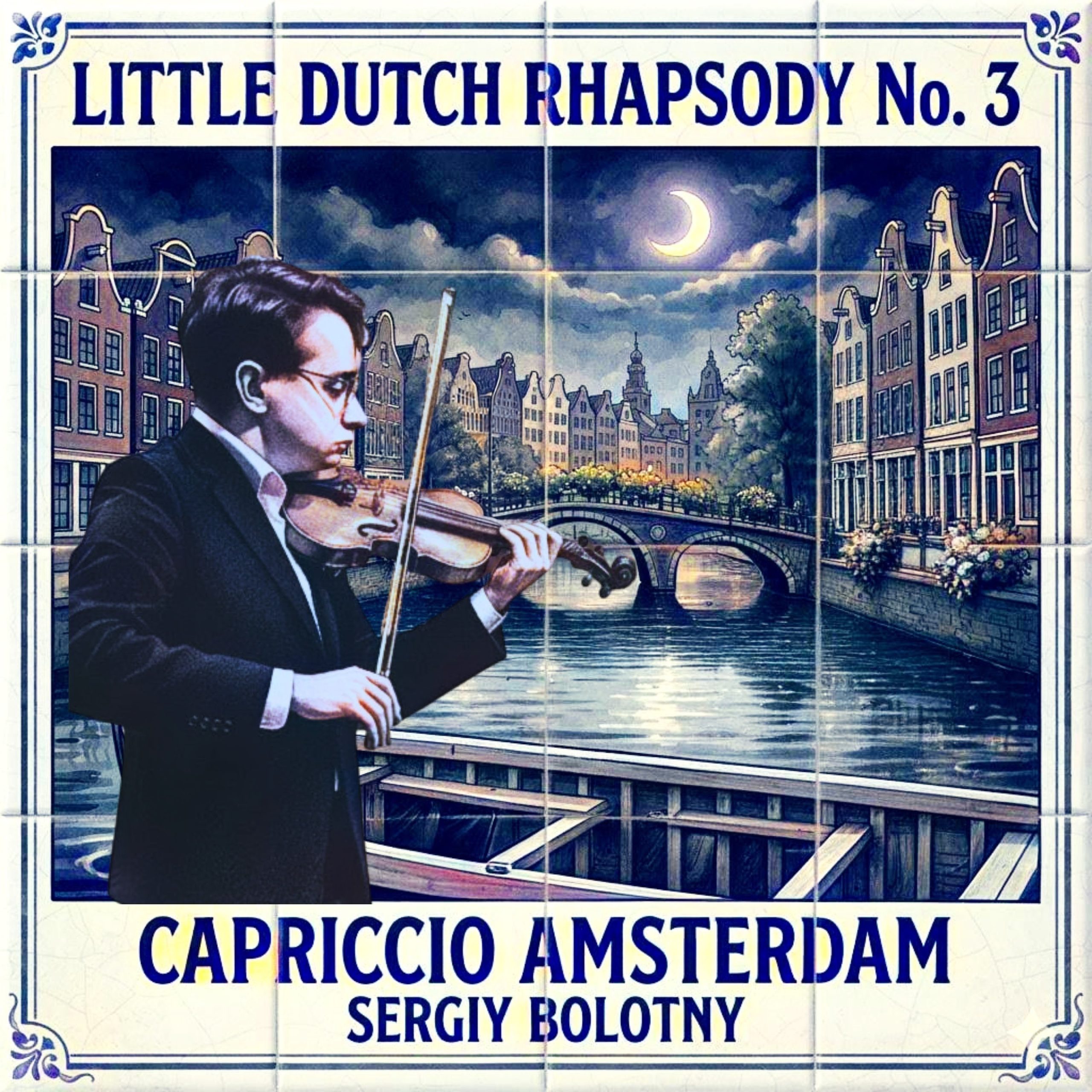
The Vienna in question is that of Fritz Kreisler, whose miniatures were a masterclass in how to flatter a violin without condescending to the listener. Bolotny does not imitate Kreisler so much as borrow his manners: the languid portamento, the rubato that leans on a note a moment longer than good sense advises, and the confiding tone of a performer who assumes you are as susceptible to a beautiful tune as he is. The Goemans theme arrives in this company like a provincial cousin invited to a Hofburg ball, and it holds its own with great charm.
The writing deserves credit before the playing does. Capriccio Amsterdam is no mere transcription. Bolotny treats the tune as a subject for conversation rather than recitation, turning it over and testing it in different lights. Cantabile phrases, shaped with a singer's breath, give way to passages of double-stopped counterpoint in which the violin plays both the tune and its argumentative companion. Then come the variations, which are playful rather than punishing. Virtuosity here is a form of wit, closer to a raised eyebrow than a clenched fist. The fireworks are real, but they never drown out the melody they decorate.
This is the third instalment of the Little Dutch Rhapsodies, and the series now has a recognisable character. The first brought the rustic comedy of a Groningen folk tale to the concert platform, and its successor trades the countryside for the canal-side promenade. Where that earlier piece grinned, this one sighs, and the sigh is neither syrupy nor self-indulgent. Nostalgia is a dangerous commodity in music, easily tipped into sentimentality, yet Bolotny keeps it on the right side of the line with good taste and a firm rhythmic sense. The urban heartbeat promised in the title is audible beneath the lyricism, a quiet pulse that stops the romance from floating away.
The recording itself is a pleasure. In a market where so much solo playing is polished until it resembles a showroom floor, Bolotny and his engineers have allowed the room to speak. Bow friction, air and the slow bloom of overtones are left in place, and one hears a violin as it sounds across a good hall's width rather than an inch from a microphone's nose. The absence of heavy compression is a risk, since an unvarnished sound exposes every flaw of intonation and tone. Bolotny's playing meets the risk without strain. The tone is warm, the double-stops are in tune, and the bow arm has a poised, unhurried authority that suggests a player entirely at home in his own sound.
It is fitting that the single was broadcast on NPO Klassiek beside Ravel and Nino Rota. The company suits it: Ravel for the sheer dazzle of violin writing, Rota for the gift of making a simple tune feel like a whole world. Bolotny belongs in that conversation, at least on the evidence of this single, as a composer-performer who understands that charm is a serious discipline.
Capriccio Amsterdam lasts only a few minutes, and the miniature is the right form for what it has to say. It leaves the listener smiling, slightly wistful, and eager for a fourth rhapsody. Bolotny has made a love letter to a city, written in the elegant hand of a vanished Viennese master, and posted with a Ukrainian violinist's passion.