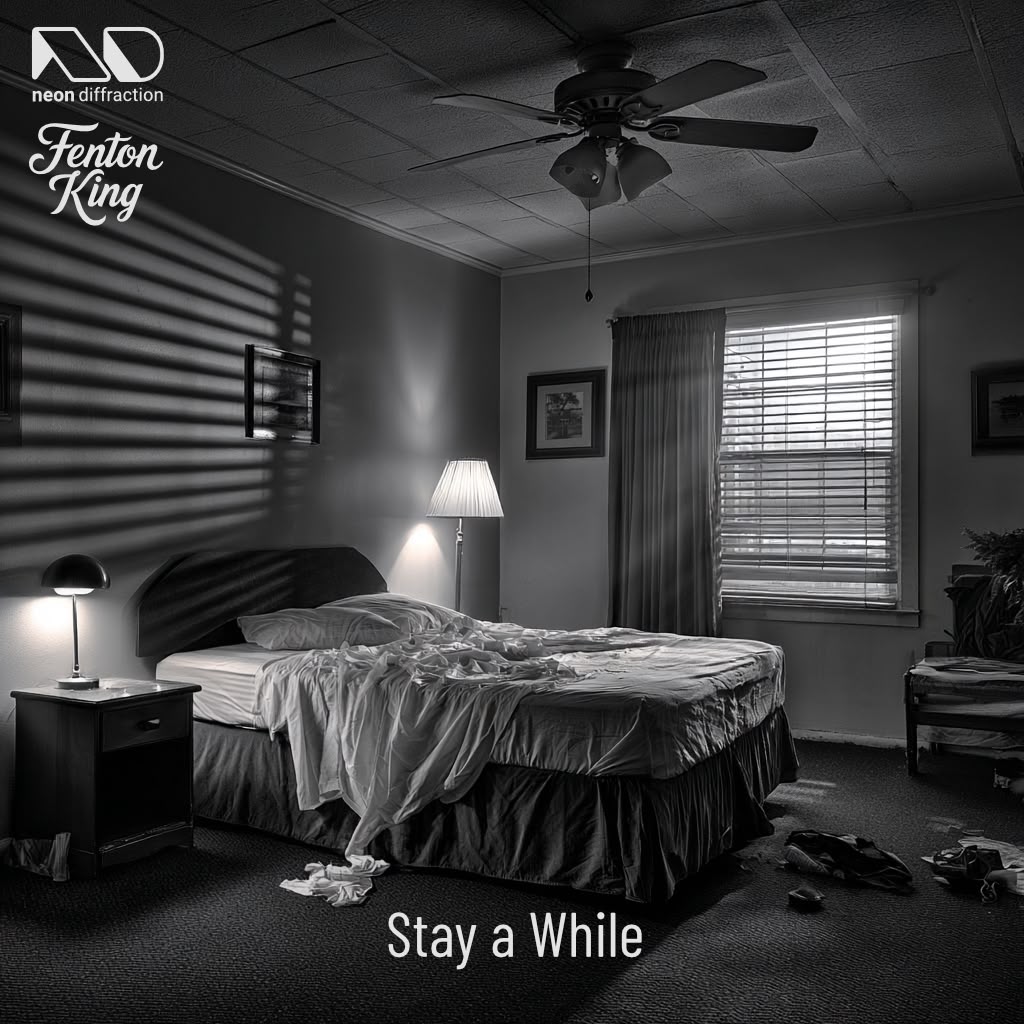
The producer behind Neon Diffraction, Rupert Goddard, has made a record that treats the song as the sacred object and the machinery as its servant. That sounds like a modest ambition until you recall how many liquid drum & bass singles hire a voice as an ornament: a breathy topline bolted to a rolling groove, pretty and disposable, a hologram of feeling. Goddard does something harder. He builds the room around the singer and lets the singer fill it.
The singer is Fenton King, formerly of Sick as Thieves, and he arrives with a voice that has plainly spent time in older, smokier rooms. His blues phrasing bends notes the way a tired man bends toward a bar at closing time, with tenderness and a little bruising. He never oversells it. Where lesser vocalists reach for the big gesture, King leans into the hesitation, the half-breath before a line lands, and the effect is of someone confiding rather than performing. Soul music has always understood that restraint can be louder than volume. King understands it too.
Around him, the production is a study in tasteful gravity. The breaks roll rather than rattle, keeping the physical pulse that makes drum & bass what it is while refusing the aggression that often comes with it. The bass sits deep and warm, more a change in the weather than a weapon. Above it, the textures open out into something cinematic: wide, dim, lit from below like a city seen from a night bus window. It is music for the hour when the clubs are emptying and the streets belong to people who cannot quite go home yet.
What makes the whole thing cohere is the tension between those two worlds. The blues is slow, human and rooted in the body's oldest griefs. The drum & bass is fast, digital and forever on the move. Rather than smoothing the contradiction away, Goddard lets them rub against each other, and the friction gives the record its charge. The vocal seems to drift above a tempo it has no intention of chasing, and that hovering, unhurried quality is the song's quiet genius. You are being carried at speed while someone sings to you as though time had stopped.
The single also includes a downtempo mix, which strips the rhythm back and offers what amounts to a second reading of the same material. It is a smart inclusion, and a revealing one. Hearing the song at rest confirms what the Original Mix implies: the writing is strong enough to survive any costume. Many dance records collapse the moment the beat is removed. This one simply exhales.
It also marks the opening of a four-part run of collaborations between Neon Diffraction and King, and on this evidence the series is worth following closely. Debut instalments are often cautious, a handshake rather than an embrace. "Stay a While" is already an embrace, confident in its melancholy and generous with its warmth.
Independent releases are sometimes assumed to be rough drafts of bigger ambitions. This sounds like the ambition itself, fully formed and entirely unbothered by anyone's permission. Play it late, play it loud enough to feel the low end in your chest, and accept the invitation in the title. It is an easy one to take up.