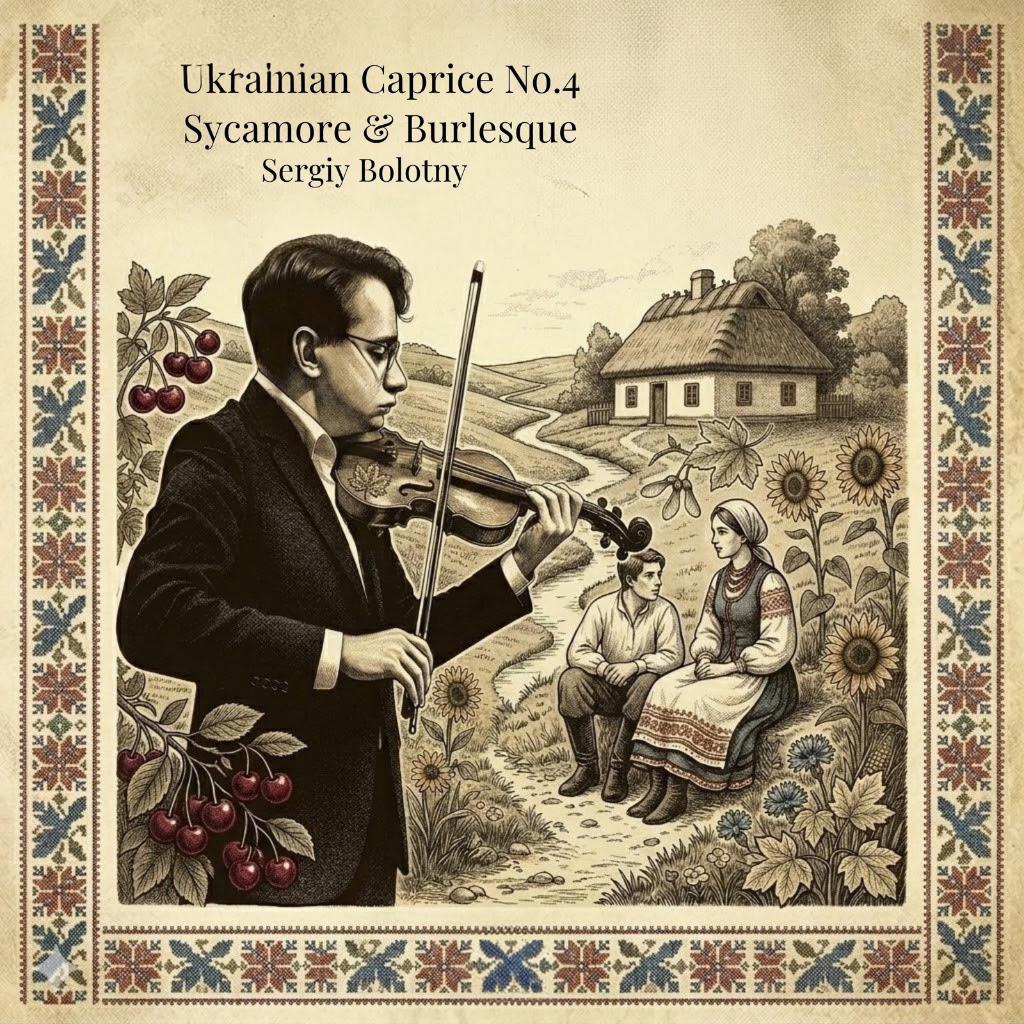
The piece is built in two panels, and the hinge between them is the best joke in the score. The first, "Sycamore," takes its cue from Shevchenko's verse about water flowing from beneath the tree, a poem that has long carried the ache of a whole nation's longing. Bolotny does not decorate it. He lets the melody sing in long, cantabile lines, bowed with a patience that recalls the great Slavic lyricists, and the tone is warm without ever turning syrupy. The harmonies, implied through double-stops and the occasional shadowy drone, darken at the edges like water under overhanging branches. It is music of real inwardness, played with the poise of a man who trusts the song to do its own work.
Then the mood shifts, and Bolotny does not warn us. "Burlesque" arrives like a wedding guest kicking open the door of a funeral parlour. Where the opening breathed, this section bristles. The spiccato is quick and crisp, each note landing with a pinpoint clarity that only a very secure right arm can produce. The string crossings are fast and fearless, and the rhythmic drive has the swagger of village dance music filtered through a conservatory education. It is athletic playing, yet never merely athletic. Bolotny phrases the fireworks with a raised eyebrow, so the virtuosity reads as wit rather than exhibition. The Caprice tradition demands exactly that: technique in the service of character, not technique as a curriculum vitae.
The contrast is the point, and it is handled with rare dramatic intelligence. Grief and mischief are not opposites in Ukrainian folk culture. They are neighbours who share a fence and a great many songs. By setting Shevchenko's melancholy beside the festive dance, Bolotny suggests that a people can mourn and carouse in the same breath, and that the second impulse is often a form of defiance. Given the circumstances in which this music reaches us, that is a quietly moving idea, and the composer wisely leaves it unstated.
The recording deserves its own paragraph. The violin is captured with natural room presence, and the resonance you hear belongs to wood, air and space rather than to a mixing desk. The bow's grain, the small intake of a phrase, the bloom of a sustained note dying into the acoustic: all remain intact. Too many solo string recordings are polished until they resemble brushed aluminium. This one still smells of rosin. It is the ideal setting for a work that depends on intimacy in the first half and combustion in the second.
Listeners who admire the spare lyricism of Max Richter and Ólafur Arnalds will find a kindred patience in "Sycamore," while those raised on Hilary Hahn's crystalline exactitude will relish the precision of "Burlesque." Berlin On Air has already praised its expressive elegance and neoclassical poise, and the verdict is hard to dispute.
Bolotny's day job in the ranks of the Noord Nederlands Orkest, alongside his training in Lviv, Kyiv and Vienna, gives him the orchestral player's ear for line and the soloist's appetite for risk. Both are audible here. This is the fourth entry in his *Ukrainian Caprices*, a cycle now clearly worth following, and it makes an excellent argument for the form's continuing life. It runs to a few minutes and asks nothing of the listener except attention. It repays that attention with a portrait of a culture in two moods, rendered by one violin and one fine musician.
Bravo, then, and more, please.