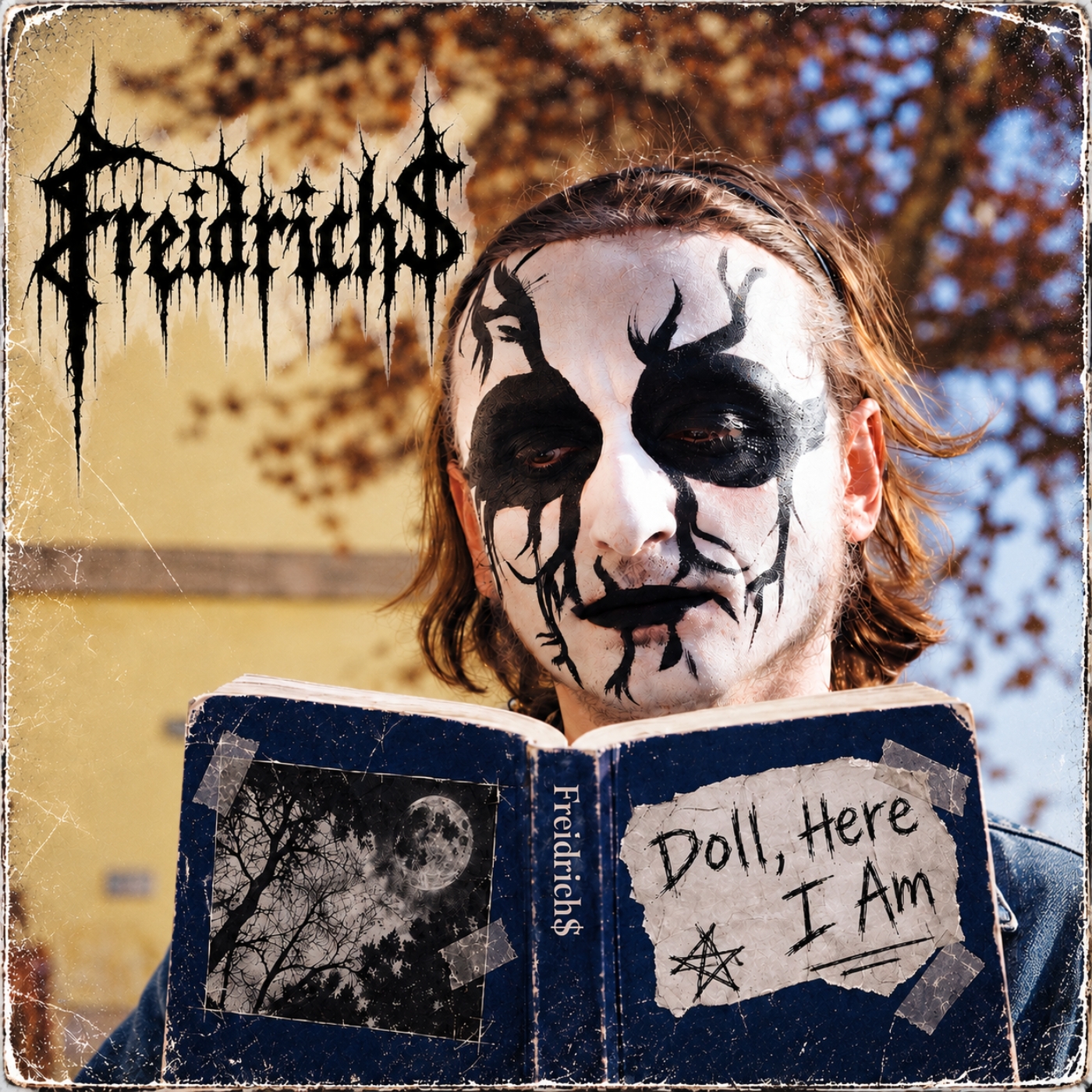
What he's done here is remove the armour rather than change the subject. His voice cracks, talks over itself, laughs at its own jokes mid-line, and occasionally forgets it's being recorded at all. It sounds less like a performance of honesty than honesty caught off guard — a crucial distinction, and the one that makes this EP work when a hundred other "raw" records don't.
The title character is a shifting target: a former lover, an audience, a stand-in for every person who never gave Freidrich$ quite enough attention. He begs for it outright — "Please pay attention to me," "I wanna be adored" — with a lack of cool that most songwriters would sand down before release. He leaves it in, and dares you to find it embarrassing. That dare is the record's engine. Romantic need, presented without the usual protective irony, becomes strangely moving precisely because it refuses to disguise how undignified it is to want tenderness this badly.
He's just as unguarded with autobiography. An argument from his late twenties gets reheard at thirty-five, wiser but no less raw. A teenage bedroom spent alone with Bright Eyes becomes a lyric rather than a footnote, and Conor Oberst turns from influence into character — the person who taught the narrator what heartbreak was meant to sound like before he'd had one worth the name. Names are filed off, but the specificity survives the filing, which is why the songs read as diary rather than composite sketch.
None of this stays sacred for long. Corpse paint turns up mid-plea for affection; Nietzsche, Drake, Augustine, Saul, DJ Mehdi, Lil Peep, and Gurdjieff crowd into the same handful of verses without anybody checking IDs at the door. A punchline curdles into confession, or a confession detonates into a punchline, often within the same breath. That collision of the sacred and the ridiculous has always been his signature move, but rarely has it felt this unforced.
The back half is where the ambition really shows. Grief over a woman gives way to Gnostic cosmology — reincarnation, the Bardo, the "prison planet," Gurdjieff's grim image of humanity kept as food for the moon. It shouldn't cohere. On paper it reads like a man who has read too much and processed too little. On tape, it lands as a single mind working through a single question at wildly different magnifications: one moment asking why she won't call back, the next wondering whether the species itself is stuck in a loop it can't see the edges of. Heartbreak and eschatology turn out to be asking the same question — how does anyone get out — and Freidrich$ never pretends to answer it, which is the most honest choice on an already unusually honest record.
It isn't tidy, and it isn't trying to be. Doll, Here I Am is a document of a songwriter finally willing to let the seams show, and it's better, stranger, and more human for it.