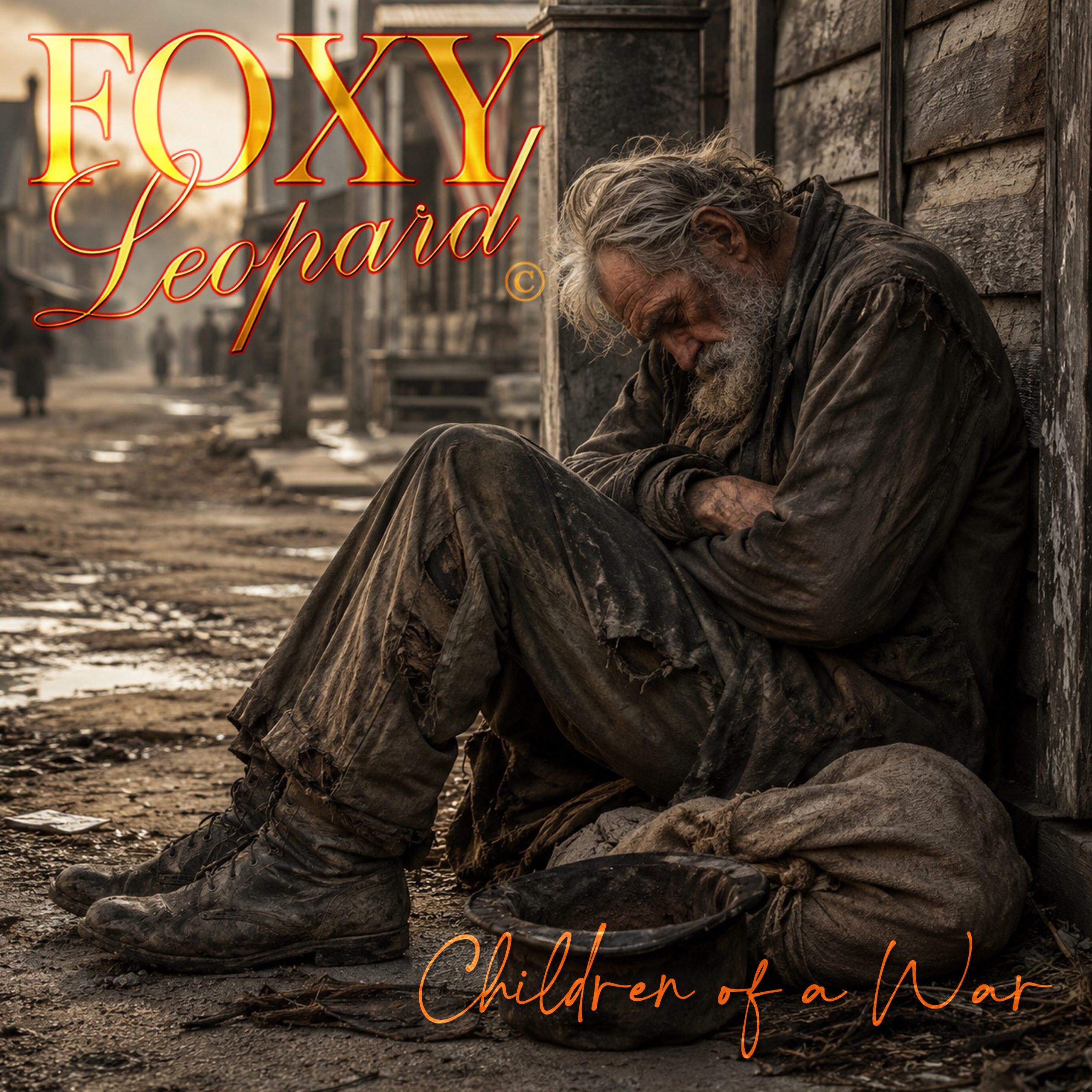
The central conceit is disarmingly simple. Who, exactly, are the children of a war? Not merely those born into its wreckage, the song argues, but anyone whose life was bent by a conflict they neither started nor controlled nor fully understood. The first verse entrusts this idea to an old man sleeping by the roadside, whose war is never named. It could be the Civil War, or poverty, grief, memory or age. The narrator asks whether we might help him win it, and the question hangs in the air like woodsmoke. It also makes the listener complicit: you may stop, or you may walk past.
The second verse shifts its lens to a woman waiting for a man who will not come home, raising her children with one less pair of helping hands. She has a cousin elsewhere on the album. She was partly inspired by Zee James, wife of Jesse, whose story runs through the neighbouring "The Outlaws of Peace." She isn't a biographical portrait, more an emotional reference point for all the women for whom a man's war ending merely began another one at home. Such threads are what make *After* look less like a playlist and more like a novel in song.
Then come the children, and here Foxy Leopard pulls off its masterstroke. Rather than a gleaming cinematic choir, the song hands its plainest observations to a small, ragged band of young voices, who reduce the world's complications to a handful of stark contrasts: different men, different roads, different minds, different goals. Adults muddy the water, the song suggests, while children simply describe it. The wobble and imperfection are the point. A polished choir would have turned this into a Hollywood epitaph. This one sounds like a village hall at dusk.
The arrangement is a lesson in subtraction. A worn, raspy male voice sits at the centre, accompanied by sparse single notes on a steel-bodied resonator guitar, restrained percussion and harmonica accents. Loose timing, metallic ring, audible breaths and string noise have all been left in, so the whole thing feels played rather than manufactured. Johnny Cash's late-life gravel comes to mind, as does the dusty hush of a Morricone western, though the song's moral clarity is entirely its own.
The obvious question concerns the machine in the room, and the answer is more interesting than the cliché. Artificial intelligence was used throughout, but the project describes a process closer to sculpture than vending machine. More than 40,000 words were exchanged and over 1,250 generations, edits, extensions and remixes explored, all to arrive at a lyric containing a mere fraction of that. Versions collapsed because a voice changed character near the end, or a lone child answered where a choir was needed, or a few seconds of silence killed the momentum. The eventual solution was to make the record smaller, not bigger. The finest compliment one can pay the result is that it sounds nothing like a thousand attempts.
Best of all is the refusal of a grand finale. The last verse returns us to the same old man beside the same store, still unable to say what he fights for. Yet something has shifted. Where the adult narrator once asked for help, the children now answer with a hope to give it. No victory scene follows, and no promise his struggle will end. There is only a decision not to walk away, which lands harder than any key change could.
Listeners raised on big choruses may itch for a release that never comes. That restraint, though, is the song's whole argument. Wars end on dates, and their consequences rarely follow suit.
**Verdict:** A spare, tender and quietly shattering single, and a persuasive reason to hear *After* in full.