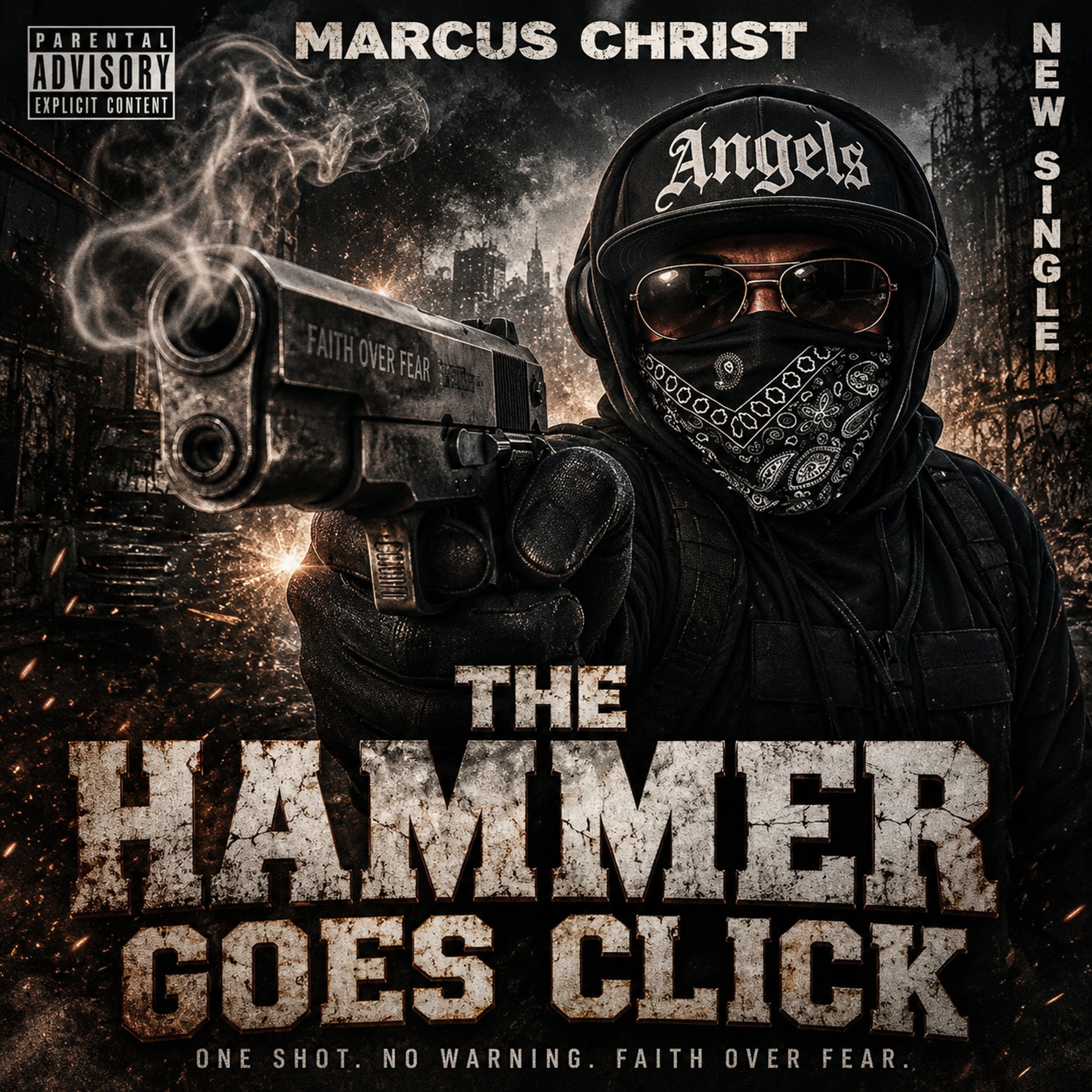
Working again with producer Bankroll — their second collaboration, and you can hear the shorthand between them — Marcus Christ arrives with a flow that's tightened into something almost surgical. Where his earlier record, the Whittier, California album, occasionally let its ambition sprawl, this single is compact, coiled, and merciless in its pacing. Bankroll's production doesn't compete with the vocal for space; it recedes into a low, ominous hum and lets Christ's cadence do the violence. That's a mark of a producer who understands restraint is its own kind of aggression.
Lyrically, the record's audacity lies in its structural sleight of hand. It opens as a street-level diss — all swagger, all challenge, the sound of an artist informing the field that his flow has simply outpaced theirs. Fine. Familiar territory, expertly executed. But then the perspective shifts, and what looked like braggadocio curdles into something closer to a parable — vengeance recast as cosmic inevitability, the click of the hammer less a threat than a verdict already handed down. It's the kind of tonal pivot that shouldn't work on paper and absolutely does in practice, because Christ commits to it with total conviction. He's not winking at you. He believes in the mythology he's building, and that sincerity is what elevates the track above pastiche.
There's a reason his own stated philosophy — that even a poisoned apple looks healthy — feels like the record's thesis statement. This is music engineered to seduce before it reveals its rot, and the seduction is genuinely well-crafted. The engineering, courtesy of Jester back at the Whittier sessions, gives the track a live-wire tension: nothing overproduced, nothing polished into blandness. You can hear the room. You can hear the risk.
What's most striking, though, is the confidence of an artist willing to be genuinely unfiltered rather than performatively edgy. Plenty of rappers reach for shock value; fewer are willing to let a single song contain multitudes — swagger and scripture, threat and testimony, comedy (that toilet-seat origin story is almost too good) and genuine dread. Christ threads all of it through a three-minute record without it ever feeling overstuffed.
Is it comfortable listening? No — and it shouldn't be. But comfort was never the assignment. "The Hammer Goes Click" is a young artist testing exactly how far narrative ambition can stretch inside a diss-track skeleton, and it largely succeeds because the craft underneath the provocation is real: the internal rhymes land, the beat shifts breathe at exactly the right moments, and the closing perspective shift genuinely recontextualises everything that came before it.
Marcus Christ has always promised confrontation. Here, for the first time, he delivers confrontation with architecture — a song that knows exactly what it wants to do to you, and does it. Compton's got a new voice worth watching, and this is the sound of him deciding he no longer has anything left to prove quietly.
**Verdict: A confident, unsettling, technically sharp statement of intent.**