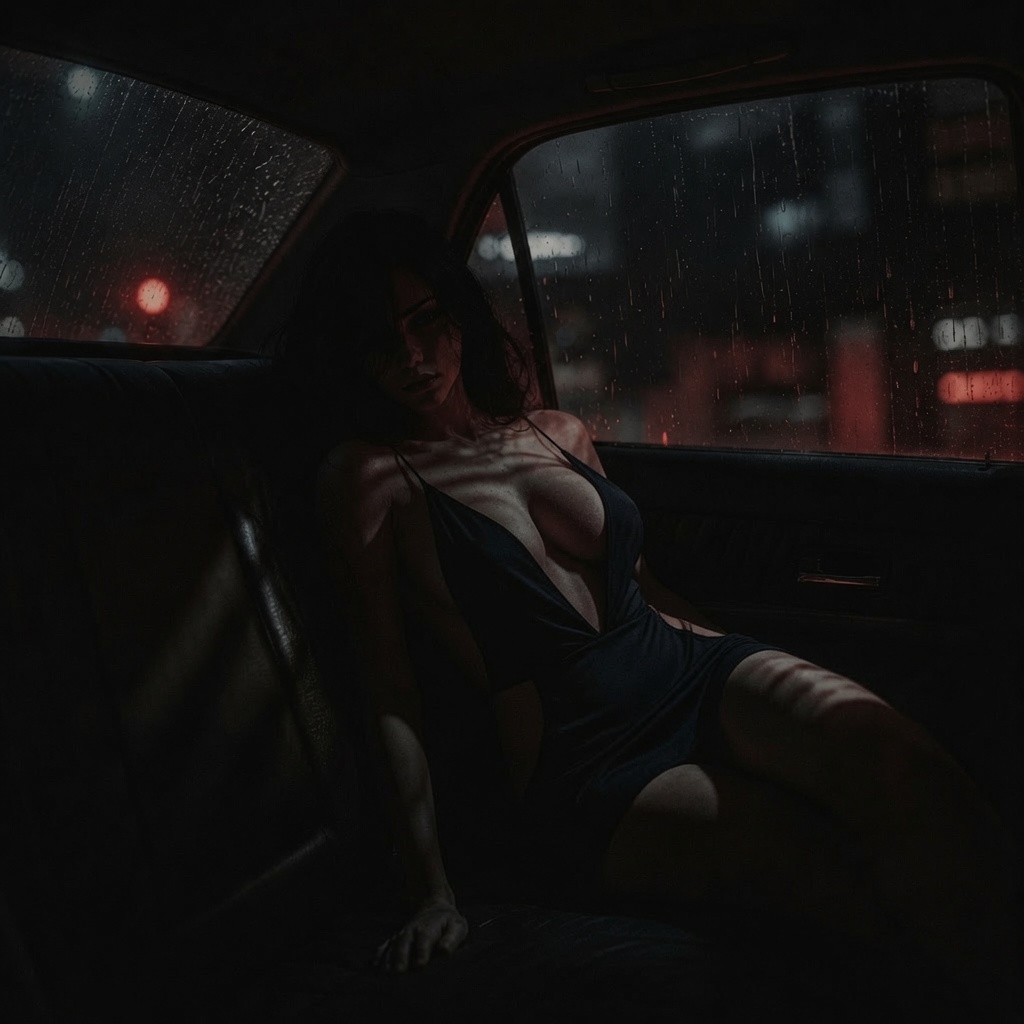
The premise, lifted loosely from the psychological unease of the film "Obsession" and filtered through the spectral presence of Inde Navarette's character, could easily have collapsed into gimmick. Instead it becomes scaffolding for something genuinely knotty: a protagonist who wants to be worshipped but flinches from worship offered in return, who mistakes longing for intimacy and then resents the mistake. This isn't a breakup album in any conventional sense. It's closer to a study of a man watching his own hunger from a slight distance, fascinated and repelled in equal measure.
Sonically, the palette draws an obvious lineage — the narcotic hush of Cigarettes After Sex, the gothic swell of Ethel Cain, the late-night R&B smear of Partynextdoor and Drake — but @MoStFeAr resists simply inhabiting those reference points. He slows everything down further, strips the drums back until they feel almost apologetic, and lets reverb do the work usually reserved for melody. Tracks bleed into one another with barely a seam, so the album plays less like a sequence of songs and more like a single extended exhale, which suits its stated ambition: this is music meant to be marinated in, not skimmed.
What separates "Amore Nero黒い愛" from its obvious peers is discipline. Where a less confident producer might chase a hook every ninety seconds, @MoStFeAr trusts atmosphere to carry weight that melody alone couldn't. Silence gets deployed like an instrument. Vocal takes are left close-mic'd and unvarnished, occasionally cracking in ways a more polished session would have scrubbed clean — and the album is stronger for keeping them. The confession that "I don't make songs to fill silence" reads as more than artist-statement boilerplate here; the record genuinely behaves as though silence were the material being worked, not the absence to be covered up.
The Japanese-inflected lyric fragments scattered through the tracklist function as a kind of internal commentary, a second voice observing the first one's collapse with something close to tenderness. It's a small formal choice that pays dividends across the record's back half, where the emotional register tightens and the earlier reflection curdles into something closer to fixation proper.
None of this quite resolves — deliberately so. The album ends without absolution, the protagonist no closer to loving himself than he was at the opening track, and that lack of tidy resolution is precisely what keeps the record honest. Heartbreak doesn't behave like a three-act structure, and @MoStFeAr seems to understand that instinctively.
"Amore Nero黒い愛" won't work as background music, and it isn't trying to. It demands the listener sit inside its darker rooms for a while before rendering judgment. Do that, and what emerges is a genuinely absorbing, beautifully controlled record from an artist building something singular out of borrowed light and quiet hours.