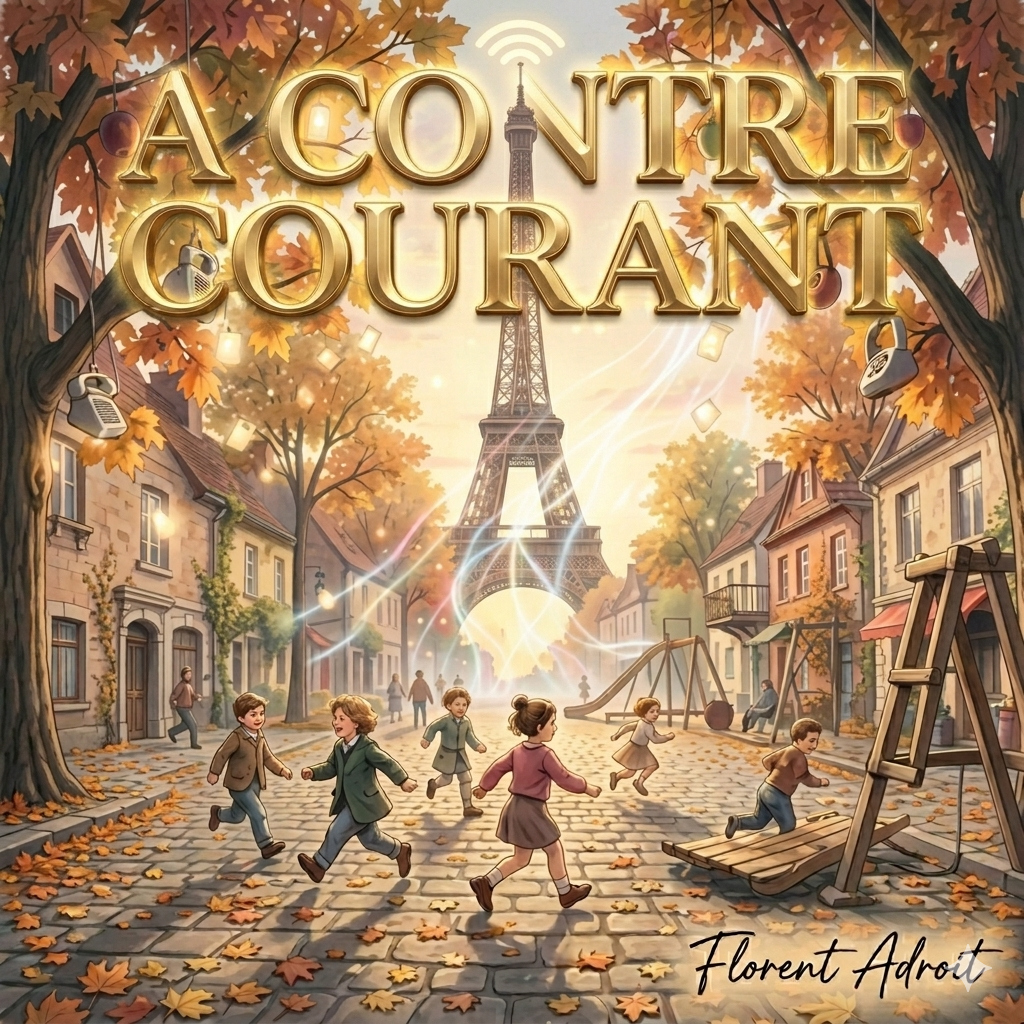
The artwork alone tells you where you stand. A cobbled Parisian street, dusted in autumn gold, children scattering across it with the unselfconscious joy of memory rather than performance, the Eiffel Tower glowing faintly in the middle distance like a half-remembered promise. It's a tableau that trades in nostalgia without collapsing into pastiche — the kind of image that asks you to recall a France of collective feeling rather than postcard cliché. Whether the song matches that ambition remains to be heard, but the visual grammar sets a high bar for itself.
What distinguishes Adroit, on paper at least, is the totality of his authorship. He writes, composes, sings, arranges and adapts every element of his own work, a rare completeness in an industry that so often fragments a single into a committee of specialists. That kind of control can go badly wrong — vanity projects have been built on less — but the framing here suggests discipline rather than indulgence: a musician who has spent years refining a singular voice before insisting the world listen to it whole.
The stated intent is disarmingly direct. Adroit speaks of wanting music that people recognise themselves in immediately, both at home and abroad, and of a return to plainness after years of noise and acceleration. It's a philosophy that could easily curdle into sentimentality, but the ambition — sincerity without artifice, melody without pandering — is the oldest and hardest trick in songwriting, and one that separates the merely competent from the genuinely felt.
If the finished single delivers on its promise, this won't be a song content to sit quietly on a playlist. It positions itself as populist in the best sense of that maligned word: built to be hummed on a first listen and to reveal something sturdier underneath on the fifth. The video's imagery of children running free through an autumnal Paris suggests a narrative of innocence chased and perhaps recovered, a visual metaphor doing real work rather than decorating the frame.
Adroit is gambling on something unfashionable — that plain-spoken emotion, delivered by an artist who insists on owning every part of the process, can still cut through in a market obsessed with novelty and fragmentation. "A Contre Courant" arrives as a statement of intent rather than a finished verdict. The proof, as ever, will be in the listening — but the ambition on display here deserves attention, and deserves to be heard on its own terms rather than judged by its cover.