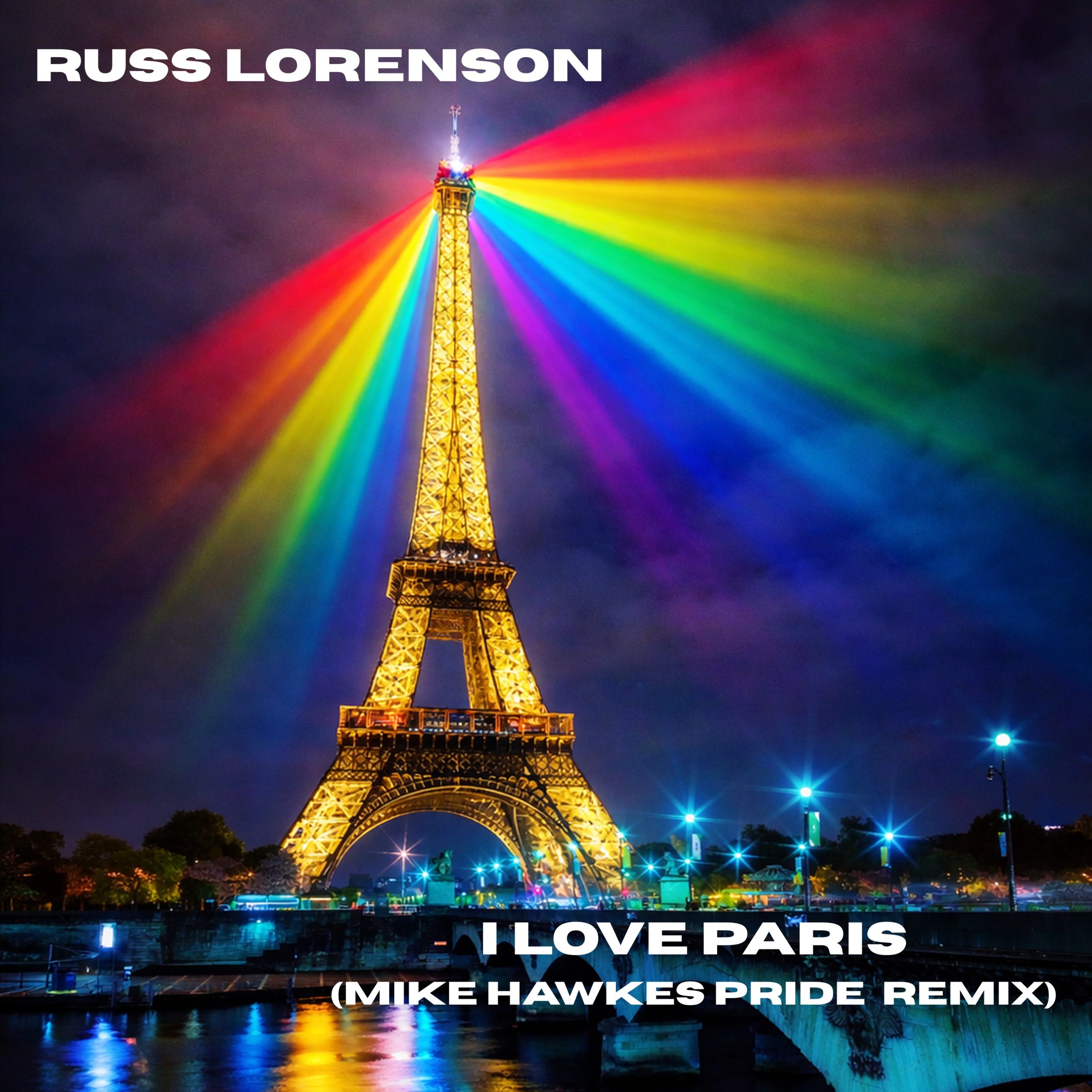
Russ Lorenson's original reading of "I Love Paris" — part of his twentieth-anniversary reissue campaign for *A Little Travelin' Music* — was a tasteful, faintly nostalgic piece of vocal jazz: warm brass, unhurried phrasing, a singer clearly fond of the song's architecture rather than interested in dismantling it. Mike Hawkes has now taken a hammer to that architecture, though to his credit a fairly delicate one. The remix doesn't demolish Lorenson's vocal so much as relocate it, lifting the original take wholesale and dropping it into a pulsing four-minute chassis of synth pads, filtered hi-hats and the kind of bass throb engineered for a 2am crowd rather than a cocktail hour.
What's mildly remarkable, and a credit to whoever sat at the mixing desk, is that Lorenson's vocal survives the transplant largely unscathed. He still sounds like a man who has spent a career inside this repertoire and trusts it implicitly; the phrasing retains its theatrical lilt even as the rhythm section beneath him becomes considerably more interested in body movement than in nuance. It's the vocal equivalent of someone calmly finishing a crossword while being driven at speed through Saint-Tropez — disconcerting in theory, oddly charming in practice.
Whether the song needed this treatment is a different question entirely, and one the press notes seem to pre-empt with a certain amount of earnest framing about songs "continuing to evolve." Porter's original tune has survived seventy-plus years of interpretation precisely because it's sturdy enough to take a beating, and this remix tests that sturdiness without quite breaking it. The melody is durable; the lyric's romantic geography (a city, a feeling, a slightly overripe metaphor about love and landmarks) translates well enough into a club setting, since Pride celebrations have never had much objection to sincerity wearing a glitter jacket.
Lorenson, a singer who has spent two decades treating the Great American Songbook as a living document rather than a museum piece, hands the song over without apparent anxiety about what might happen to it. That generosity comes through. The result is less a reinvention than a costume change — the song still recognisably itself underneath the sequins, still fundamentally about a city, a feeling and the slightly absurd human habit of falling in love with geography.
It will not trouble anyone's list of essential Porter interpretations, nor is it trying to. As a piece of Pride-season ephemera, built to glow for a season and be danced to rather than studied, it does precisely what it sets out to do, with a vocal performance underneath that's considerably better than the brief required.