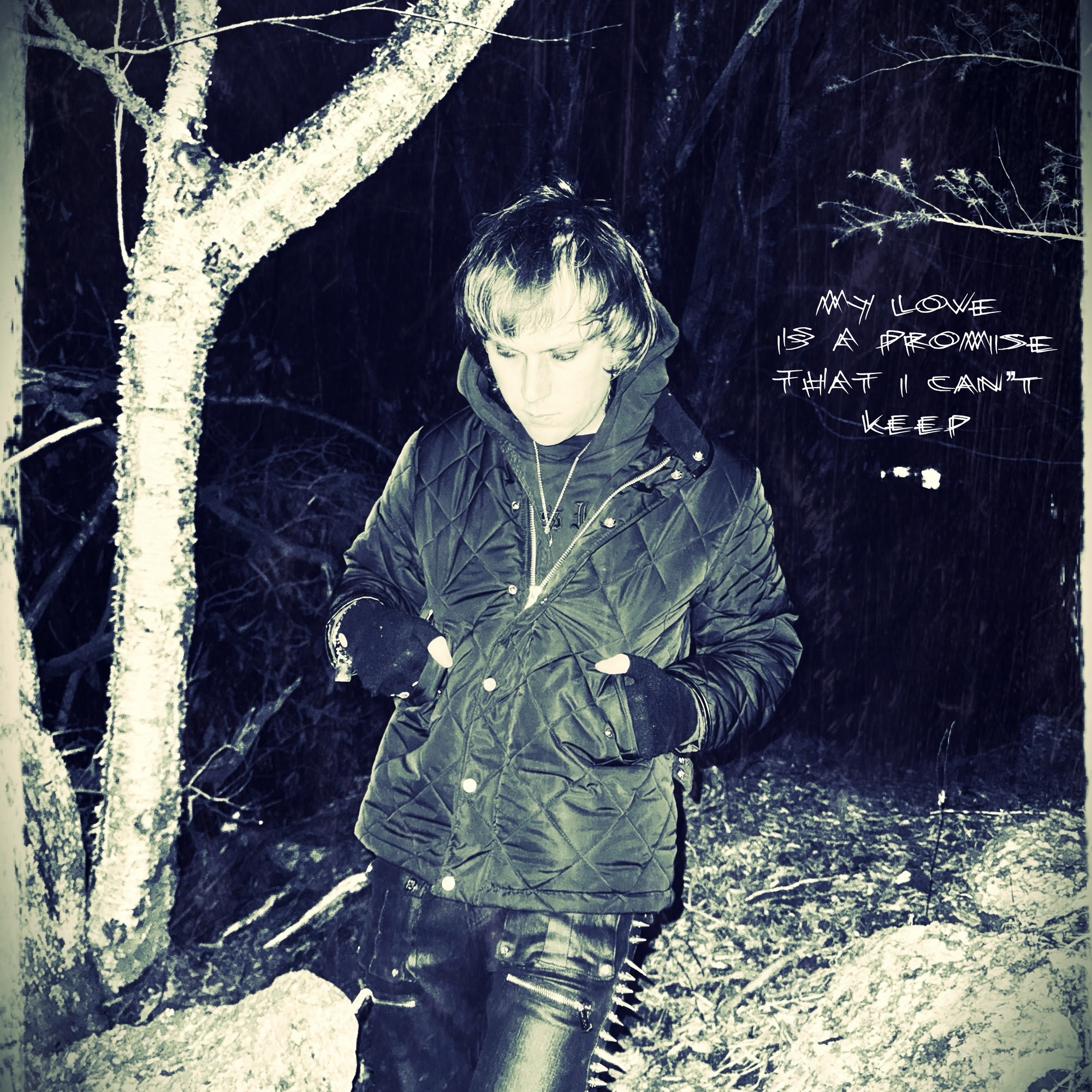
The term "Appalachian Gloom" is Frissell's own coinage for the sonic territory he has staked out, and one must grudgingly admit it earns its keep. The Appalachians are not the Scottish Highlands, nor the Welsh valleys — they carry their own peculiar American desolation, a landscape of Protestant stubbornness and ghost-town pride — and Frissell has found a way to translate that weight into a post-punk idiom that feels neither forced nor culturally confused. He draws his vocal lineage from Gerard Way's theatrical anguish and Robert Smith's gossamer melancholy, and while lesser artists would crumple beneath such obvious debts, Frissell wears them as a starting point rather than a destination.
The production architecture deserves particular attention. Working remotely with UK/German producer Manget$u — whose fingerprints are well-known across the underground emo and post-punk circuit — and Quebec-based mixing engineer VE Beats, Frissell has assembled what ought to be a Frankenstein's monster of transatlantic influences but instead emerges as something surprisingly coherent. The reverb is oceanic without drowning. The basslines are heavy without becoming leaden. The delays ping and cascade with the kind of controlled spatial intelligence that Beach House spent entire albums perfecting, while the dream-pop textures carry the DNA of Cigarettes After Sex without the suffocating passivity that can make that band feel like beautiful wallpaper.
The closing track, "Slowly Without You," is the centrepiece and the mission statement simultaneously. Frissell's so-called "pyramid" recording technique — intertwining a vintage 1974 Shere O Dyne 533SA microphone with an AKG C214 condenser, panning each to opposite extremes of the stereo field before allowing them to collide at the emotional peak — produces a genuinely distinctive vocal texture. The verses feel guarded and far away, as though heard through church stone; the crescendo arrives like a dam breaking. By the time the track collapses into its fragile whispered outro — the EP title itself, delivered as confession rather than declaration — the effect is quietly devastating. Elliott Smith understood that the most unbearable grief requires the quietest voice. Frissell has clearly understood the same.
The EP's greatest achievement is its handling of scale. Frissell is singing from a very specific geography — the tree-lined streets of a small Appalachian college town, a lake draped in mountain fog — but the emotional coordinates are universal. Misunderstood by the people closest to you, watching familiar things dissolve, searching for transformation in the wreckage of your own sentiment: this is not regional suffering. This is the permanent condition. The production team he has assembled ensures those feelings are rendered with enough fidelity to travel, to cross the Atlantic and find purchase in a London bedsit or a Berlin flat as readily as in the North Carolina hills where they were born.
London mentor Philip Spalding — a protégé of legendary producer Martin Rushent, the man who shaped the Human League's most enduring work — has reportedly provided creative guidance throughout, and one can detect a certain disciplined restraint in the arrangements that speaks to that lineage. Nothing here overstays its welcome. The EP does not indulge when it could decimate; it pulls back precisely when the temptation to push further would have been irresistible for a lesser collaborator.
RIOT SON is not yet a finished article — the projected NYC and London live dates will tell us far more about what this project becomes under stage lights than any bedroom recording can — yet *My Love Is A Promise That I Can't Keep* announces an artist with genuine instincts, real emotional intelligence, and the rare understanding that the most honest confession is also the most universal one.
The mountains have delivered. The question now is what the cities will make of him.