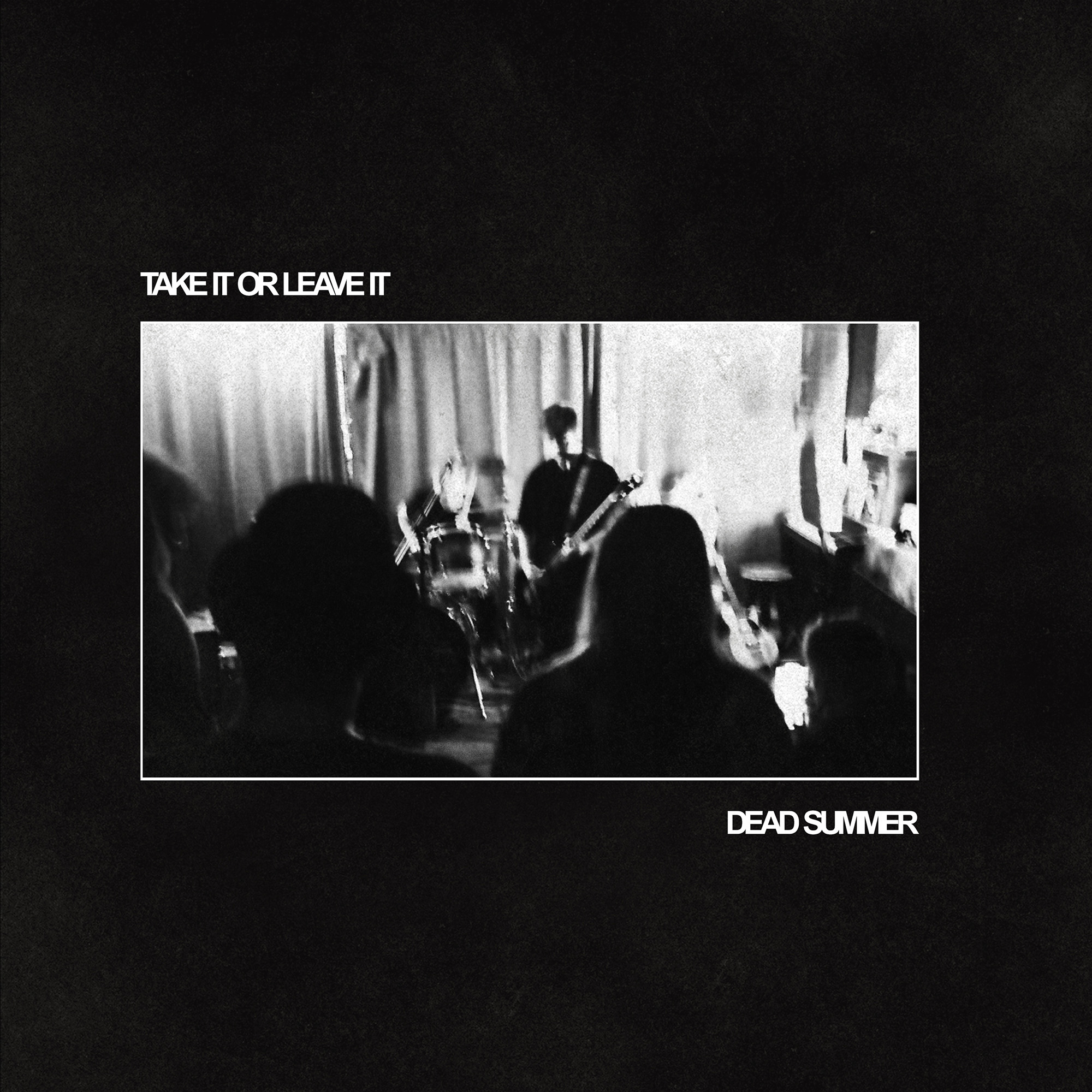
The premise is deceptively simple: bass and drums. No guitar to pad out the silences, no synthesiser wash to smooth the rough edges, no producer's safety net stretched beneath the tightrope. Just two men, two instruments, and the kind of reckless confidence that either looks magnificent or catastrophic, with precious little road between the two. Dead Summer look magnificent.
Prevedoros' bass is the thing you notice first — a thick, coiling riff that doesn't so much announce the song as *colonise* it. It has the low-slung menace of early Killing Joke filtered through something rawer, something more Western and coastal, as though the Pacific itself had developed a grudge and decided to express it through amplification. The tone is gritty in the genuinely interesting sense of that word — not the soft-focus "gritty" of marketing copy, but the sort of grit you'd find embedded in a wound. It stings. Good.
Wilford's drumming is the ideal foil: punchy where the bass is rumbling, propulsive where it might otherwise drag, holding the whole enterprise to the track like a man who has decided, firmly and finally, that *this* is the pace and *this* is the rhythm and no further negotiation is available. The interplay between the two is what elevates this beyond mere noise with attitude. They listen to each other the way long-term collaborators do — the way bands spend years learning to do — which makes it all the more remarkable that this was apparently the first song they ever wrote together. Some partnerships are forged; this one seems to have arrived fully formed.
Lyrically, the track belongs to a lineage of songs about emotional gridlock — the slow suffocation of a relationship conducting itself entirely in mixed signals and deliberate ambiguity. But where lesser writers would collapse into complaint, Dead Summer build toward confrontation. The song moves. It escalates. By the time the ultimatum arrives — and it does arrive, unmistakably, with the finality of a door slamming and a number changed — you believe every syllable of it. Self-worth, here, is not a therapeutic concept whispered over acoustic guitar. It's a line drawn in the dirt with a boot heel.
The production deserves its own moment of appreciation: uncluttered, immediate, honest in the way that only recordings made without excessive money or interference tend to be. You can hear the room. You can hear the decision to leave things in rather than smooth them out. This is a band that has spent time on stages and knows that live music is not a rehearsal for the record — sometimes the record should sound like it's trying to catch up to the stage.
Canada's west coast has been doing interesting things in the rock underground for some time, and Dead Summer fit neatly into that tradition of bands who would rather be genuinely uncomfortable than comfortably impressive. The festival reputation mentioned in their press materials is entirely believable. This is music built for crowds, for volume, for the specific electricity of watching two people make an unreasonable amount of sound.
Is "Take It or Leave It" the finished article? Not quite — and that's not entirely a criticism. The rough edges are, for now, both the record's limitation and its most attractive quality. The debut EP expected later this summer will tell us whether Dead Summer can sustain this energy across a body of work, whether the intensity is a mode they inhabit or a trick they've brilliantly performed once.
But on the strength of this opening statement, the smart money is on the former.
Demanding, visceral, and utterly certain of itself. A remarkable single.