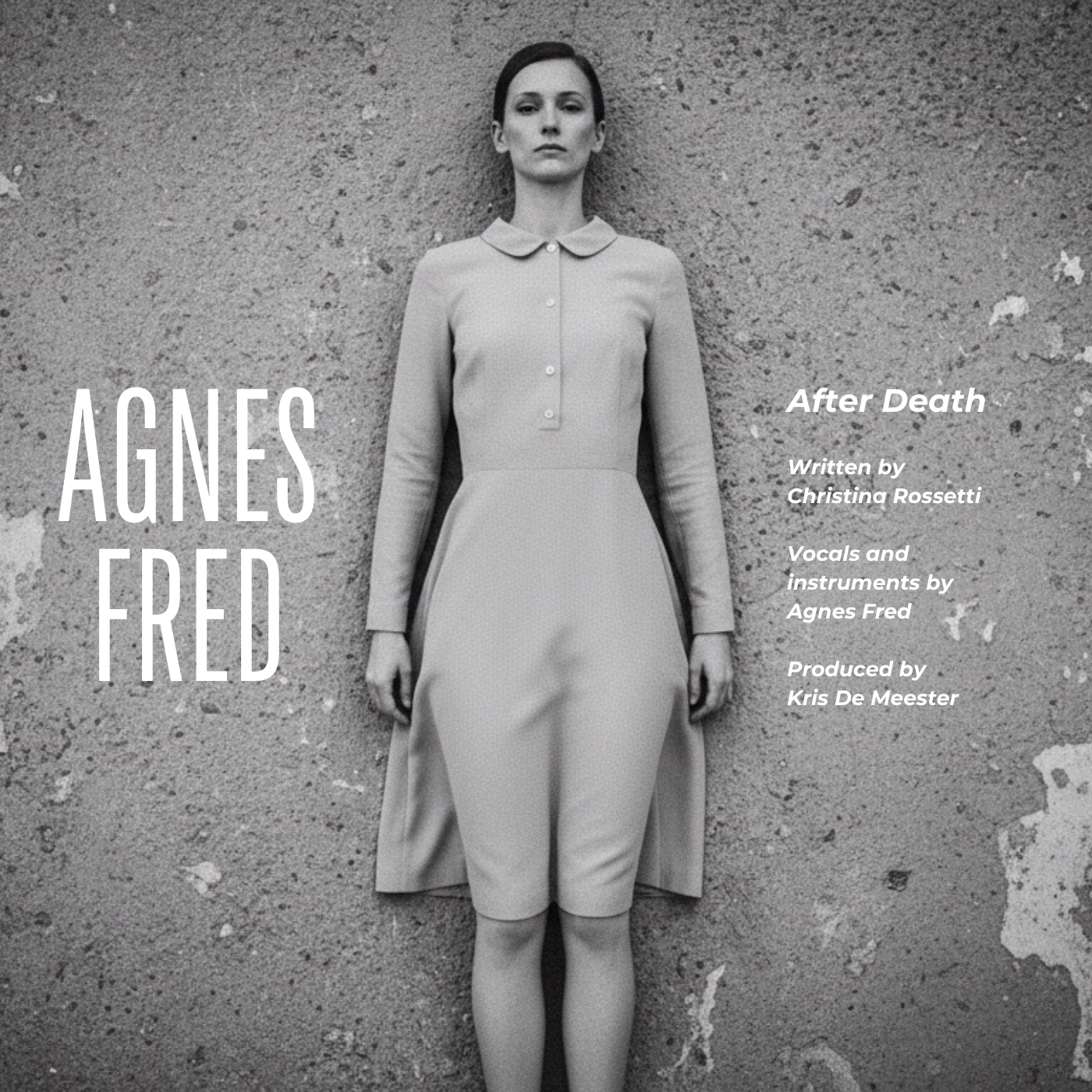
It arrives, as the best things often do, without fanfare — a whisper from somewhere between Brussels and the 19th century, between Christina Rossetti's grave Victorian parlour and the luminous fog of early Cocteau Twins. *After Death* is the debut single from Agnes Fred, a project conceived by filmmaker and multidisciplinary artist Kris De Meester, and it announces itself not with a bang, nor even really with a whimper, but with something altogether more unsettling: a sustained, trembling hush that you feel rather than hear.
The source material is Rossetti's 1862 poem of the same name — a fourteen-line meditation on posthumous unrequited love, in which the speaker, freshly dead, observes a former beloved grow cold and indifferent at her side. It is a poem of exquisite, almost perverse restraint. Rossetti does not rage. She watches. She notices. And crucially, she understands — with devastating lucidity — that the love she harboured was largely a fiction she authored herself. De Meester has not so much adapted this poem as *metabolised* it, allowing its emotional logic to dictate every production decision on the track.
What you hear — and this is the correct verb, the *only* verb — is fragility rendered architectural. The vocals drift high and untethered, drenched in reverb until they lose the quality of a human voice and become something more like a weather system, a low atmospheric pressure front moving through your chest cavity. There is no chorus in any conventional sense. The track does not build toward release or resolution. It *lingers*, in the way that Rossetti's speaker lingers, unable or unwilling to depart. This is dream pop in its most literal, committed form — not the genre tag lazily applied to anything with a woozy guitar and a girl who sounds a bit sleepy, but actual oneiric architecture, music that replicates the texture of a dream from which you cannot quite wake.
The shoegaze lineage is audible and worn with confidence — the layered reverb, the emotional restraint, the deliberate smearing of the boundary between instrument and atmosphere. One thinks of early Mazzy Star, of Grouper's more accessible work, perhaps of Beach House stripped of warmth. But De Meester is not engaged in pastiche. The minimalism here is too precise, too clearly *chosen*, to be merely referential. Each silence is load-bearing. Each moment of near-nothing is doing conceptual work.
This is where De Meester's background in filmmaking becomes audible. *After Death* is less a song than a composed frame — static, carefully lit, emotionally pressurised. He has spoken of Agnes Fred as "something between a person and a memory," and this constructed quality, far from feeling cold or academic, gives the project a genuinely haunting dimension. We are not being asked to identify with a narrator. We are being asked to *project* onto one, much as Rossetti's speaker projected love onto someone who barely registered her existence.
That is a sophisticated and rather brave artistic gambit for a debut single. Pop music, even at its most experimental fringes, tends to offer itself up — to court the listener, seduce, explain. *After Death* does none of these things. It simply *is*, suspended and faintly luminous, waiting for you to lean in close enough to hear it properly.
The promise embedded in this release, and the promise of further recordings drawn from public domain poetry, is considerable. If De Meester continues to work with this kind of rigorous, atmospheric intelligence — if Agnes Fred remains a *space* rather than simply a sound — then we may be watching the early stages of something genuinely important emerge from the European margins.
For now, though, *After Death* is more than enough. A remarkable beginning. Handle with care.
*"After Death" is available now on all major streaming platforms.*