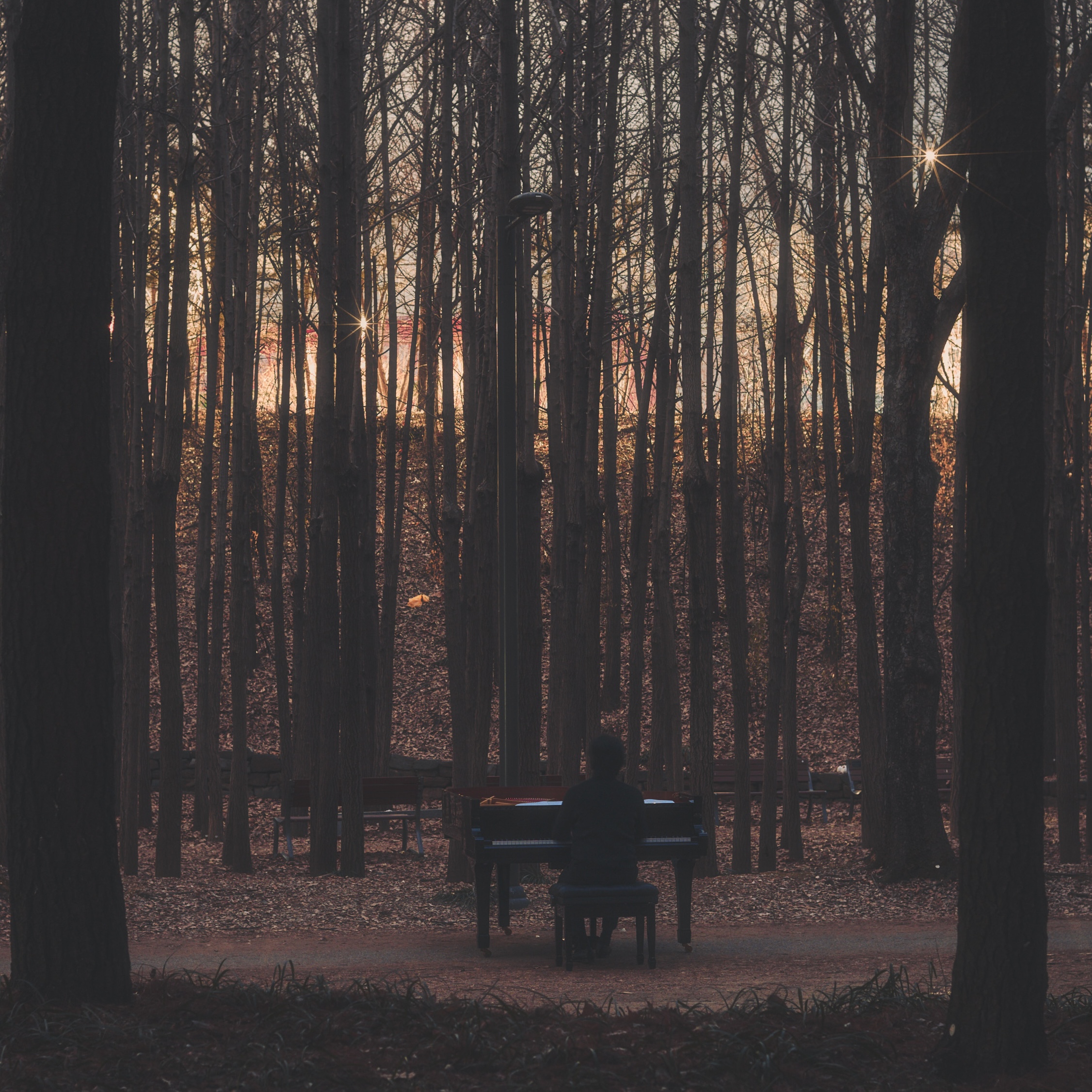
*Concrete Forest* is the second chapter in what has quietly become one of the more quietly devastating projects in contemporary Korean chamber composition. Its predecessor, *The World of Us*, used Seoul Forest as a contemplative anchor: trees, open sky, the rare breath of wildness squeezed between motorways. Here, Jaemin turns to look at what surrounds that forest — the dense apartment blocks, their windows identical, their numbering relentless: 201, 202, 203. These track titles, lifted directly from building plaques, are not merely conceptual decoration. They are the whole argument, stated plainly before a single note is played. We are inside a system of replication. The question the album spends thirty-odd minutes asking is: what survives inside it?
The answer, delivered across six pieces for piano, cello, violin and voice, is: more than you might expect, and less than you might hope.
Cha Sia's vocals on *Echos, My Room* — the album's most emotionally raw passage — feel caught between the personal and the ambient, neither fully confessional nor wholly decorative. Her voice circles the same melodic material like something searching for a gap in a wall. The lyric is spare to the point of haiku: *"Voices of others, a lump of noise, roams around my head."* Jaemin trusts the instrumentation to do what words cannot, and Shin Yumi's cello responds accordingly, its lower register carrying a weight that feels almost gravitational.
*Gray Morning* opens the record with a kind of studied ordinariness that is, paradoxically, quite difficult to achieve. The piano — Jaemin's own instrument, and the emotional spine of the whole album — moves through its phrases with the mechanical patience of a commuter who has made this journey so many times that their body knows every step without instruction. The music is not sad, exactly. It is something closer to depleted.
*Seoul Engine* is the album's centrepiece and its most overtly political gesture: a piece that builds with the mechanical efficiency of a city that has decided optimisation is the highest virtue, before running out of fuel somewhere in its third minute and never quite recovering. That the collapse is not dramatic — there is no crash, no crisis, only a slowing, a quieting — makes it considerably more troubling than any conventional breakdown would have been.
What separates Jaemin from the broader wave of neo-classical composers currently filling streaming playlists with tasteful, interchangeable melancholy is a specific quality of attention. His music is not about mood; it is about observation. The title track, *Concrete Forest*, closes the album not with resolution but with a question — *"The gray forest, where should my lost soul be headed at?"* — and the piano lets the answer dissolve before it can form. This is not evasion. It is honesty about the limits of what music can settle.
Jaemin has made an album that understands something most art about urban alienation gets wrong: the problem is not that the city is loud and hostile. The problem is that it is efficient. That its systems work, that the buildings fill, that the trains run, and that somewhere inside all of that functioning machinery, the particular, unrepeatable texture of a human interior is quietly, continuously, almost administratively erased.
*Concrete Forest* does not rage against this. It simply remembers it. Which, all things considered, might be the braver act.
*Released 2024. Available on major streaming platforms.*