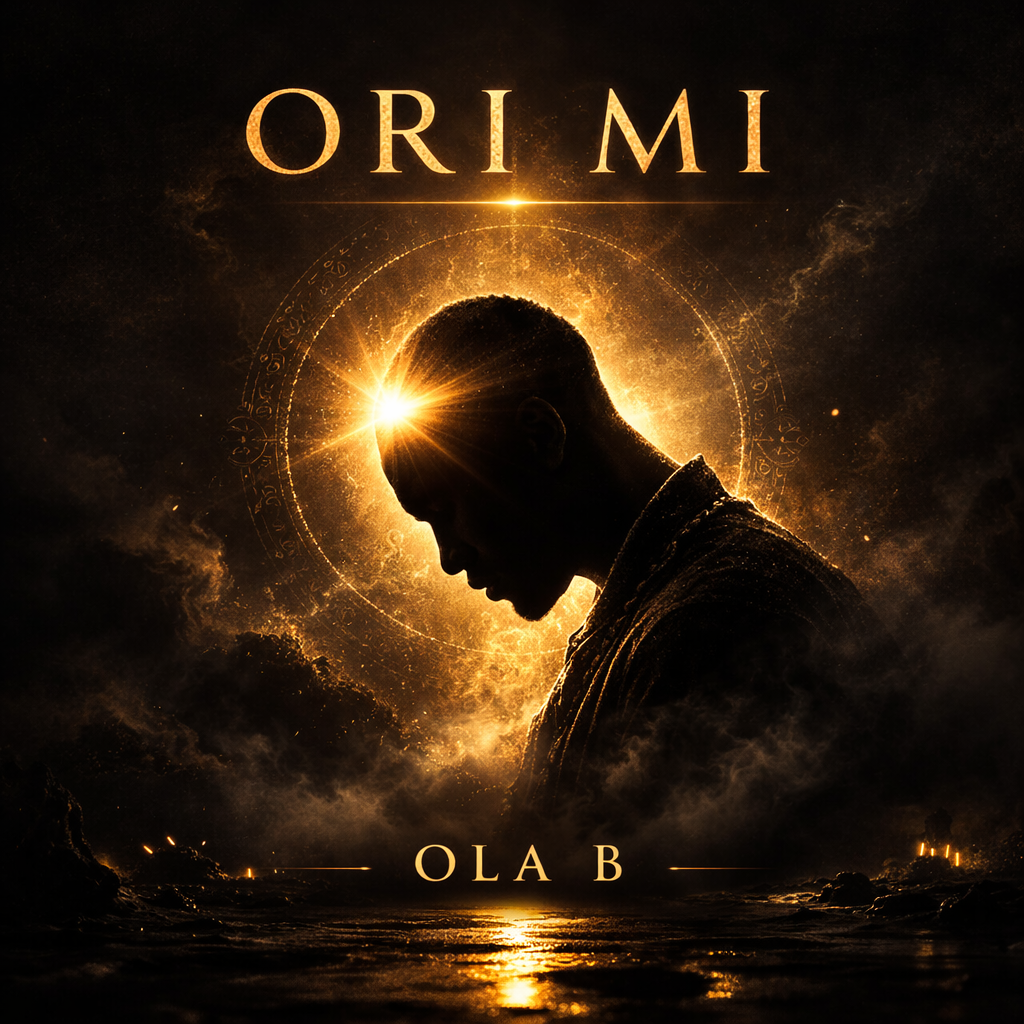
*Ori Mi* is built around the concept of Orí — the Yoruba belief that every person carries within them a personal deity, chosen before birth, that guides and shapes the entire arc of their life. This is not metaphor. This is not vague spiritual branding of the kind that gets sprinkled over pop records to give them a veneer of depth. OLA B is reaching back into a tradition of *oriki* — devotional praise chants addressed directly to personal deities and ancestors — and pulling it forward into a contemporary Afrobeats framework without filing off the edges. The result is a track that feels simultaneously ancient and entirely present.
The production does something quietly remarkable: it resists the temptation to announce itself. Where much of the Afrobeats crossing over to global audiences right now arrives with the confidence of someone who already knows they belong everywhere, *Ori Mi* keeps its voice close, intimate, almost conspiratorial. The rhythmic architecture owes something to the Fela Kuti lineage — that insistence on African sonic identity as non-negotiable — while the arrangement carries traces of Burna Boy's gift for making the spiritual feel emotionally immediate rather than academically distant. But OLA B is not imitating either of those artists. The vocal delivery is the giveaway: this is not a performance projected outward to a stadium or a streaming algorithm. It is a prayer directed inward, and the microphone simply happens to be present.
The decision to release three distinct versions — original, Gospel Version, and Male Gospel Version — is not a marketing strategy dressed up as artistic intent. Each version functions as a separate spiritual offering, and the Gospel iterations are particularly striking in what they acknowledge: that for many in the African diaspora, Yoruba tradition and Christian faith do not exist in opposition but in conversation. Both worlds asking the same question. Both turning toward something larger than the visible self. The Male Gospel Version in particular reframes the central plea with a rawness that the original, for all its beauty, holds slightly at arm's length.
OLA B is a faceless artist by deliberate choice, and this matters more than it might initially seem. The anonymity is not mystique for its own sake — it is a philosophical position. By removing the image entirely, the artist enacts the very principle the song is about: the primacy of the inner self over the visible one. Playlist curators accustomed to needing a face to sell a story will have to reckon with music that simply refuses that transaction. The art speaks. The person steps back.
*Ori Mi* is available now on all major streaming platforms.