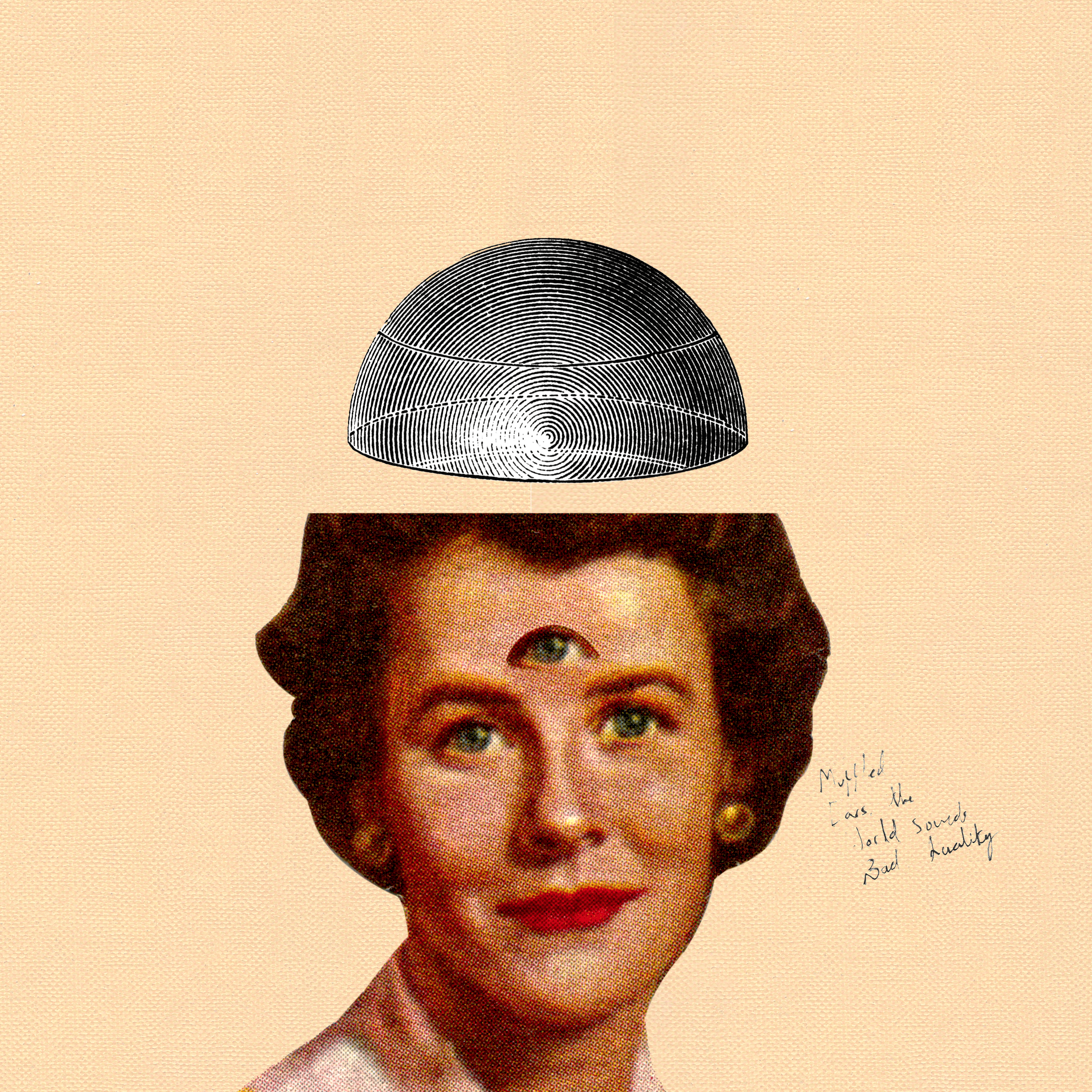
The biographical facts matter here. Written across three different jobs—landscaping, bartending, office work—this isn't music made in the hermetically sealed environment of a studio residency. Vickers composed these pieces in the mental gaps between physical labour and customer service and spreadsheets, assembling his vision in whatever hours remained. The album's fragmented aesthetic, its collisions of post-rock dynamics and psychedelic jazz, its deliberately degraded "bad quality" production, all feel like the natural output of a mind stretched across multiple realities, trying to make coherent art from fundamentally incoherent conditions.
Which brings us to the Static Man, the album's protagonist—alienated to the point of delusion, convinced he's witnessed alien contact, desperate for validation that never arrives. When you realise this character emerged from the mind of someone writing between shifts, producing in solitude, the metaphor deepens. The Static Man's isolation isn't romantic or chosen; it's the default state of modern existence, where connection feels simultaneously ubiquitous and impossible.
"Yestermillisecond" tackles the temporal collapse of social media, where everything happens at once and therefore never quite happens at all. Vickers captures the scroll-fatigue brilliantly—not through explicit commentary but through music that itself feels caught in a loop, unable to settle, constantly refreshing. The production choices mirror this: moments of clarity that immediately degrade, as if the signal keeps dropping.
The title track offers perhaps the album's most devastating image: standing in a club, surrounded by noise, admitting "the noise doesn't reach me." It's numbness presented without judgment, a simple statement of protective disconnection. Vickers doesn't romanticise this alienation or pretend there's an easy exit. The muffled sonics throughout the album replicate this barrier—beauty exists, but it reaches us through layers of interference, distorted by the very mechanisms meant to deliver it.
That Vickers assembled this largely single-handedly makes the achievement more remarkable. The sprawling arrangements, the jazz detours, the carefully controlled chaos—these aren't the marks of a solo artist working within limitations but someone using solitude as compositional tool. The references to Radiohead, King Krule, and 1969-era King Crimson feel apt, but there's also something distinctly modern here, a post-internet sensibility that those artists couldn't have fully grasped. Vickers understands that contemporary alienation isn't about being alone in a room; it's about being alone in a crowd of infinite digital voices.
The lead single "Another Day in Uniform" establishes the template: repetition not as minimalist meditation but as documentation of routine. The uniform might be a landscaper's boots, a bartender's apron, an office worker's resignation. Vickers cycles through these identities while maintaining a singular artistic vision, and the tension between these roles—physical labour, emotional labour, bureaucratic labour—animates the entire record.
The hired session players—saxophone, trumpet, strings—provide crucial texture without diluting Vickers' control. Their contributions feel integrated rather than decorative, adding warmth and unpredictability to arrangements that might otherwise calcify into pure concept. The jazz elements prevent the album from becoming mere sonic thesis about alienation; they inject moments of genuine searching, improvisation, the possibility that something unexpected might break through the static.
What distinguishes *Muffled Ears* from countless other albums about modern disconnection is its refusal of resolution. The Static Man doesn't achieve breakthrough or acceptance; he remains suspended in his delusion, and Vickers doesn't rescue him. This formal honesty—the acknowledgment that some conditions can only be documented, not transcended—gives the album a peculiar integrity. It's not defeatist so much as realistic about what art can and cannot do.
Vickers has created a second album that sounds precisely like 2026 feels: overloaded, underconnected, searching for signal in overwhelming noise. That he did so while juggling multiple jobs, playing multiple instruments, and maintaining a singular vision suggests an artist continuing to refine a distinctive vision. The Static Man is still waiting for his witness. This review serves as confirmation: someone heard it.